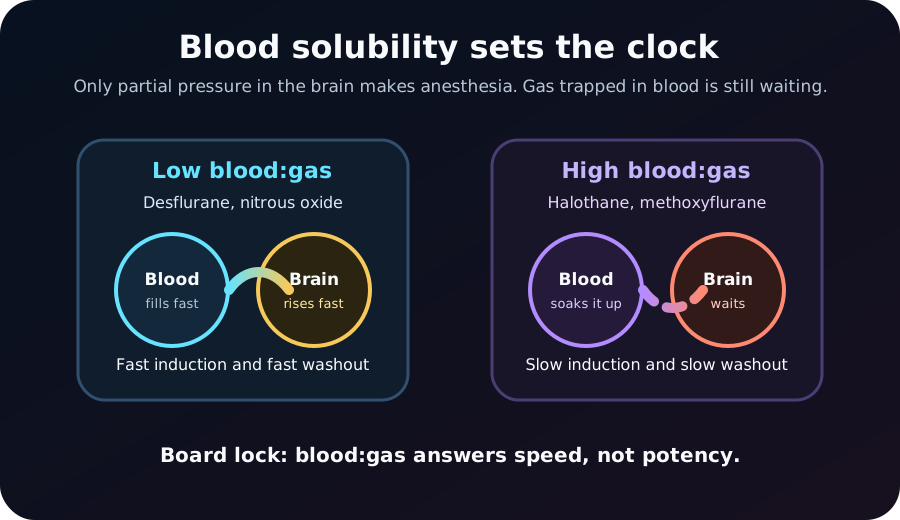
Make the gas clock visible.
Anesthesia questions look like drug lists until you split them into two axes: blood solubility controls how fast the brain sees the gas, and lipid solubility plus MAC controls how much gas is needed.
Blood:gas is the speed dial.
The gas only works when its partial pressure reaches brain tissue. If it dissolves into blood, it is not in the brain yet. That is the whole clock.
Low blood solubility
Desflurane and nitrous oxide do not hide in blood. Alveolar pressure rises quickly, brain pressure follows quickly, and the patient goes down or wakes up fast.
High blood solubility
Halothane and methoxyflurane dissolve more in blood. Blood becomes a reservoir, so the brain waits while the reservoir fills and drains.
Oil:gas and MAC tell the dose.
MAC is the alveolar concentration that prevents movement in 50 percent of patients exposed to a painful stimulus. Low MAC means high potency.
More lipid soluble
Less alveolar gas needed
Halothane lives here
Less lipid soluble
More alveolar gas needed
Nitrous oxide lives here
One question, two traps
Question says the agent is potent. Do you reach for blood solubility or lipid solubility?
The emergencies are not subtle.
When anesthesia questions stop asking coefficients, they usually hand you a complication with one decisive feature.
Malignant hyperthermia
Volatile anesthetics or succinylcholine can trigger uncontrolled RyR1 calcium release in susceptible skeletal muscle.
Fever, rigidity, tachycardia, hyperkalemia, acidosis, high creatine kinase.
Nitrous oxide
It diffuses into closed gas spaces faster than nitrogen leaves.
A pneumothorax, bowel obstruction, middle-ear space, or intracranial air pocket can enlarge.
Agent-specific toxicity
Halothane: hepatitis and malignant hyperthermia. Methoxyflurane: nephrotoxicity. Enflurane: seizures.
Common volatile effects include myocardial depression, respiratory depression, nausea, and increased cerebral blood flow.
IV anesthetics are patient-specific.
The board stem usually chooses the drug for you with hemodynamics, airway tone, amnesia, analgesia, or the reversal agent.
Propofol
GABA-A modulator. Rapid sedation and amnesia, antiemetic flavor, but myocardial depression and hypotension.
Etomidate
GABA-A modulator. Hemodynamically stable induction, useful when blood pressure is fragile, but suppresses adrenal steroid synthesis.
Ketamine
NMDA antagonist. Dissociative anesthesia with analgesia and preserved respirations. Raises heart rate and blood pressure; emergence reactions can occur.
Midazolam
Benzodiazepine. Anxiolysis, sedation, amnesia, anticonvulsant effect. Reversal is flumazenil.
Opioids
Mu agonists. Analgesia without amnesia. Respiratory depression reverses with naloxone.
Thiopental
Barbiturate. Very lipid soluble, rapid brain entry, short action from redistribution into muscle and fat.
Choose the induction drug
Hypotensive trauma patient needs rapid sequence induction and cannot tolerate a big blood-pressure drop.
Three pictures, three answers.
Use these as the page anchors: speed, calcium, and IV selection.
Gas clock
Low blood solubility means the brain equilibrates quickly.
Calcium leak
Hot rigid postoperative patient means dantrolene.
IV map
Hemodynamics, analgesia, amnesia, and reversal agent pick the drug.
Prove it.
Original vignettes, one at a time, shuffled and never repeated until the bank is exhausted.
Exam tools: right-click or long-press to cross out a choice. Double-click or double-tap to highlight one. Tools switch off after you answer.