Every cell runs on glucose, but only the liver can make it from scratch: the enzymes that diverge between the two pathways are where clinical medicine set their traps.
Glycolysis & Gluconeogenesis
Master the pathways that power your cells → and what happens when they go wrong
These hormones activate adenylyl cyclase → cAMP increases → Phosphorylates catabolic enzymes to turn them ON.
Location Matters
Mitochondria is catabolic HQ (TCA, oxidative phosphorylation, β-oxidation). Exception: Glycolysis happens in cytoplasm.
Where Your Energy Comes From
GLUCOSE
40% of diet
4 kcal/g
FATS
30% of diet
9 kcal/g
PROTEINS
30% of diet
4 kcal/g
KETONES
Last resort
> 36 hours starvation
Which Organ Prefers What Fuel?
Click a stress level to see what changes:
Organ
Normal: Preferred Fuel
Why This Matters (Board Alert!)
Brain
Glucose
Hypoglycemia destroys the brain first. Seizures, coma, death.
Heart
FFAs (60% of ATP)
In stress, heart DEMANDS glucose. Explains why acute MI + cardiogenic shock = give dextrose IV.
Muscles
Glucose + FFAs
During long fasts, muscles break down → FFAs, but also catabolized for gluconeogenesis (loss of mass).
RBCs
ALWAYS Glucose
RBCs have NO mitochondria. Only pathway = glycolysis (+ pentose phosphate for NADPH). G6PD deficiency → NADPH loss → oxidative hemolysis when triggered by oxidant stressors.
The Starvation Timeline
When glucose runs out, your body runs this playbook:
1
Plasma Glucose: 2-4 hours
Fed state → normal blood glucose
2
Liver Glycogen: 24-28 hours
Glycogenolysis maxed out, then depleted
3
Lipolysis: > 36 hours
Break down fat → FFAs → gluconeogenesis, ketogenesis
4
Ketogenesis: > 36 hours
Brain shifts to ketones, muscle finally spares glucose
⚠️ The RBC Connection: Why Hypoglycemia Kills Fast
RBCs only eat glucose via glycolysis. They have NO mitochondria → can't use FFAs, ketones, amino acids.
The Pentose Phosphate Pathway (The Other RBC Need)
RBCs need NADPH to protect themselves from oxidative damage. Only source: pentose phosphate pathway (happens in cytoplasm, requires glucose as substrate).
Board Alert: G6PD Deficiency & RBC Vulnerability
G6PD deficiency → RBCs can't make NADPH → no glutathione → oxidative stressors (primaquine, dapsone, fava beans, infections) trigger hemolytic anemia. Simple hypoglycemia alone does NOT cause hemolytic anemia in normal individuals.
Glycolysis: The Assembly Line
Click each step to reveal the enzyme, substrate, product, and ATP cost/gain.
ATP Counter
0
+4 created →
−2 used =
+2 net
The Net Yield
4 ATP created − 2 ATP invested = +2 ATP net
⚠️ Also produces 2 NADH per glucose (crucial for energy in the electron transport chain).
NADH: The Niacin (B3) Connection
Every NADH contains Niacin (Vitamin B3). Glycolysis makes 2 NADH per glucose.
Board Alert: Pellagra
Niacin deficiency → Pellagra → The 4 Ds:
Dermatitis (photosensitive rash on sun-exposed skin)
Diarrhea
Dementia
Death
Hartnup's Syndrome
Defective renal transport of tryptophan (can't reabsorb from urine) → tryptophan not available to make niacin → presents like pellagra.
2,3-DPG: The RBC Oxygen Delivery Driver
A branch off glycolysis (at G1,3DP) makes an RBC secret weapon:
What 2,3-DPG Does
2,3-DPG binds hemoglobin → lowers its O₂ affinity → hemoglobin more likely to DROP oxygen in tissues → tissues get MORE oxygen when they need it most.
The Stored Blood Problem
Stored blood loses its 2,3-DPG over time → hemoglobin grips O₂ too tightly → tissues get less O₂ → why transfusions can paradoxically worsen hypoxia if you give old blood.
The Fix: Inosine
Additive inosine to stored blood → helps RBCs regenerate 2,3-DPG → shelf life extends from 21 days → 45 days.
🔑 Sticky Mnemonics (Tap to Reveal)
🚪The Bouncer (PFK-1)
PFK-1 is the RATE-LIMITING ENZYME → the bouncer at glycolysis' nightclub. Citrate tells it "we're full, slow down." F2,6DP says "let them in!" During exercise, PFK-1 gets too slow → F6P builds up → alternative pathway activates (F6P → F2,6DP via PFK-2) → F2,6DP activates PFK-1. Genius feedback loop.
⚗️Mercury Loves Sulfur
Mercury blocks G3P Dehydrogenase (step 6) because Hg binds sulfur in the active site. Remember: Mad Hatter disease (mercury poisoning). In adults: tuna contamination. In kids: thermometer biting. Either way, step 6 dies → glycolysis stops → no ATP → cellular death.
🦷Fluoride's White Teeth Clue
Fluoride blocks Enolase (step 9). Clue: fluoride = beautiful white teeth + strong bones (too much of a good thing → toxic). Enolase blocked → PEP can't form → pyruvate never forms → glycolysis stops at step 9.
🚚2,3-DPG: The Delivery Driver
2,3-DPG is hemoglobin's delivery driver → makes it DROP oxygen off in tissues. Stored blood loses its driver (2,3-DPG degrades). Inosine = roadside assistance → helps RBCs regenerate the driver. Without it, tissues get O₂-starved from transfusion of old blood.
👮Gluconeogenesis: 4 Bouncers
Gluconeogenesis needs 4 special bouncers to reverse glycolysis: Pyruvate Carboxylase → PEP Carboxykinase → F1,6DPase → G6Pase. Only liver (90%) and adrenal cortex (10%) have all 4 bouncers. Muscle can store glycogen but CAN'T do gluconeogenesis. : that's why during starvation, muscle eats itself to feed the brain.
🔒G6P: Glucose Trap
Glucose → G6P (step 1) is the FIRST REGULATORY STEP. G6P is charged (phosphorylated) → can't cross the cell membrane → glucose is TRAPPED inside the cell. This is how cells "capture" glucose. In the liver, G6Pase REMOVES the phosphate → glucose can escape → bloodstream gets fed.
Contrast with G6PD deficiency: oxidative trigger needed. PK deficiency is chronic, not episodic.
Board hit: chronic hemolytic anemia in newborn, elevated 2,3-DPG
Clinical Decision Tree
Walk through substrate, product, ATP yield, and clinical implication step by step.
A patient's RBCs are failing to produce ATP despite normal blood glucose. Which substrate enters glycolysis first?
Glucose
Fructose-6-Phosphate
Pyruvate
Glucose. Step 1 traps it as G6P. It cannot leave once phosphorylated. This trapping step is why hypoglycemia starves cells before glycolysis even starts.
F6P is step 2, not the entry. Glucose must be phosphorylated to G6P first, then isomerized to F6P.
Pyruvate is the exit product, not the entry. Glucose in, pyruvate out.
Glucose reaches PFK-1, the rate-limiting step. What is the direct product of PFK-1 action?
Fructose-1,6-bisphosphate
DHAP + G3P
Fructose-2,6-bisphosphate
Fructose-1,6-bisphosphate. PFK-1 adds a second phosphate at carbon 1. Aldolase (step 4) then cleaves it into two 3-carbon pieces.
DHAP and G3P are products of Aldolase (step 4), not PFK-1. PFK-1 makes F1,6BP, which Aldolase then splits.
F2,6BP is the regulator of PFK-1, not its product. It is made by PFK-2, a separate enzyme.
One glucose yields how much net ATP from glycolysis alone?
2 net ATP
4 ATP
6 net ATP
2 net ATP. Investment phase: 2 ATP spent (steps 1 and 3). Return phase: 4 ATP made (steps 7 and 10, x2 from carbon split). 4 minus 2 = 2 net. Plus 2 NADH for downstream ETC use.
4 ATP is the gross production. You spent 2 ATP at steps 1 and 3. Net = 2. Gross vs net is a classic board trap.
Too high. Net glycolysis ATP is always 2. The bulk of ATP (30 total) comes from Krebs and ETC downstream.
A newborn has chronic hemolytic anemia. ATP in RBCs is critically low despite intact G6PD and normal blood glucose. Which enzyme deficiency explains this?
Pyruvate Kinase deficiency
Hexokinase deficiency
Phosphoglucose Isomerase deficiency
Pyruvate Kinase deficiency is the most common glycolytic enzyme defect causing hemolytic anemia. Step 10 fails, no ATP at the final yield step, RBC membrane pump fails. Echinocytes, hemolysis, splenomegaly. Elevated 2,3-DPG because substrate backs up upstream.
Hexokinase deficiency is the second most common glycolytic enzyme defect but far rarer. PK deficiency is the board answer for this vignette.
PGI deficiency is very rare and presents with milder hemolysis. Not the first-line answer. PK deficiency is the classic board answer here.
Sticky Memory Hooks
Tap any highlighted term for the memory hook.
Regulatory Enzymes
HexokinaseHigh-affinity trapper in muscle and brain. Activates at low blood sugar. Gets product-inhibited by G6P accumulation. Shuts off when the cell is already full of phosphorylated glucose.
catalyzes step 1 in most tissues, while the liver uses
GlucokinaseThe liver's glutton. High Km means it only activates when glucose is flooding in after a meal. Never inhibited by G6P. Keeps eating glucose until blood sugar drops back to normal. The liver buffers postprandial glucose spikes through this enzyme.
instead. The rate-limiting step is catalyzed by
PFK-1The bouncer. Citrate says slow down (Krebs is full). F2,6BP says let them in (fed state or exercise). AMP says run faster (energy is low). ATP says relax (we have plenty). PFK-1 weighs all four and sets the pace of glycolysis.,
which is activated by
F2,6-bisphosphateThe master key. Made by PFK-2 when insulin is high (fed state) or AMP is high (exercise). Overrides ATP and citrate inhibition of PFK-1. The most potent PFK-1 activator. Without it, glycolysis idles even in high glucose.
and inhibited by
citrateKrebs cycle's messenger to glycolysis: stop sending fuel, we are backed up. When fat is burning and Krebs is loaded, citrate leaks into the cytoplasm and hits the brakes on PFK-1. This is the Randle cycle. The heart is especially vulnerable during prolonged fasting..
Enzyme Poisons
Mercury (Hg)Mad Hatter disease. Mercury is a sulfur-lover. It finds the sulfhydryl group in GAPDH and latches on permanently. Step 6 dies. No NADH, no 1,3-BPG, glycolysis stops. Clinical clue: tuna or seafood history plus neurological symptoms.
blocks GAPDH at step 6 by attacking the sulfhydryl group.
FluorideToo much toothpaste. Fluoride inhibits Enolase (step 9) by chelating the Mg2+ cofactor. This is also why fluoride is added to blood collection tubes: it stops glycolysis in the sample by blocking Enolase, preserving blood glucose levels for lab analysis.
blocks Enolase at step 9 by chelating Mg2+.
ArsenicThe phosphate impostor. Arsenate mimics inorganic phosphate (Pi). It slips into the GAPDH reaction where Pi should bind, creating 1-arsenate-3-phosphoglycerate instead of 1,3-BPG. This intermediate spontaneously hydrolyzes. No ATP is made at step 7. The entire investment payoff of glycolysis is wiped out without a direct block on the enzyme itself.
mimics phosphate in the GAPDH reaction, bypassing ATP production at step 7.
RBC-Specific Hooks
2,3-DPGThe delivery driver for hemoglobin. Binds beta-chains and forces hemoglobin to release oxygen in tissues. Stored blood loses 2,3-DPG over time. Inosine in storage media helps regenerate it. High altitude raises 2,3-DPG as an adaptation, shifting the O2-Hgb curve right.
is generated via the Luebering-Rapaport shunt off step 6.
PK DeficiencyThe RBC's ATP bank closes at step 10. No PK = no ATP = Na/K-ATPase fails = membrane crumples into echinocytes = spleen eats them. Chronic hemolytic anemia. Negative Coombs confirms no immune cause. Elevated 2,3-DPG from upstream backup shifts the O2-Hgb curve right, partially compensating.
causes chronic hemolytic anemia because
RBCs have no mitochondriaNo Krebs. No ETC. No fatty acid oxidation. Glycolysis is the only ATP source. That is why any glycolytic enzyme deficiency hits RBCs hardest. Every other cell can switch fuels. RBCs cannot.,
making glycolysis their only ATP source.
Gluconeogenesis Bypass Hooks
Gluconeogenesis requires
Pyruvate CarboxylaseFirst reverse bounce. Pyruvate to OAA in mitochondria. Needs biotin. Activated by acetyl-CoA (fat burning signals: make OAA so Krebs can handle the acetyl-CoA load). Also the anaplerotic enzyme: keeps OAA stocked for Krebs when it is being consumed.
in the mitochondria, then PEPCK in the cytoplasm via
PEPCKRate-limiting enzyme of gluconeogenesis. Decarboxylates OAA to PEP. Induced by glucagon and cortisol. Inhibited by insulin. Its mRNA takes hours to increase, which is why gluconeogenesis cannot turn on instantly during acute hypoglycemia..
The irreversible glycolytic bypasses use
F1,6-bisphosphataseReverses PFK-1's step. Removes phosphate from F1,6BP to make F6P. Inhibited by AMP (energy low, do not waste glucose). Activated by citrate. Only in liver and kidney. That is why only these organs can perform gluconeogenesis.
and
G6PhosphataseExit gate. Dephosphorylates G6P to free glucose for export into blood. Only in liver, kidney, and small intestine. Muscle lacks it. Muscle glycogen cannot raise blood glucose directly. Von Gierke disease: G6Pase missing. Glucose trapped in liver. Severe fasting hypoglycemia + hepatomegaly..
Clinical Photo Gallery
Tap any image to expand. Images via Wikimedia Commons (CC license).
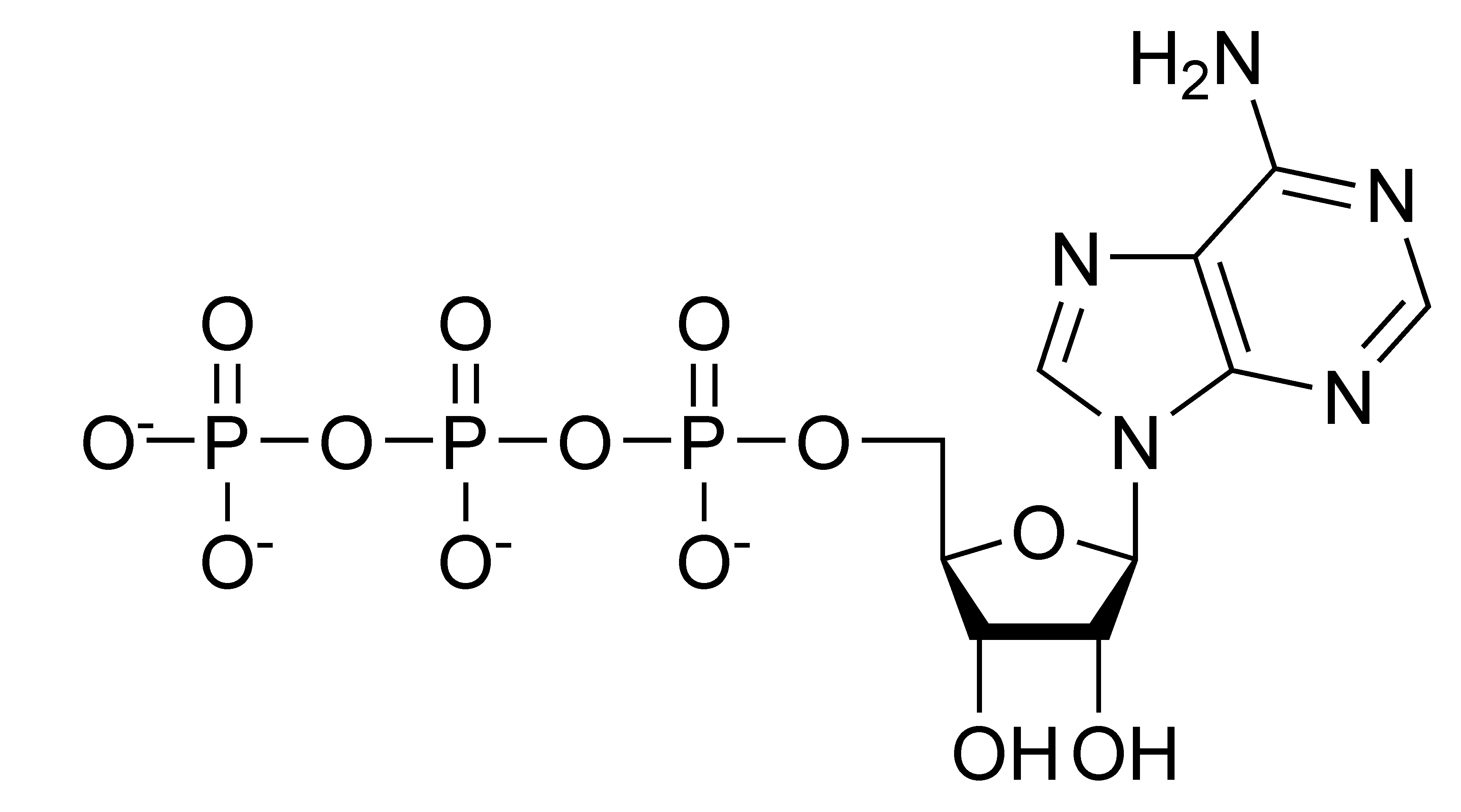
ATP Structure Energy currency made at steps 7 and 10. Tap to expand.
Normal RBCs (SEM) No mitochondria = glycolysis only. Tap to expand.
Extra Clinical Questions
Eight more questions. Pick the answer, then read the full breakdown.
A 4-year-old ingests a large amount of toothpaste. Elevated fluoride is confirmed. Which glycolytic step is most directly blocked?
Step 6 (GAPDH): blocked by arsenate mimicking phosphate
Step 3 (PFK-1): blocked by fluoride
Step 9 (Enolase): fluoride chelates Mg2+ cofactor
Step 10 (Pyruvate Kinase): blocked by fluoride
Glucokinase has a higher Km than Hexokinase. What is the physiological significance of this in the liver?
Glucokinase acts as a glucose sensor, activating only during postprandial hyperglycemia to buffer excess glucose
Glucokinase has higher affinity than Hexokinase and captures glucose even at low blood levels
Glucokinase is inhibited by G6P, preventing excess glucose trapping in hepatocytes
Glucokinase is the rate-limiting enzyme of glycolysis in hepatocytes
A patient presents with hemolytic anemia and elevated 2,3-DPG on RBC analysis. G6PD is intact. Which enzyme is most likely deficient?
G6PD
Pyruvate Kinase (PK)
Hexokinase
GAPDH
Insulin acts on the liver to increase glycolysis. Which molecular intermediate is elevated as a result of insulin signaling at PFK-2?
AMP
Citrate
Fructose-2,6-bisphosphate (F2,6BP)
ATP
Arsenate is added to a cell-free glycolysis system. Which step is sabotaged and what is the energy consequence?
Step 9 (Enolase): arsenate chelates the active site metal
Step 6 (GAPDH): arsenate substitutes for Pi, forming unstable 1-arsenate-3-PG that hydrolyzes without producing ATP
Step 10 (PK): arsenate competes with ADP, blocking ATP synthesis
A long-distance cyclist at 3,500 m altitude shows a rightward shift of the O2-hemoglobin dissociation curve after 2 weeks. Which glycolytic metabolite is responsible for this chronic adaptation?
Lactate
CO2
2,3-DPG from the glycolytic Luebering-Rapaport shunt
Erythropoietin (EPO)
A patient with end-stage liver failure has hypoglycemia and lactic acidosis. Which gluconeogenic limitation best explains the hypoglycemia?
Loss of Glucokinase, preventing glucose entry into hepatocytes
Loss of all four gluconeogenic enzymes housed exclusively in the liver
Muscle glycogen depletion causing loss of systemic glucose supply
The brain switching to gluconeogenesis, consuming excess glucose
A patient on valproate develops fasting hypoglycemia. Which gluconeogenic enzyme is most sensitive to valproate-related inhibition?
Pyruvate Carboxylase
PEPCK (Phosphoenolpyruvate Carboxykinase)
Fructose-1,6-bisphosphatase
Glucose-6-Phosphatase
clinical vignettes
12+ questions. We're showing 5 random ones. Get them right and celebrate!
0 of 5 correct
Medically reviewed by Kaitlyn Cocuzzo, MD and Fatima Ali, DO · Last updated July 1, 2026 at 10:03 PM ET
Bone Wizardry is an independent educational resource for visual learning in the medical sciences. It is not affiliated with, endorsed by, or sponsored by any licensing or examination board, contains no real or recalled examination questions, and does not guarantee any educational or examination outcome.