Master the citric acid cycle, energy yield, and how electrons cross the mitochondrial membrane
The Krebs Cycle (Citric Acid Cycle)
Click each step around the wheel to explore the 8 reactions of the Krebs cycle. Watch the energy products accumulate as you complete the cycle.
Citric Acid Cycle
Tap a metabolite to explore each reaction
Select a metabolite node to view reaction details
EnzymeCofactorsProducts
Click a step to begin
NADH Produced
0
FADH₂ Produced
0
GTP Produced
0
CO₂ Released
0
The 8 Steps at a Glance
Step 1
Citrate SynthaseEntry point for Acetyl-CoA into Krebs. Condenses 2C acetyl with 4C OAA to make 6C citrate. Inhibited by citrate itself (product feedback) and ATP/NADH (energy sufficiency signals).
Acetyl-CoAThe 2-carbon taxi that enters Krebs. Made from pyruvate by Pyruvate Dehydrogenase (needs all 5 PLAN F cofactors). Fat-derived acetyl-CoA bypasses PDH entirely, which is why ketogenic diet works in PDH deficiency. + OxaloacetateOAA is the 4-carbon regenerator that "catches" Acetyl-CoA each cycle. If OAA is drained for gluconeogenesis during fasting, Acetyl-CoA piles up and gets diverted to ketone bodies. This is why starvation and fasting cause ketosis. (OAA) → Citrate
Step 2
Aconitase
Citrate → Isocitrate
Step 3 ⚡ RATE LIMITING
Isocitrate DehydrogenaseThe bouncer of Krebs. Rate-limiting. Inhibited by NADH and ATP (energy abundance). Activated by ADP and Ca2+ (energy demand and muscle contraction). IDH1/IDH2 mutations in glioma produce 2-hydroxyglutarate instead of alpha-KG (oncometabolite).
Isocitrate → α-Ketoglutarate
↓ NADHEach NADH is worth 2.5 ATP at the ETC (enters at Complex I). Per cycle: 3 NADH at steps 3, 4, and 8. Per glucose (2 cycles): 6 NADH = 15 ATP from Krebs NADH alone. + CO₂
Step 4
alpha-Ketoglutarate DehydrogenaseThe PDH twin: uses the exact same 5 PLAN F cofactors (B1-TPP, Lipoate, B5-CoA, B3-NAD, B2-FAD). Arsenic poisons BOTH this enzyme and PDH by binding lipoic acid's dithiol groups. Inhibited by succinyl-CoA and NADH (product feedback).
alpha-KG → Succinyl CoA
↓ NADH + CO₂
Step 5
Succinyl CoA Thiokinase
Succinyl CoA → Succinate
↓ GTPThe only substrate-level phosphorylation in Krebs. No ETC needed: the thioester bond in succinyl-CoA is broken and the energy directly phosphorylates GDP to GTP. GTP equals ATP energetically. Two GTP total per glucose (cycle runs twice).
Step 6
Succinate Dehydrogenase
Succinate → Fumarate
↓ FADH2Worth 1.5 ATP at the ETC (enters at Complex II, bypassing the first proton pump). SDH is the ONLY Krebs enzyme embedded in the inner mitochondrial membrane: it doubles as ETC Complex II. SDH mutations cause paraganglioma, pheochromocytoma, and GIST.
Step 7
Fumarase
Fumarate → Malate
Step 8
Malate Dehydrogenase
Malate → OAAOxaloacetate regenerated here to accept the next Acetyl-CoA. This is why Krebs is a CYCLE. If OAA is pulled away for gluconeogenesis, the cycle stalls. Fat burning produces Acetyl-CoA but OAA depletion means Acetyl-CoA cannot enter Krebs, so it becomes ketones.
↓ NADH
Per Cycle: 3 NADH + 1 FADH₂ + 1 GTP
Since 1 glucose produces 2 Acetyl-CoA molecules, the cycle runs twice:
Per Turn
3 NADH
Per Turn
1 FADH₂
Per Turn
1 GTP
Total per glucose: 6 NADH + 2 FADH₂ + 2 GTP (from both Krebs cycles)
Total ATP from 1 Glucose = 30-32 ATP
Click each contributor to see how much ATP it produces. They stack up to 32!
Glycolysis NADHs
5
2 NADH × 2.5 = 5 ATP
Glycolysis Direct ATP
2
Net 2 ATP produced
Pyruvate → AcCoA
5
2 NADH × 2.5 = 5 ATP
Krebs Cycle #1
10
3 NADH (7.5) + 1 FADH₂ (1.5) + 1 GTP (1)
Krebs Cycle #2
10
3 NADH (7.5) + 1 FADH₂ (1.5) + 1 GTP (1)
TOTAL ATP
0
from 1 glucose molecule
Energy Equivalents
NADH
2.5 ATP
FADH₂
1.5 ATP
GTP
1 ATP
5 B Vitamins Required for Krebs Cycle
The Krebs cycle enzymes depend on these essential cofactors (PLAN F mnemonic):
TPP
Thiamine (B1)TPP (thiamine pyrophosphate) is required by BOTH PDH and alpha-KG Dehydrogenase. B1 deficiency = Wernicke Encephalopathy (confusion, ophthalmoplegia, ataxia). Give IV thiamine BEFORE glucose in any alcoholic. Glucose without B1 accelerates neuronal death at broken PDH.
Used by PDH and alpha-KG Dehydrogenase
Lipoic Acid
Lipoic AcidThe arsenic target. Arsenite binds the two sulfhydryl (dithiol) groups of lipoic acid, inactivating BOTH PDH and alpha-KG DH simultaneously. Treatment: BAL (dimercaprol) chelates arsenic off the sulfhydryl groups. Lipoic acid carries the acyl group within the PDH/alpha-KG DH enzyme complexes.
Dithiol electron/acyl carrier: arsenic target
CoA
Pantothenic Acid (B5)Coenzyme A carries acyl groups across the pathway. Acetyl-CoA carries the 2C fragment into Krebs. Succinyl-CoA carries the 4C product at step 5. The thiol group in CoA forms the high-energy bond that transfers cargo between enzymes. Deficiency is rare because B5 is in almost everything.
Acyl-group carrier (acetyl-CoA, succinyl-CoA)
NAD
Niacin (B3)NAD accepts electrons to become NADH. Every oxidative decarboxylation step in PLAN F produces NADH. NADH then carries electrons to Complex I of the ETC for 2.5 ATP. Niacin (nicotinic acid, high-dose) also raises HDL and lowers triglycerides: useful as a lipid drug.
Electron acceptor, becomes NADH (2.5 ATP/ETC)
FAD
Riboflavin (B2)FAD accepts electrons to become FADH2 at Succinate Dehydrogenase (Step 6). FADH2 yields only 1.5 ATP because it bypasses Complex I. FAD is also used inside PDH and alpha-KG DH as part of the dihydrolipoyl complex. Riboflavin deficiency causes cheilosis (cracked mouth corners) and corneal vascularization.
Electron acceptor at step 6, becomes FADH2 (1.5 ATP)
NADH Shuttles: Crossing the Membrane
NADH is produced in the cytoplasm during glycolysis but the electron transport chain is in the mitochondria. How do electrons get across?
Malate-Aspartate Shuttle
The Efficient Subway (No Cost)
Cytoplasm
ASP
Mitochondria
MAL
Steps:
Cytoplasmic NADH + OAA → Malate via AST
Malate crosses into mitochondria
Mitochondrial Malate → OAA (releases electrons for NADH)
Aspartate returns to cytoplasm
OAA regenerated for next cycle
✓ NO energy loss: 1 cytoplasmic NADH = 2.5 ATP in mitochondria
Always active • Primary shuttle in most tissues
Glycerol-3-Phosphate Shuttle
The Expensive Taxi (Costs 1 ATP)
Cytoplasm
G3P
Mitochondria
FADH₂
The Problem:
Electrons from cytoplasmic NADH are transferred to Glycerol-3-Phosphate, which feeds into the ETC at FADH₂ level.
Energy Loss:
1 cytoplasmic NADH (2.5 ATP) → 1 FADH₂ (1.5 ATP) = NET LOSS of 1 ATP per transfer
✗ COSTS 1 ATP per transfer: 1 NADH yields only 1.5 ATP
Active during rapid growth • Used alongside malate-aspartate
Shuttle Comparison
Feature
Malate-Aspartate
Glycerol-3-Phosphate
Energy Cost
None (2.5 ATP)
1 ATP loss per cycle
Primary Active
All tissues (baseline)
Rapid growth periods
Electrons Enter ETC At
NADH level (Complex I)
FADH₂ level (Complex II)
Tissues
Brain, heart, liver
Skeletal muscle, brown fat
⚔️ Battle Cards
Tap any card to flip it and see the full detail.
🚇
Malate-Aspartate Shuttle
Efficiency: 100% · ATP: 2.5
Tap to flip
Malate-Aspartate Shuttle
ATP yield: 2.5 per cytoplasmic NADH
Energy cost: Zero loss
ETC entry: Complex I (NADH level)
When active: Always → baseline in all tissues
Tissues: Liver, heart, brain
Carrier: Malate crosses inner membrane
Default shuttle. If the stem says "normal conditions," this is running.
🚕
Glycerol-3-Phosphate Shuttle
Efficiency: 60% · ATP: 1.5 · Cost: −1
Tap to flip
Glycerol-3-Phosphate Shuttle
ATP yield: 1.5 per cytoplasmic NADH
Energy cost: −1 ATP per NADH transferred
ETC entry: Complex II (FADH₂ level)
When active: Rapid growth, high muscle demand
Tissues: Skeletal muscle, brown adipose
Why costly: Bypasses Complex I proton pump
NADH downgraded to FADH₂ = 1 ATP lost per transfer.
⚡
Isocitrate Dehydrogenase
Rate-Limiting Step · Step 3
Tap to flip
The Krebs Bouncer
Step 3: Isocitrate → α-Ketoglutarate
Products: NADH + CO₂ (first decarboxylation)
Role: Rate-limiting (committed step)
Inhibited by: NADH, ATP (energy abundance)
Activated by: ADP, Ca²⁺ (energy demand)
Cancer link: IDH1/IDH2 mutations → 2-HG oncometabolite → glioma, AML
Follow acetyl-CoA through the cycle: electron donors, GTP, CO2. Each step locks in a concept.
Acetyl-CoA enters Krebs by combining with what 4-carbon molecule?
Oxaloacetate (OAA)
Alpha-ketoglutarate
Malate
Oxaloacetate. Citrate Synthase catalyzes this condensation: 2-carbon acetyl-CoA + 4-carbon OAA = 6-carbon citrate. OAA is regenerated at the end of each cycle, which is why Krebs is a cycle. Block OAA production and the cycle stalls.
Alpha-ketoglutarate is a later intermediate (step 3 product). Acetyl-CoA does not enter there. The entry molecule is OAA, which Citrate Synthase uses to make the first 6-carbon product.
Malate is near the end of the cycle (step 7 product). It eventually becomes OAA, which picks up the next acetyl-CoA. You are close, but one step downstream of the actual entry molecule.
Per one turn of the Krebs cycle, how many NADH molecules are produced?
3 NADH
2 NADH
4 NADH
3 NADH per turn. Three steps produce NADH: Isocitrate Dehydrogenase (step 3), alpha-KG Dehydrogenase (step 4), and Malate Dehydrogenase (step 8). One turn also produces 1 FADH2 (Succinate DH, step 6) and 1 GTP (Succinyl-CoA Synthetase, step 5).
Two is too low. Three steps in Krebs produce NADH: steps 3, 4, and 8. One FADH2 comes separately from Succinate DH at step 6. You may be undercounting the third NADH step (Malate DH).
Four is too high. Three steps make NADH (steps 3, 4, 8). One step makes FADH2 (step 6). You may be counting FADH2 as NADH. They are different carriers with different ATP yields (2.5 vs 1.5).
Which step in Krebs is the ONLY substrate-level phosphorylation step?
Succinyl-CoA Synthetase (succinyl-CoA to succinate)
Citrate Synthase (acetyl-CoA + OAA to citrate)
Isocitrate Dehydrogenase (isocitrate to alpha-KG)
Succinyl-CoA Synthetase. It breaks the thioester bond in succinyl-CoA and uses the released energy to phosphorylate GDP directly to GTP. This is the only place in Krebs where a high-energy phosphate bond is created without the ETC. Two GTP per glucose.
Citrate Synthase makes citrate but does not phosphorylate anything. It uses energy from the CoA bond but no GTP or ATP is produced here. The substrate-level phosphorylation step is later in the cycle.
Isocitrate DH produces NADH and CO2, not GTP. It is the rate-limiting step, not the energy-yielding phosphorylation step. These are two different roles at two different enzymes.
A neonate with PDH deficiency cannot run Krebs even though OAA is available. Why does the cycle stop?
No acetyl-CoA is produced, so Citrate Synthase has no substrate to start the cycle
PDH deficiency blocks NADH production, stopping all three dehydrogenase steps
OAA cannot enter the mitochondria without PDH acting as a transporter
Correct. PDH converts pyruvate to acetyl-CoA. Without PDH, pyruvate backs up into lactate. OAA is available but has no acetyl-CoA partner for Citrate Synthase. The cycle cannot start step 1. Treatment: ketogenic diet (fat-derived acetyl-CoA bypasses PDH entirely and enters Krebs directly via Citrate Synthase).
PDH makes its own NADH during the pyruvate-to-acetyl-CoA reaction, but this does not feed the three internal Krebs dehydrogenase steps. Those steps run independently once acetyl-CoA enters. The block is at the acetyl-CoA supply, not at the internal NADH steps.
OAA does not require PDH to enter the mitochondria. OAA is made inside the mitochondria from malate (Malate DH) or from pyruvate (Pyruvate Carboxylase). PDH is not a transporter. It is the acetyl-CoA-generating enzyme.
Sticky Memory Hooks
Tap any highlighted term for the memory hook.
Electron Donors
Per turn, Krebs produces three
NADHEach NADH is worth 2.5 ATP at the ETC. Three NADH per turn = 7.5 ATP. Per glucose (2 turns) = 15 ATP from Krebs NADH alone. Add FADH2 (3 ATP for both turns) and GTP (2 ATP), and Krebs accounts for 20 of the 32 total ATP from one glucose.
at steps 3, 4, and 8, and one
FADH2FADH2 is worth 1.5 ATP at the ETC. It enters at Complex II (Succinate Dehydrogenase). SDH is the same enzyme that is Krebs step 6. FADH2 yields less ATP than NADH because it enters the ETC later, bypassing the first proton pump (Complex I).
at step 6 (
Succinate DehydrogenaseThe double-agent. Simultaneously Krebs step 6 AND ETC Complex II. It is the only Krebs enzyme embedded in the inner mitochondrial membrane. SDH mutations cause paraganglioma (SDHB/SDHC/SDHD genes) and GIST. Fumarate and succinate accumulate and inhibit HIF prolyl hydroxylase, stabilizing HIF-1alpha even in normoxia.
).
Additionally, one
GTPMade by substrate-level phosphorylation at Succinyl-CoA Synthetase (step 5). GTP equals ATP energetically. In heart and kidney, GDP is used directly to make ATP. Two GTP total per glucose. Board question: "which Krebs step makes a high-energy phosphate bond?" = Succinyl-CoA Synthetase, always.
is made at step 5.
CO2 Release Steps
Two CO2 molecules are released per turn: one at
Isocitrate DehydrogenaseStep 3. Rate-limiting. Isocitrate (6C) loses one carbon as CO2 to become alpha-KG (5C). First CO2 release. IDH1/IDH2 mutations produce 2-hydroxyglutarate instead, an oncometabolite that hypermethylates the genome and silences tumor suppressors.
(step 3) and one at
alpha-KG DehydrogenaseStep 4. Alpha-KG (5C) loses one carbon as CO2 to become succinyl-CoA (4C). Both CO2 releases in Krebs happen back-to-back at steps 3 and 4. Arsenic blocks this enzyme and PDH simultaneously by attacking lipoic acid. Note: by the time oxaloacetate is regenerated, both original carbons from acetyl-CoA have already left as CO2.
(step 4). Both dehydrogenations require the full
PLAN F cofactor setB1 (Thiamine/TPP), Lipoate, B5 (Pantothenic acid/CoA), B3 (Niacin/NAD), B2 (Riboflavin/FAD). Both PDH and alpha-KG DH use the exact same five cofactors. Any PLAN F deficiency impairs both enzymes. Wernicke encephalopathy = B1 deficiency hitting both of these simultaneously..
Clinical Disease Hooks
PDH DeficiencyX-linked dominant. Pyruvate backs up to lactate. Neonatal lactic acidosis that worsens with glucose (more pyruvate = more lactate). Treatment: ketogenic diet bypasses PDH. Thiamine may help E1 subunit mutations. Rule: never give glucose first in suspected PDH deficiency.
causes neonatal lactic acidosis that worsens with glucose.
Wernicke EncephalopathyThiamine (B1) deficiency. PDH and alpha-KG DH both fail. ATP production in neurons crashes. Selective damage to mammillary bodies, periaqueductal gray, and thalamus. Classic triad: confusion, ophthalmoplegia, ataxia. Give IV thiamine before any glucose. Glucose loading a B1-depleted patient floods pyruvate through a broken PDH system, accelerating cell death.
results from Thiamine (B1) deficiency blocking PDH and alpha-KG DH.
IDH MutationsIDH1 (cytoplasm) and IDH2 (mitochondria) mutations are oncogenic. Mutant enzyme makes 2-HG instead of alpha-KG. 2-HG inhibits TET enzymes and KDM histone demethylases, causing CpG island hypermethylation and silencing of tumor suppressors. Found in glioma (WHO grade 2/3), AML, cholangiocarcinoma, and chondrosarcoma. Ivosidenib targets IDH1, enasidenib targets IDH2.
produce the oncometabolite 2-HG in glioma and AML.
Anaplerotic Hooks
When Krebs intermediates exit for biosynthesis,
anaplerotic reactionsAnaplerosis = refilling the cycle. Pyruvate Carboxylase is the key: makes OAA from pyruvate when OAA is depleted. Activated by acetyl-CoA (signals that fat is burning and Krebs needs OAA to handle it). Biotin is its cofactor. Biotin deficiency impairs anaplerosis and gluconeogenesis simultaneously.
replenish them.
OAA leaving for gluconeogenesisDuring fasting, OAA is pulled from Krebs to make PEP for gluconeogenesis. This depletes the Krebs cycle. Acetyl-CoA (from fat burning) then has no OAA partner for Citrate Synthase. Acetyl-CoA accumulates and is diverted to ketone body synthesis. This is why prolonged fasting produces ketosis: gluconeogenesis and ketogenesis run simultaneously as parallel responses to OAA depletion.
forces ketogenesis when OAA is chronically depleted.
Alpha-KG and amino acid metabolismAlpha-KG is the carbon skeleton of glutamate. Transamination reactions pull alpha-KG from Krebs to make glutamate (via ALT and AST). Elevated AST/ALT reflects transaminase activity consuming alpha-KG. Also, glutamate can be re-oxidized to alpha-KG (via glutamate dehydrogenase) to refuel Krebs. This connects protein catabolism directly to the Krebs cycle.
connects protein catabolism to Krebs via glutamate/alpha-KG exchange.
Clinical Photo Gallery
Tap any image to expand. Images via Wikimedia Commons (CC license).
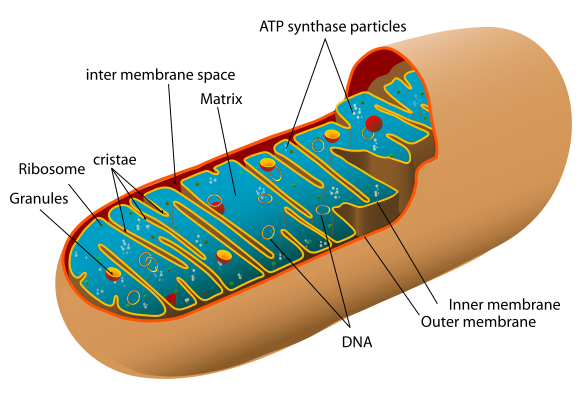
Mitochondria Anatomy Matrix vs membrane. Krebs lives in the matrix. Tap to expand.
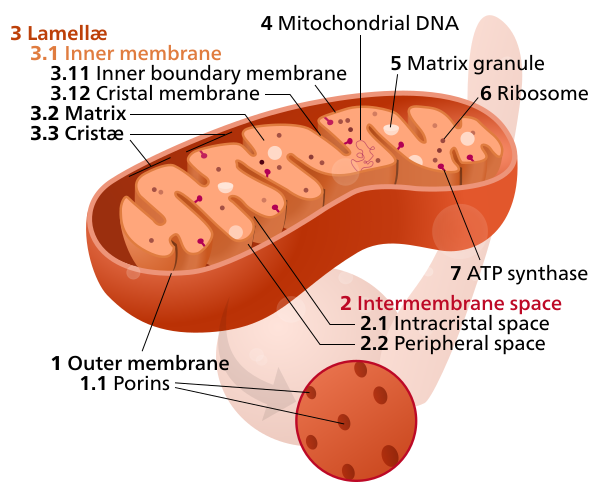
Mitochondrion Schematic Cristae where ETC complexes sit. Tap to expand.
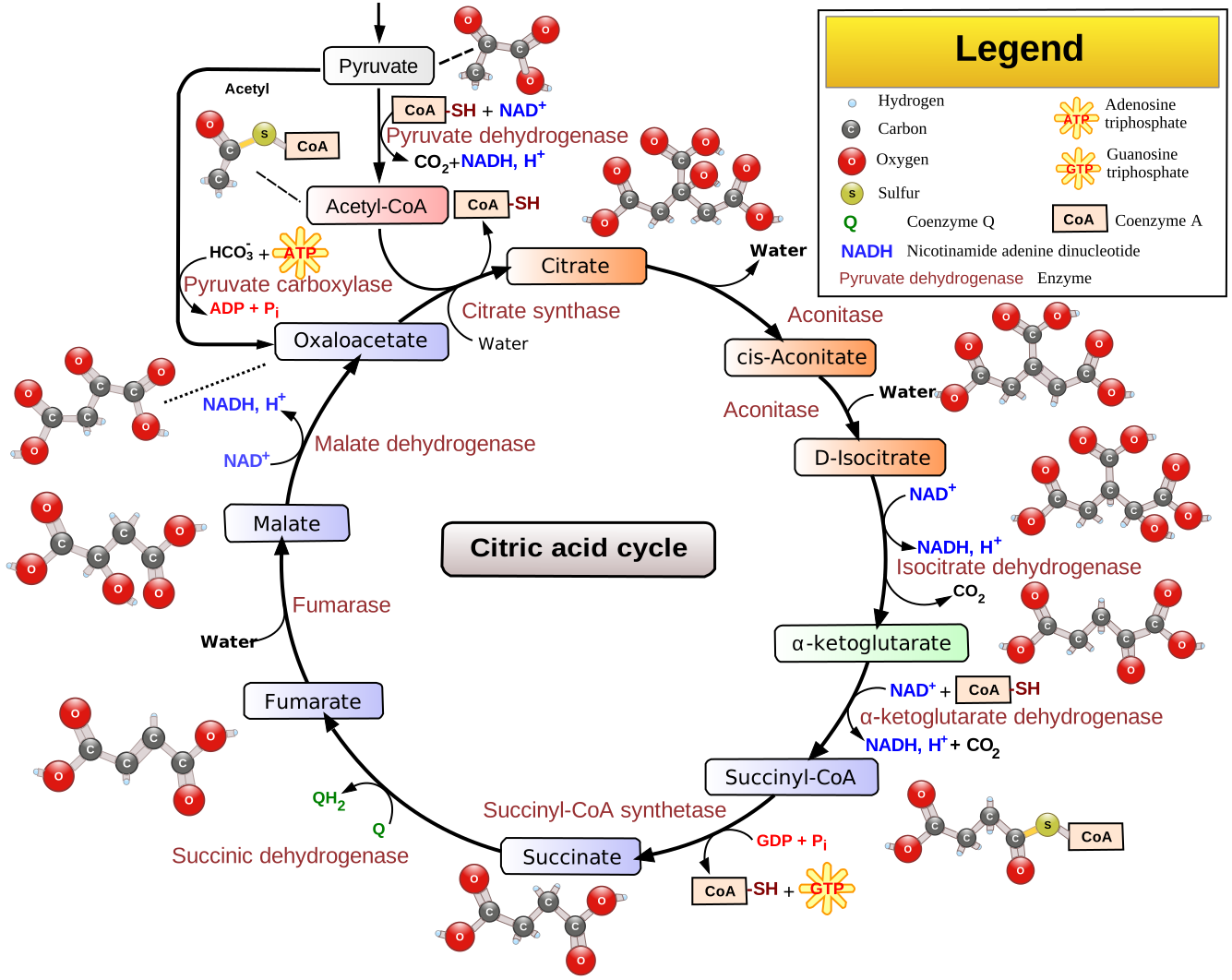
Citric Acid Cycle Map Where each carrier comes off. Tap to expand.
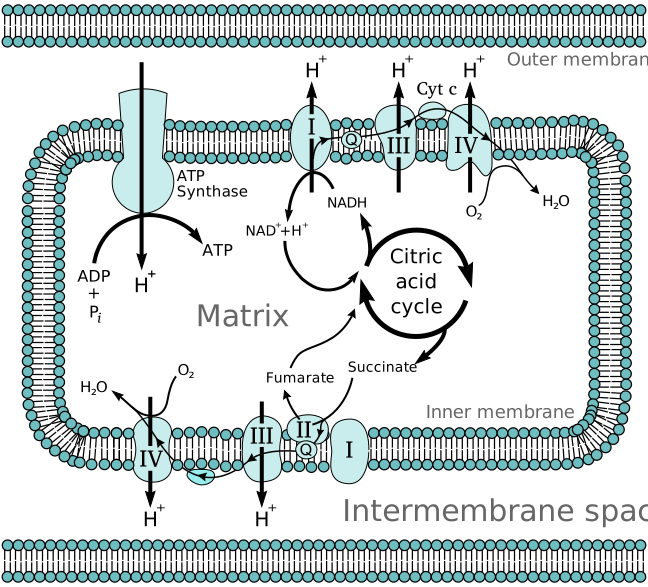
Electron Transport Chain Complex I vs II entry. Tap to expand.
Extra Clinical Questions
Eight original questions. Pick an answer to see the full breakdown.
A neonate presents with severe lactic acidosis that worsens after a glucose infusion. Which enzyme deficiency is most likely?
Pyruvate Carboxylase
Pyruvate Dehydrogenase (PDH)
Isocitrate Dehydrogenase
Succinyl-CoA Synthetase
A chronic alcoholic presents with confusion, lateral gaze palsy, and ataxia. Blood alcohol is zero. IV dextrose is given and the patient acutely worsens. What is the mechanism?
Acetaldehyde accumulation from alcohol metabolism is neurotoxic
Thiamine-depleted PDH fails to process the glucose load, causing acute neuronal ATP collapse (Wernicke)
Rapid glucose causes hyperosmolar injury to dehydrated neurons
An oncology patient has an IDH1-mutated glioma. Which metabolic product is pathologically elevated in the tumor?
Citrate
Succinate
2-Hydroxyglutarate (2-HG)
Fumarate
Arsenic poisoning blocks two Krebs-related enzymes simultaneously by attacking the same cofactor. Which cofactor is targeted?
Thiamine (B1/TPP)
Coenzyme A (B5)
Lipoic acid (the dithiol-containing cofactor)
NAD (B3)
During intense exercise, Isocitrate Dehydrogenase (rate-limiting step of Krebs) must accelerate. Which activating signal drives this during muscle contraction?
High NADH
Calcium ion (Ca2+) and ADP
High ATP
High succinyl-CoA
Which Krebs cycle enzyme is unique in being both a metabolic enzyme AND a structural component of the mitochondrial electron transport chain?
Citrate Synthase
NADH
Succinate Dehydrogenase (SDH / Complex II)
Fumarase
During prolonged fasting, OAA is pulled from the Krebs cycle toward gluconeogenesis. Acetyl-CoA from fatty acid oxidation continues to accumulate. Where does this acetyl-CoA go?
Back into glycolysis via pyruvate regeneration
Into OAA synthesis via Pyruvate Carboxylase activation
Ketone body synthesis, as OAA depletion leaves acetyl-CoA without a Krebs entry partner
Fatty acid synthesis in the cytoplasm
The Glycerol-3-Phosphate shuttle yields 1.5 ATP per cytoplasmic NADH. The Malate-Aspartate shuttle yields 2.5 ATP. What is the structural reason for this difference?
The G3P shuttle requires an ATP investment to transfer molecules across the membrane
The G3P shuttle uses a lower-grade form of NADH with fewer electrons per molecule
G3P shuttle delivers electrons to FAD (Complex II), bypassing the Complex I proton pump
The G3P shuttle is slower and loses energy as heat during transport
🎯 Krebs Cycle & NADH Shuttles Quiz
clinical questions covering the citric acid cycle and NADH shuttles. 5 random from our bank.
Bone Wizardry is an independent educational resource for visual learning in the medical sciences. It is not affiliated with, endorsed by, or sponsored by any licensing or examination board, contains no real or recalled examination questions, and does not guarantee any educational or examination outcome.
clinical Walkthrough
Original third-order vignettes, one at a time. Shuffled, never-repeat until the bank is exhausted.
Cover the choices, hunt the stem clue, answer bottom up. Right-click or long-press to cross out a choice. Double-click or double-tap to highlight one.