Psoas Syndrome & the Opposite-Motion Rule
OMM · Myofascial · Board Review

Psoas Syndrome & the Opposite-Motion Rule

One rule unlocks a whole category of board questions: a muscle that is stuck contracted holds the joint in the direction it acts, so it restricts the opposite motion. Learn it on the psoas, then watch it transfer.

A 10-year-old boy is brought to the office because of 3 days of difficulty walking after a weekend of soccer. There was no fall and no direct blow. He guards a slightly bent-forward posture and resists straightening up. Examination reveals a hypertonic, tender right psoas with a firm contracted band; hip and knee are neurovascularly intact and radiographs of the hip and pelvis are unremarkable. On motion testing of the right hip, one direction is clearly blocked. Which hip motion is most likely restricted?
A.  Flexion
B.  Extension
C.  Abduction
D.  Internal rotation

Extension. The psoas is the major hip flexor. A hypertonic psoas is stuck pulling the hip into flexion, so it physically holds the joint flexed. The motion it cannot allow is its own antagonist: hip extension.

Flexion is wrong because that is the direction the tight muscle is already pulling, so it stays free or even feels strong. Abduction and internal rotation are governed by other muscles, not the psoas. The lost motion is always the opposite of what the tight muscle does.

The engine of the whole topic

The opposite-motion machine

Pick a muscle. Watch which way it drags the hip, and watch the motion it steals. The green arrow is the pull. The red arc is the motion you lose.

side view
PULL: FLEXION BLOCKED: EXTENSION Side view flexion and extension happen here psoas major tightening Top-down view rotation needs a floor-plan view piriformis turns the femur outward Front view Adduction vs abduction Adductors contract Pull thigh to midline. Blocked test: abduction.
Watch the muscle pull first. Then test the opposite motion and see where the red barrier stops it.
Muscle action
Flexion
Resting drag
Hip held flexed
Lost motion
Extension
A hypertonic psoas holds the hip flexed. The motion that would lengthen it is extension, so extension disappears.
From the Attending

Stop memorizing lists of restricted motions. There is one move. A tight muscle is a rope pulled taut on one side of the joint. The joint sits where the rope drags it, and it cannot travel the way the rope refuses to lengthen. Flexor stuck on means flexion is the resting deformity and extension is the casualty. Name the muscle, name its action, flip it. That distinction drives every one of these questions.

Anatomy makes the rule unavoidable

Build the psoas, predict the deficit

If you know where the psoas starts, where it ends, and what it does, the restricted motion is not a fact to memorize. It is the only answer that fits.
1
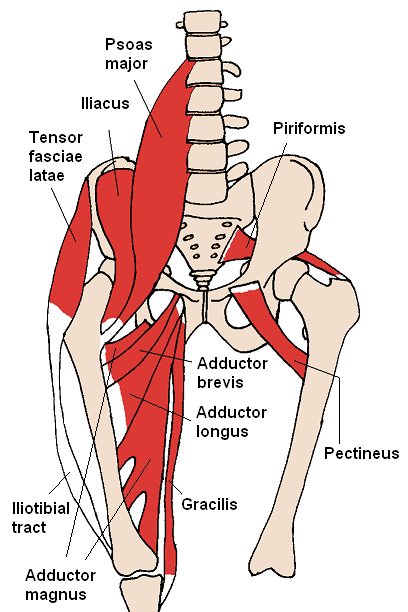
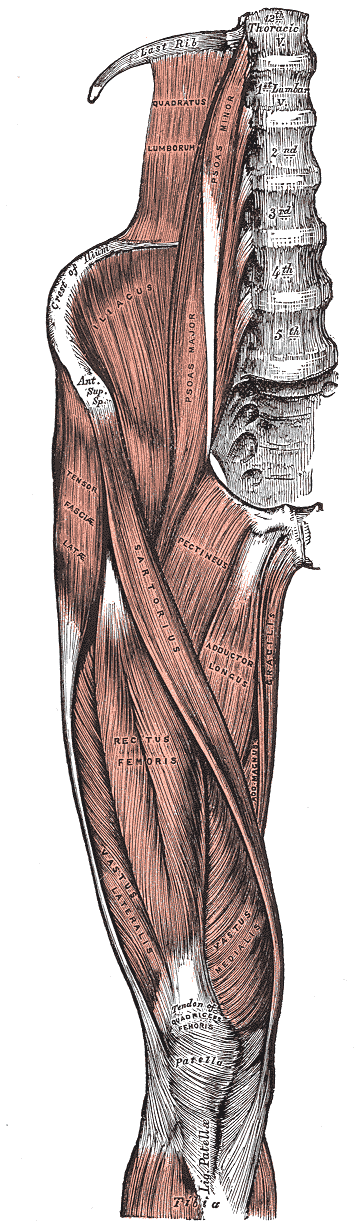
Origin: the lumbar spine, bodies and transverse processes of T12 down through L5. It hugs the front of the vertebrae.
2
Insertion: it dives through the pelvis and grabs the lesser trochanter of the femur.
3
Nerve: the psoas itself gets direct L1 to L3 branches. The lumbar plexus forms inside the psoas, so its named branches explain the groin and thigh symptoms.
4
Action: spanning spine to femur in front of the hip axis, it is the chief hip flexor (and bends the lumbar spine forward).
5
Stuck on: it shortens, tugs the upper lumbar spine, and holds the hip flexed. Extension cannot happen. A stubborn L1 or L2 dysfunction often rides along.
Anatomical drawing of the iliac and anterior femoral muscles showing psoas major and iliacus converging on the lesser trochanter of the femur
Psoas major and iliacus run from the lumbar spine and iliac fossa to the lesser trochanter. Anterior to the hip axis = flexor. (Gray's Anatomy, Wikimedia Commons)
Lumbar plexus diagram showing L1 through L4 nerve roots emerging around the psoas major muscle
The lumbar plexus (T12 to L4) is born inside the psoas. Its branches leave around the muscle, which is why psoas spasm can send pain into the groin and anterior thigh. (Wikimedia Commons)
Name the nerves, not just the plexus
Iliohypogastric + ilioinguinalL1. Lower abdomen and inguinal region.
GenitofemoralL1-L2. Groin, upper anterior thigh, genital branch.
Lateral femoral cutaneousL2-L3. Lateral/anterior thigh sensory track.
FemoralL2-L4. Anterior thigh plus quadriceps and patellar reflex.
ObturatorL2-L4. Medial thigh and adductor compartment.
Clinical rulePsoas spasm lives where these nerves travel, so symptoms can look neural without a root deficit.
From the Attending

Look at where it inserts. The lesser trochanter sits in front of the hip axis. Anything that crosses in front of a joint and pulls is a flexor. You do not need a chart. Front of the axis means flexor, flexor stuck means extension is gone. Find the insertion, find the answer.

Recognize it across the room

Psoas syndrome: the bent-forward patient

The whole syndrome is the rule playing out in a person. The psoas will not lengthen, so the body folds forward to live inside the deficit.

  • Posture: stands forward-flexed, sidebent toward the tight side, cannot straighten fully.
  • Pain: deep low back, often radiating to the groin or anterior thigh through the psoas-adjacent lumbar plexus: genitofemoral/ilioinguinal for groin, femoral/lateral femoral cutaneous for anterior thigh.
  • Trigger: follows prolonged sitting, a flexion strain, or sustained hip flexion.
  • Tender point: deep in the lower quadrant, about two thirds of the way from the ASIS to the umbilicus.
  • Partner dysfunction: a nonneutral L1 or L2 dysfunction; the piriformis on the same side often gets irritated too.
  • Confirm: a positive Thomas test.
Clinical photograph of the Thomas test: patient supine, one hip fully flexed to the chest while the opposite thigh lifts off the table revealing a tight hip flexor
Thomas test. Patient supine, one knee hugged to the chest to flatten the lumbar lordosis. If the opposite thigh rises off the table, that hip flexor is shortened. (Wikimedia Commons)

Why the Thomas test works

When the patient flattens the back by pulling one knee up, gravity should let the other leg lie flat. A shortened psoas will not allow its hip to extend onto the table, so that thigh floats. The test is just the opposite-motion rule, measured. The muscle that flexes refuses to extend.

Medically reviewed by Fatima Ali, DO and Kaitlyn Cocuzzo, MD.
Piriformis & deep rotatorsThe buttock pain that mimics sciatica Low back pain workupSort mechanical from red-flag back pain Pelvis & lumbar counterstrainTender points and treatment positions
Sources: Greenman, Principles of Manual Medicine; Nicholas, Atlas of Osteopathic Techniques; Chila, Osteopathic Medicine; Savarese, OMT Review; Gray's Anatomy. Images courtesy of Wikimedia Commons. For education only, not a substitute for clinical judgment.