Subjects Mnemonics Cluecards QBank Tutoring Physicians Prescryption

Pharmacology · Antimicrobials

The Arsenal: Antibiotics

Every clinical practice hides 8 to 12 antibiotic questions in plain sight. Five mechanisms, one spectrum grid, a handful of resistance tricks, and the toxicity traps written to fool you. Start by beating one.

A healthy outpatient with lobar pneumonia is started on a drug that kills by binding penicillin-binding proteins. By what mechanism does that drug actually destroy the bacterium?
Beta-lactams mimic the D-Ala-D-Ala terminus, so they slip into the transpeptidase active site and lock it. With no crosslinks, autolysins keep chewing while no new wall is laid down, and the cell lyses under its own osmotic pressure. A beta-lactam is a fake brick that jams the bricklayer: no crosslinks, no wall, the bacterium bursts.

The Five Mechanisms

Every antibiotic does one of five things. Know the mechanism, and coverage and side effects follow logically.

Quick, penicillin kills bacteria by doing what?
Penicillin binds transpeptidase, the enzyme that cross-links peptidoglycan. What happens to a wall with no cross-links? It cannot hold osmotic pressure, so the cell lyses. Why does that make every beta-lactam fail against (MRSAMRSA carries the mecA gene encoding PBP2a, a modified transpeptidase that beta-lactams cannot bind. That is why you reach for vancomycin or daptomycin.)? Because MRSA swaps in PBP2a, a transpeptidase with no beta-lactam pocket, so the whole class loses its grip at once. How does vancomycin still work? It binds the D-Ala-D-Ala substrate directly instead of the enzyme, sidestepping PBP2a entirely. Beta-lactams hit the enzyme, vancomycin hits the substrate, and that is why MRSA needs vancomycin while every penicillin and cephalosporin bounces off.
Cell Wall Synthesis
Target: transpeptidase (PBPs) or D-ala-D-ala
Penicillins Cephalosporins Carbapenems Vancomycin

Beta-lactams bind PBPs. Vancomycin binds D-ala-D-ala directly (different target, same wall).

Protein Synthesis, 30S
Target: 30S ribosomal subunit
Aminoglycosides Tetracyclines

Aminoglycosides and Tetracyclines = "AT 30." Aminoglycosides cause misreading (bactericidal). Tetracyclines block tRNA attachment (bacteriostatic).

Protein Synthesis, 50S
Target: 50S ribosomal subunit
Macrolides Clindamycin Chloramphenicol Linezolid

"Buy AT 30, CELL at 50", Chloramphenicol, Erythromycin (macrolides), Linezolid, cLindamycin. 🔑 Buy AT 30, CELL at 50, Aminoglycosides & Tetracyclines at 30S. Chloramphenicol, Erythromycin, Linezolid, cLindamycin at 50S.

DNA/RNA Synthesis
Target: DNA gyrase / topoisomerase IV, or DNA directly
Fluoroquinolones Metronidazole Rifampin

FQs block gyrase (gram-neg) and topo IV (gram-pos). Metronidazole forms toxic free radicals that shred DNA. Rifampin blocks RNA polymerase.

Folate Synthesis
Target: dihydropteroate synthase + dihydrofolate reductase
TMP-SMX Dapsone

Double blockade: sulfamethoxazoleSulfa drugs are structural analogs of PABA, they competitively inhibit dihydropteroate synthase, the first step in bacterial folate synthesis. Humans don't have this enzyme (we get folate from food), so sulfa drugs are selectively toxic to bacteria. blocks step 1, trimethoprimTrimethoprim inhibits dihydrofolate reductase (DHFR), the second step in folate synthesis. Bacterial DHFR and human DHFR are structurally different, giving selectivity. But high doses or long courses can still cause folate deficiency in humans → megaloblastic anemia. blocks step 2. Synergistic, two hits on the same pathway.

Where Each Drug Hits the Cell

Tap a drug class. The diagram lights up the exact target. Cell wall, ribosome, DNA, or membrane: every antibiotic in clinical practice lives in one of these spots.

Gram + cell, Gram − cell
GRAM POSITIVE Thick peptidoglycan, one membrane peptidoglycan + PBP 30S 50S DNA + gyrase GRAM NEGATIVE Thin peptidoglycan, two membranes outer membrane (LPS) thin peptidoglycan + PBP 30S 50S DNA + gyrase
peptidoglycan + PBP ribosome DNA outer membrane
Pick a drug class to light up its target.

Sort the Arsenal

Drag each antibiotic to its mechanism. This is how clinical medicine test it, they give you the drug name and expect you to know the target.

Cell Wall
30S Ribosome
50S Ribosome
DNA / RNA
Folate Synthesis
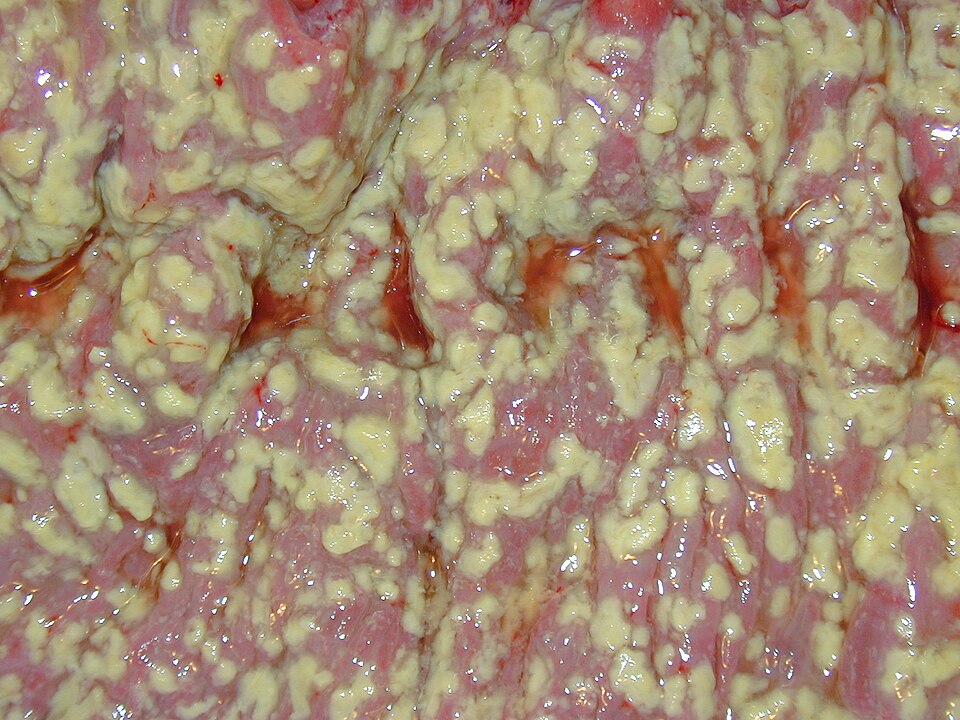
Clinical photo enlarged
Medically reviewed by Kaitlyn Cocuzzo, MD and Fatima Ali, DO · Last reviewed June 2026
Bone Wizardry is an independent educational resource for visual learning in the medical sciences. It is not affiliated with, endorsed by, or sponsored by any licensing or examination board, contains no real or recalled examination questions, and does not guarantee any educational or examination outcome.