Choose an answer, then open any option to work its reasoning.
Ethics and Communication
Stages of Change Communication
Decode readiness language, match the response, and move the patient one respectful step forward.
What this page makes you able to do
- Distinguish the original stages by readiness language
- Select stage-matched communication responses
- Recognize communication traps and shame-free relapse re-entry
- Dr. Fatima Ali, DOPsychiatry residentReview pending
Assigned · Pending physician review
From the Attending:
Board punch: thinking without a plan equals contemplation, so explore both sides of change.
Prove it
Opening question
A 46-year-old patient who smokes says, "I know cigarettes are damaging my lungs, and I have been thinking about quitting. I am not ready to pick a quit date yet."Which response is most appropriate-
- Why this is rightThe patient recognizes harm but has no near-term plan, which signals contemplation. Exploring ambivalence matches that readiness.
- Why this failsA quit date assumes preparation and moves ahead of the patient who has not formed a near-term plan.
- Why this failsConfrontation can provoke resistance and does not help the patient examine competing motivations.
- Why this failsFalse reassurance minimizes difficulty and misses the opportunity for reflective exploration.
Work the reasoning
Thinking about change plus no near-term plan identifies contemplation.
Match the response to the readiness verb: consider means explore ambivalence, not prescribe action.
Prove it
Five original walkthrough cases
Use the fastest rhythm: readiness phrase, stage, trap elimination, matched response.
Map the original progression
The rule is to find the readiness verb before choosing the response.
The original transtheoretical model progresses through precontemplation, contemplation, preparation, action, maintenance, and termination. Relapse is commonly tested as a return pattern that can move a patient back through earlier work, not as the original sixth stage.
Place the original stages in order.
No current intention to change.
Recognizes a problem and weighs change.
Intends near-term action and begins planning.
Has made an observable behavior change.
Sustains change and prevents recurrence.
The former behavior no longer presents meaningful temptation.
Pearl. Mnemonic: Please Consider Preparing, Acting, Maintaining, Terminating.
Separate recognition from readiness
The rule is that awareness of harm does not automatically mean action is next.
Precontemplation language denies a problem or expresses no intention to change. Contemplation language recognizes concern and weighs pros and cons without a committed near-term plan. Preparation adds intention and concrete planning.
Compare the language that separates neighboring stages.
Pearl. Board trap: insight alone is contemplation, not preparation.
Choose the stage-matched move
The rule is to respond to readiness, not to the clinician's preferred timeline.
For precontemplation, ask permission and raise awareness without confrontation. For contemplation, use open-ended questions and reflective validation to explore ambivalence. For preparation, collaborate on a feasible plan. Action and maintenance call for reinforcement, problem solving, and relapse prevention.
Select the best response to contemplation.
Explore both sides. What do you enjoy about smoking, and what concerns you about it- Give a deadline. You need to stop by Friday. Dismiss concern. You will be fine if you cut down a little. Demand commitment. Promise me you will never smoke again.
Pearl. Quickest route: identify the stage, then choose the least forceful response that advances one step.
Tasha Green moves through readiness
The rule is to reassess the present stage after every change, lapse, or re-entry.
A lapse does not erase prior progress. A shame-free response validates the difficulty, identifies the trigger, and helps the patient re-enter the most useful stage rather than forcing a permanent failure label.
Track Tasha Green through the smoking cessation scene.
Setup: Tasha considers quitting. Clue: her readiness shifts. Consequence: shame raises resistance. Locked rule: reassess and support re-entry.1 / 5
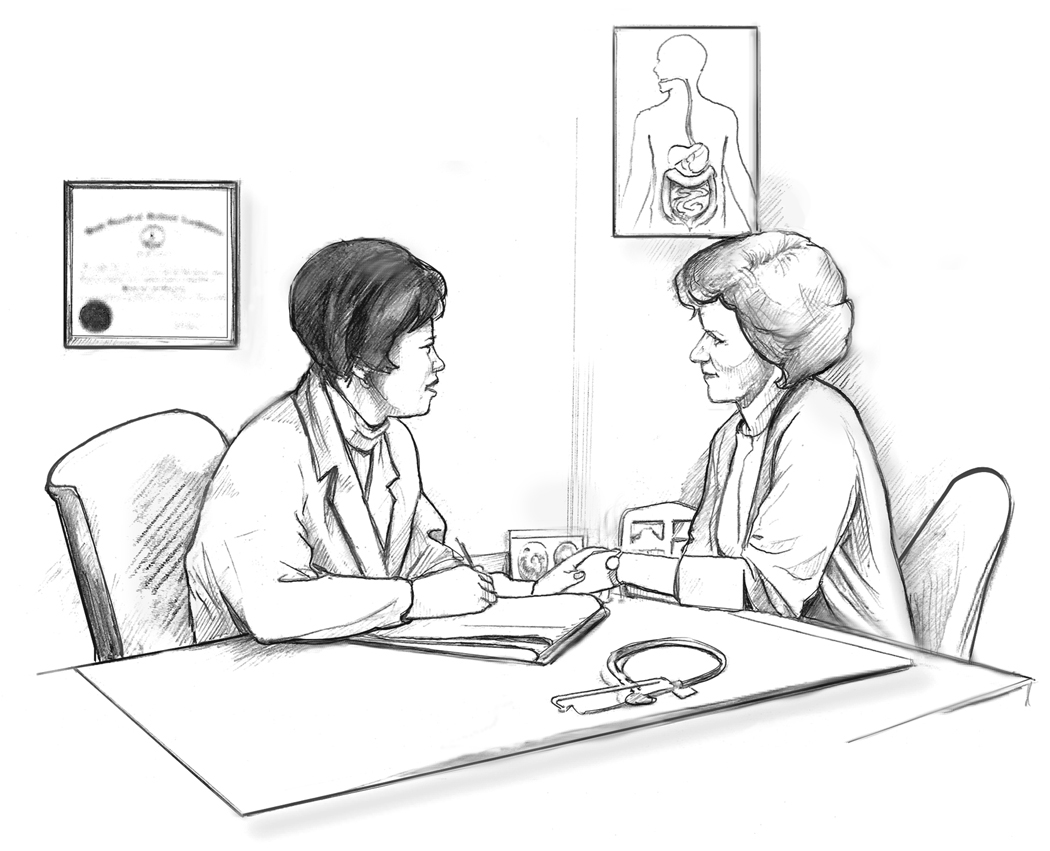 Motivational interviewing matches the conversation to readiness instead of forcing action. Public-domain image: NIDDK, NIH.
Tasha Green · Patient discussing smoking cessation
Closed door
Tasha says smoking is not a problem.
Ask permission to discuss risk without arguing.
Board pattern. No intention to precontemplation
Two-sided scale
She admits harm but values stress relief.
Reflect both sides and invite her own reasons.
Board pattern. Recognition without plan to contemplation
Route selected
She chooses a quit date and support person.
Collaborate on specific next steps.
Board pattern. Near-term intention to preparation
Behavior changed
She stops smoking and changes routines.
Reinforce progress and solve barriers.
Board pattern. Observable change to action
Return without blame
She smokes after stress and feels ashamed.
Normalize re-entry, examine the trigger, and reassess readiness.
Board pattern. Lapse to reassessment and renewed change
Pattern card. No intention, ambivalence, plan, action, lapse, then shame-free re-entry.
Pearl. Pattern recognition: shame signals a need for validation and re-entry, not confrontation.
Use time language as a clue
The rule is to use the patient's planning horizon as the stage clue.
A practical board heuristic is to place readiness on a continuum from no intention through active change. The numeric scale here is a learning aid, not a diagnostic score: values below the planning threshold represent recognition without a concrete near-term plan, while values at or above it represent planning or behavior change.
Place each statement on the readiness learning scale.
Score 0 readiness level
Pearl. Do not turn the heuristic into a clinical instrument; use it to decode stem language.
Open the conversation without pushing
The rule is to invite the patient's reasons for change before offering advice.
Open-ended questions elicit the patient's perspective, while reflections demonstrate accurate listening and validate ambivalence without endorsing harmful behavior. False reassurance, excuses, confrontation, and premature advice short-circuit that process.
Reveal a communication move and its board-level purpose.
What matters most to you about changing-
Part of you wants better breathing, and part fears losing a coping tool.
Would it be okay if we discuss how smoking affects your goals-
Do not promise that change will be easy or risk-free.
Pearl. Pearl: reflection names the conflict; advice waits until readiness and permission are present.
Spot communication traps
The rule is to reject efficient-sounding answers that ignore readiness.
Confrontation substitutes clinician pressure for patient motivation. Excuses minimize accountability, false reassurance minimizes difficulty, and premature advice skips eliciting the patient's goals. Stage-matched communication remains truthful while preserving autonomy and engagement.
Contrast productive responses with common traps.
Pearl. Board trap: empathy is not agreement, and validation is not excuse-making.
Respond to lapse in order
The rule is to treat a return to smoking as plan information, not a moral verdict.
After a lapse, first respond without shame, then clarify what happened, reassess current readiness, identify triggers and supports, and collaborate on the next step. The patient may return to contemplation or preparation before resuming action.
Order the lapse response.
Acknowledge effort and disappointment without blame.
Ask what happened before and during the lapse.
Identify the patient's current readiness.
Name triggers, barriers, and useful supports.
Agree on the next stage-matched step.
Pearl. Lapse is a return pattern; it is not termination and not proof that change failed.
Lock the fastest board algorithm
The rule is stage first and response second.
The quickest route is to underline the readiness phrase, identify the stage, eliminate responses that pressure or minimize, and choose the option that advances one appropriate step. When two answers seem empathic, prefer the one that elicits the patient's own motivation and matches the planning horizon.
Choose the board-safe algorithm.
Stage, eliminate traps, match one step. Decode readiness, reject pressure or minimization, then choose the stage-matched response. Risk first, demand action. Choose the strongest warning regardless of readiness. Advice first, ask later. Provide a plan before exploring goals. Reassure first, avoid conflict. Promise success so the patient feels better.
Pearl. Locked rule: readiness language controls the communication response.
Clinical walkthrough