Skin Cancers

BCC vs SCC vs Melanoma. Three lesions walk into a clinic. Only one of them kills you fast.

Cancer hub · Classic derm findings

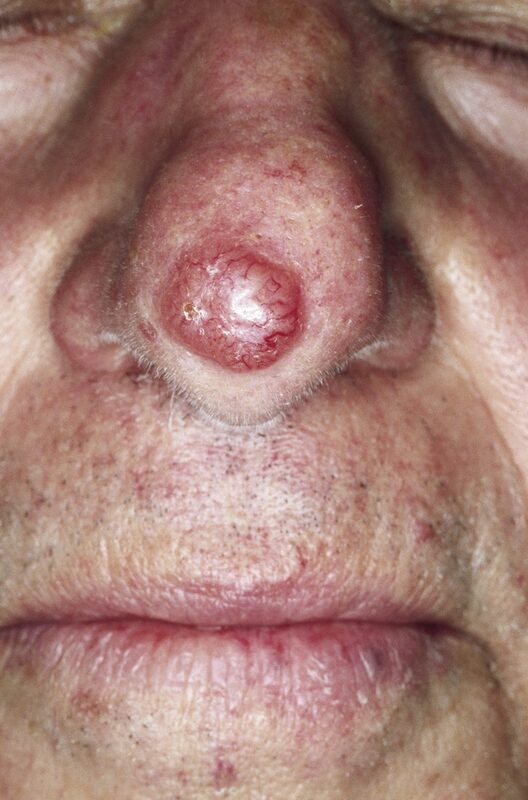
A 68-year-old farmer presents with a pearly, translucent nodule on his nose with visible telangiectasiasDilated superficial blood vessels visible on the skin surface. Classic for BCC because the tumor grows slowly and recruits new blood supply.. What's the most likely diagnosis?
Squamous cell carcinoma
Basal cell carcinoma
Melanoma
Actinic keratosis
Yes. Pearly + rolled borders + telangiectasias = BCC until proven otherwise. It's the most common skin cancer AND the most common cancer period. The "pearly" look comes from nests of basaloid cells with a palisading pattern that reflects light.
Good instinct, but pearly and translucent is BCC's signature look. SCC would be scaly and keratotic. Melanoma would be asymmetric and pigmented. Actinic keratosis is pre-malignant, not a nodule.
The Big Three

Boards will hand you a skin lesion and expect you to know which cancer it is in under 30 seconds. Here's the cheat sheet your brain actually needs:
Basal Cell Carcinoma
Nodular basal cell carcinoma on nose
📷 BCC: pearly, waxy nodule · tap to expand
Frequency: Most common (80%)
Look: Pearly, waxy, rolled borders
Behavior: Locally invasive, almost never metastasizes
Cell: Basal layer of epidermis
Risk: UV + fair skin
Path: Palisading nuclei
Squamous Cell Carcinoma
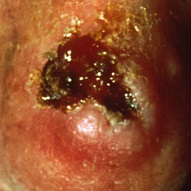
Squamous cell carcinoma on nose
📷 SCC: scaly, ulcerated nodule · tap to expand
Frequency: Second most common
Look: Scaly, crusty, ulcerated plaque
Behavior: Can metastasize (lip, ear higher risk)
Cell: Keratinocytes (squamous layer)
Risk: UV, immunosuppression, arsenic
Path: Keratin pearls
Melanoma
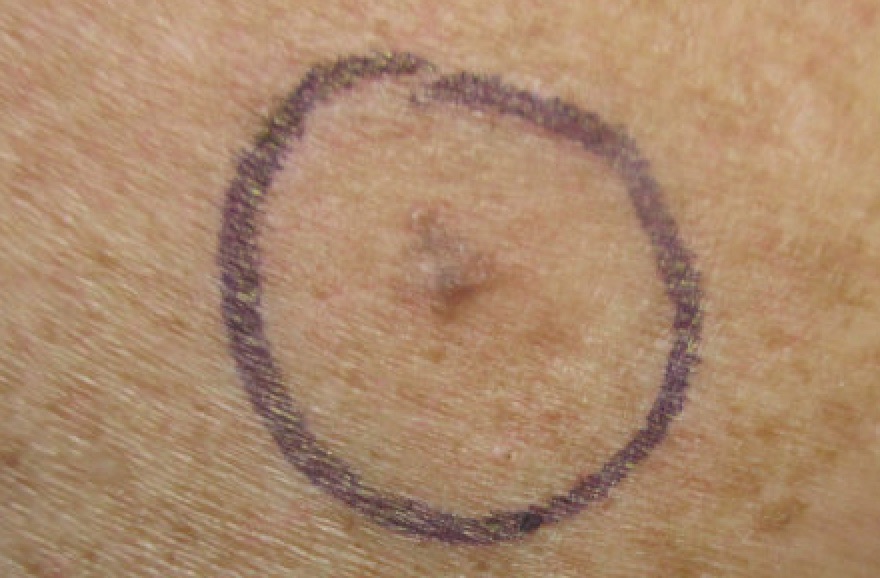
Malignant melanoma on posterior shoulder
📷 Melanoma: asymmetric, irregular borders · tap to expand
Frequency: Least common but most deadly
Look: Asymmetric, irregular borders, color variation
Behavior: Aggressive metastasis
Cell: Melanocytes (neural crest)
Risk: UV + dysplastic nevi + family hx
Path: S-100, HMB-45, Melan-A positive
The One Thing That Separates Each
BCC: Pearly. That's it. If the stem says pearly, translucent, waxy, or rolled borders · it's BCC. Nothing else looks like that. The tumor is made of basaloid cells that form little nests with palisading nucleiThe outer row of cells in BCC nests line up like a picket fence. This organized border is pathognomonic. It's why the lesion looks "pearly" · those orderly cells reflect light uniformly. at the edges, which is why it has that characteristic sheen.
SCC: Scaly and crusty. If the stem describes a rough, keratotic, ulcerated lesion · especially on sun-exposed skin · it's SCC. The key pathology buzzword is keratin pearlsConcentric whorls of keratin produced by malignant squamous cells. They look like little onion-ring cross-sections on histology. The more differentiated the tumor, the more pearls you see.. And remember: SCC can arise from actinic keratosisPrecancerous lesion from chronic UV damage. Rough, sandpaper-like patches. ~1-10% progress to SCC. Treat with cryotherapy or 5-FU cream. If it becomes tender or grows rapidly, biopsy it. · that's the precursor boards loves to test.
Melanoma: The ABCDEs. Asymmetry, Border irregularity, Color variation (multiple shades), Diameter > 6mm, Evolution (changing). If ANY of those are present in the stem, melanoma jumps to the top. Prognosis is all about Breslow depthMeasured in mm from the granular layer to the deepest point of invasion. THE single most important prognostic factor. <1mm = excellent. >4mm = poor. This is why early detection matters so much · depth at diagnosis determines survival. · deeper = worse.
Side-by-Side
Feature BCC SCC Melanoma
Appearance Pearly, waxy nodule Scaly, ulcerated plaque Asymmetric pigmented lesion
Location Face (especially nose) Hands, face, lips, ears Anywhere (back in men, legs in women)
Precursor None (de novo) Actinic keratosis Dysplastic nevus
Metastasis Almost never Can (2-5%) Aggressive
Mortality Very low Low-moderate Highest of all skin cancers
Histology Palisading nuclei Keratin pearls S-100+, HMB-45+
Treatment Mohs surgery, excision Excision, Mohs for high-risk Wide excision (margins by depth)
Genetics PTCH1 (Hedgehog) p53 mutation BRAF (V600E)
Memory Hooks
BCC = "Beautiful Pearly Cancer"
It's the prettiest cancer you'll ever see. Smooth, shiny, translucent · like a pearl sitting on the skin. It's also the nicest · barely ever metastasizes. The beautiful one that doesn't leave.
SCC = "Scaly Crusty Cancer"
The name literally tells you what it looks like. Squamous = scaly. It even makes keratin pearls on histology · the cells are SO committed to being scaly that they form little keratin balls. Actinic keratosis is the warm-up act.
Melanoma = "The one that actually kills you"
Least common of the three. Most deadly by far. ABCDE is the screening tool. Breslow depth is the prognostic tool. If the stem says "changing mole" · that's the E (Evolution) and it's melanoma until proven otherwise.
PTCH1, p53, BRAF · "Patch the 53 BRAves"
BCC = PTCH1 (Hedgehog pathway · "patched"). SCC = p53 (the tumor suppressor everyone already knows). Melanoma = BRAF V600E (targeted by vemurafenib). In order of severity: Patch (minor) → p53 (moderate) → BRAF (aggressive).
Test Day Decision Tree

A lesion walks into your exam. Work through it:

Step 1: Is it pigmented with irregular features (asymmetry, color variation, evolving)?
Yes · pigmented, irregular, changing
No · not particularly pigmented or changing
Think MELANOMA. Biopsy immediately. Check Breslow depth. Stage it. ABCDE positive = melanoma until proven otherwise. Don't wait.
Pigmented Lesion: From Suspicion to Treatment

Patient has a pigmented lesion. Walk the algorithm.

ABCDE criteria: Does the lesion have any suspicious features (Asymmetry, Border, Color variation, Diameter >6mm, Evolution)?
Yes, one or more ABCDE criteria present
No, symmetric, regular, single color, stable
Likely benign nevus. Reassure. Follow up in 3-6 months. If any change noted at follow-up, excisional biopsy. Dermoscopy can help characterize.
Breslow depth margins cheat sheet: In situ = 0.5-1cm · <1mm = 1cm · 1-2mm = 1-2cm · >2mm = 2cm. Depth drives everything.
Board Traps & High-Yield Associations
A patient with multiple BCCs at a young age, jaw cysts, and calcified falx cerebri. What syndrome?
Li-Fraumeni syndrome
Gorlin syndrome (Basal Cell Nevus syndrome)
Xeroderma pigmentosum
Familial atypical mole-melanoma syndrome
Board Trap Xeroderma pigmentosum (XP): Defective nucleotide excision repairNER fixes UV-induced thymine dimers. Without it, EVERY UV mutation accumulates. XP patients get all three skin cancers at extremely young ages. Autosomal recessive. They must avoid all sun exposure.. These patients get BCC, SCC, AND melanoma · all of them, because they can't fix ANY UV damage. Board question = child with severe sunburns → skin cancers.
Board Trap Marjolin ulcer: SCC arising in a chronic wound or burn scar. The question stem will describe a non-healing ulcer in an old burn that suddenly changes. It's aggressive SCC in damaged tissue.
Board Trap Immunosuppression → SCC: Transplant patients on immunosuppressants get SCC at massively increased rates (65-250x). Unlike the general population where BCC > SCC, in immunosuppressed patients SCC > BCC. This reversal is a board favorite.
Melanoma subtypes boards tests:

Superficial spreading · most common overall (70%)

Nodular · worst prognosis (grows vertically fast)

Lentigo maligna · elderly, sun-damaged face, best prognosis

Acral lentiginous · palms/soles/nails, most common in dark-skinned patients
Four Villains, Four Signatures

Tap each card. Front = the buzzword boards hands you. Back = everything you need to close the case.

Basal Cell Carcinoma
The Pearly One
Pearly, waxy, dome-shaped nodule on the nose. Telangiectasias visible. Rolled borders. Grows slowly for years.
tap to reveal
Cell: Basal layer keratinocytes
Path: Palisading nuclei at tumor nest edges
Gene: PTCH1 (Hedgehog pathway)
Risk: UV, fair skin, Gorlin syndrome
Behavior: Locally invasive. Almost NEVER metastasizes
Tx: Mohs (face), excision (body)
Gorlin triad: Multiple BCCs + jaw cysts + calcified falx cerebri
Squamous Cell Carcinoma
The Scaly One
Scaly, crusty, ulcerated plaque on the lower lip or ear. History of actinic keratoses. Bleeds when picked at.
tap to reveal
Cell: Squamous keratinocytes
Path: Keratin pearls (onion-ring whorls)
Gene: p53 mutation (UV damage)
Precursor: Actinic keratosis
Behavior: CAN metastasize (lip, ear = higher risk)
Immunosuppressed: SCC exceeds BCC in transplant pts
Marjolin: SCC in chronic wound/burn scar
Melanoma
The ABCDE Killer
Asymmetric, irregular-bordered, multi-colored pigmented lesion on the back (men) or calf (women). Has been changing for 3 months.
tap to reveal
Cell: Melanocytes (neural crest origin)
Markers: S-100+, HMB-45+, Melan-A+
Gene: BRAF V600E (targeted by vemurafenib)
Prognosis: Breslow depth (mm) = #1 factor
Subtypes: Superficial spreading (most common), Nodular (worst), Lentigo maligna (elderly), Acral lentiginous (dark skin, nails)
Hutchinson sign: Nail fold pigment = acral lentiginous
Merkel Cell Carcinoma
The Forgotten One
Rapidly growing, violaceous, firm nodule on the head/neck of an elderly or immunosuppressed patient. No pearliness, no scales. Just speed.
tap to reveal
Cell: Neuroendocrine (Merkel cells)
Path: Small blue cells, neuroendocrine markers
Virus: Merkel cell polyomavirus (MCPyV)
Risk: UV, immunosuppression, elderly
Behavior: Aggressive. High rate of local recurrence + distant mets
Board clue: Sun-exposed site + fast-growing + violaceous + elderly = Merkel
Decision Tree: Suspicious Skin Lesion Workup

A lesion just walked into your clinic. Work through the branches.

What do the lesion characteristics look like?
Elimination Game

5 patients just walked in with skin lesions. Don't miss the diagnosis.

Quiz

4 of these from a pool of 14. Different every time. Let's go.