Hypertension Stage It, Treat It, Survive the Crisis
Cardiology · The Silent Killer
Hypertension Stage It, Treat It, Survive the Crisis
Hypertension looks like memorization but it is really three switches: a number sets the stage, a comorbidity picks the drug, and end-organ damage decides whether you have hours or minutes. Most board points hide in those three forks. Start with the trap that catches the most students.
Medically reviewed by Fatima Ali, DO & Kaitlyn Cocuzzo, MD
Before you scroll
A 47-year-old man comes to the office because his pharmacy blood-pressure machine read high last week. He feels well and has no chest pain, headache, or vision changes. Today, after he rests quietly for five minutes, two readings average 158/96 mmHg. He has no diabetes and no kidney disease, and his examination is unremarkable. Which of the following is the most appropriate next step?
What stage is 158/96?
Either number being 140/90 or higher is Stage 2. His systolic 158 and diastolic 96 both clear that line, so this is Stage 2 hypertension, not "elevated." Elevated is only 120 to 129 systolic with a diastolic under 80.
Can you diagnose on one reading?
No. The diagnosis needs the average of two or more readings on two or more visits (white-coat effect is real). So you do not slap a label on a single office value, even a high one.
So what is the move here?
Confirm it on a second occasion (a repeat visit or out-of-office readings), and because the confirmed level is Stage 2, you will start a drug, not just lifestyle. He is asymptomatic with no end-organ damage, so this is NOT an emergency. Confirm over two visits, then treat: Stage 2 always earns a drug.
Scroll ↓ the staging dial comes next
The Signature Game · Set the Number, Pick the Drug
BP Staging Dial & First-Line Picker
Slide the systolic and diastolic. The stage lights up live. Then tap the patient's comorbidity and the guideline-correct first-line drug illuminates with the one-line reason. This is the engine behind every "which drug do I start" question.
130 / 82mmHg
Stage 1
130 to 139 systolic OR 80 to 89 diastolic. Either number qualifies.
90120130140180+
Systolic130
Diastolic82
Now pick the drug
Same patient now has confirmed hypertension that needs a drug. Tap one defining feature and watch the guideline-correct first-line agent light up.
Tap a feature above to reveal the first-line drug.
The staging table to burn in
Normal: under 120 AND under 80. Elevated: 120 to 129 systolic AND under 80 diastolic. Stage 1: 130 to 139 systolic OR 80 to 89 diastolic. Stage 2: 140 or higher systolic OR 90 or higher diastolic. The word that wins points is OR: once you reach Stage 1 or 2, either the top or the bottom number can put you there.
Normal under 120/80. Elevated needs BOTH (120 to 129 over under 80). Stage 1 and Stage 2 take EITHER number. The higher of the two always wins the stage.
Tap to reveal when Stage 1 still earns a pill
Stage 2 (140/90+) always gets a drug. Stage 1 (130 to 139 over 80 to 89) gets a drug only if the patient also has clinical ASCVD, a 10-year ASCVD risk of 10 percent or higher, diabetes, or chronic kidney disease. No high-risk feature in Stage 1 means lifestyle first, then reassess. The four risk triggers: heart disease, high calculated risk, diabetes, kidneys.
Challenge Before Reveal · Drug or Lifestyle?
Decide: Start a Drug, or Not Yet?
A real patient walks in with a confirmed number. For each one, tap whether you start a medication now or treat with lifestyle and reassess. Guess before each reveal. This is the exact fork the exam tests with "most appropriate next step."
Patient on the table
The start-the-drug rule
Stage 2 (140/90 or higher): start a drug, every time, alongside lifestyle. Stage 1 (130 to 139 over 80 to 89): start a drug only if there is clinical ASCVD, a 10-year ASCVD risk of 10 percent or higher, diabetes, or CKD. Stage 1 with none of those is lifestyle first (diet, sodium, weight, exercise, alcohol) and recheck in 3 to 6 months. Elevated and Normal: lifestyle, no drug.
Stage 2 always gets a pill. Stage 1 gets a pill only with a risk flag (heart, high risk score, diabetes, kidneys). Below Stage 1, no drug.
Tap to reveal the BP goal everyone forgets
The general treatment target is under 130/80 for most adults with hypertension, including those with diabetes, CKD, or established cardiovascular disease. So the number that diagnoses Stage 1 (130) is also roughly the number you are trying to get back under. Diagnose at 130, treat to below 130.
Four First-Line Classes, Five Sets of Rules
The First-Line Drug Lineup
Four classes carry the first-line load, and each has a signature board point: a metabolic quirk, a feared side effect, or a hard contraindication. Tap a tab. The "do not use when" line is what the clinical medicine actually test.
Diuretic · first-line
Thiazide-type Diuretics
Examples
Chlorthalidone, hydrochlorothiazide (HCTZ)
How it works
Blocks Na/Cl in the early distal tubule
Signature electrolytes
Low K, low Na, low Mg, HIGH Ca
Bonus use
Lowers urine calcium (good for stones, osteoporosis)
Board trap
Thiazides RAISE calcium and uric acid (watch gout) and lower potassium. That high-calcium effect is the opposite of loop diuretics, which dump calcium.
Thiazides keep calcium IN. Low K, low Na, high Ca. First-line and cheap; chlorthalidone is the longer-acting favorite.
RAAS blockers · first-line
ACE Inhibitors & ARBs
Examples
Lisinopril (ACEi), losartan (ARB)
Love them for
Diabetes, CKD, proteinuria, HFrEF, post-MI
ACEi side effects
Dry cough, angioedema, high K, rise in creatinine
ARB difference
No cough (use when ACEi cough is the problem)
Hard stops
Never in pregnancy (fetal renal damage). Use caution in bilateral renal artery stenosis, where they can drop GFR and cause acute kidney injury. Never combine an ACEi WITH an ARB.
Kidney and diabetes protectors. Cough and angioedema are ACEi; switch to an ARB. Banned in pregnancy and risky in bilateral renal artery stenosis.
Calcium channel blockers · first-line
Dihydropyridine CCBs
Examples
Amlodipine, nifedipine (dihydropyridines)
Action
Relax arterial smooth muscle (vasodilate)
Side effect
Peripheral (ankle) edema, flushing, headache
Great for
Black patients, older patients, isolated systolic HTN
Board trap
The peripheral edema from amlodipine is from vasodilation, NOT fluid overload, so adding a diuretic does not fix it. The non-dihydropyridines (verapamil, diltiazem) slow the heart and are not the first-line HTN choice here.
Amlodipine vasodilates, so it causes ankle edema that diuretics will not fix. A first-line workhorse, especially in Black and older patients.
Not first-line (unless compelled)
Beta-Blockers
Examples
Metoprolol, carvedilol, bisoprolol
Status
NOT first-line for plain hypertension
When they ARE the answer
HFrEF, after an MI, certain arrhythmias
Pregnancy use
Labetalol is a go-to in pregnancy
Board trap
For uncomplicated hypertension, a beta-blocker is a distractor. It becomes correct only with a compelling indication like heart failure, post-MI, or an arrhythmia. Do not start one just to lower the number.
Don't reach for a beta-blocker on simple HTN. They win only with a compelling indication: HFrEF, post-MI, arrhythmia. Labetalol is the pregnancy exception.
From the Attending
Stop reaching for the beta-blocker on a healthy 50-year-old with a high number. For plain hypertension there are exactly four first-line classes: thiazide, ACE inhibitor or ARB, and a dihydropyridine calcium channel blocker. The beta-blocker only earns its spot when the heart gives you a reason: failure, a recent infarct, an arrhythmia. No compelling indication, no beta-blocker. Know your clues.
When the Comorbidity Picks the Drug
Match the Patient to the Forced Choice
"Compelling indication" means a comorbidity overrides your free choice and points to one class. Tap a card to open its file; opening one dims the others so you study one match at a time. These pairings answer most "which drug" stems instantly.
They dilate the efferent arteriole, drop intraglomerular pressure (the pressure inside the kidney's filtering units, the glomeruli), and cut proteinuria, slowing kidney decline.
Watch
A small creatinine rise (up to about 30 percent) is expected and acceptable; high potassium is the limiting effect.
Hook
Sugar or protein in the urine: reach for the "-pril" or "-sartan." They protect the kidney, not just the number.
💉
Black Patient, No CKD or HF
thiazide or CCB first
▼
Pick
Thiazide or dihydropyridine CCB first.
Why
On average these classes lower pressure more effectively in Black patients than an ACEi or ARB as monotherapy.
Exception
If the patient ALSO has CKD or heart failure, an ACEi or ARB moves back to the front for organ protection.
Hook
Black, no kidney or heart disease: start with the water pill or amlodipine, not the "-pril."
💓
HFrEF (low ejection fraction)
ACEi/ARB + beta-blocker + MRA
▼
Pick
ACEi or ARB plus an evidence-based beta-blocker plus a mineralocorticoid antagonist (spironolactone or eplerenone).
Why
These three classes lower mortality in reduced-EF heart failure, not just blood pressure.
Avoid
Non-dihydropyridine CCBs (verapamil, diltiazem) in HFrEF, because they depress contractility further.
Hook
Weak pump: the survival trio is RAAS blocker, the right beta-blocker, and an MRA.
❤
After a Myocardial Infarction
beta-blocker + ACEi
▼
Pick
Beta-blocker plus an ACE inhibitor (or ARB).
Why
The beta-blocker cuts myocardial oxygen demand and arrhythmia risk; the ACEi limits adverse remodeling (the heart muscle reshaping itself in a harmful way after the injury).
Bonus
This is the one common setting where a beta-blocker is squarely first-line in a hypertensive patient.
Hook
Post-heart-attack: beta-blocker to protect the muscle, ACEi to protect the shape.
🤰
Pregnancy
labetalol, nifedipine, methyldopa
▼
Pick
Labetalol, nifedipine, or methyldopa.
Hard stop
No ACE inhibitors or ARBs, which cause fetal renal damage and other anomalies.
Also avoid
Skip routine thiazides and nitroprusside; hydralazine and IV labetalol are used for severe BP in pregnancy.
Hook
Pregnant: think "lab-nif-methyl." The RAAS blockers are off the table for the baby's kidneys.
The Rule That Decides Hours vs Minutes
Sort the Crisis: Emergency or Urgency?
Both look terrifyingly high on the monitor. The split is one question: is an organ being damaged RIGHT NOW? Drag each scenario into the right bin. Emergency reveals the IV agent and the lower-the-MAP rule.
Emergency
Acute end-organ damage. IV drugs, lower MAP by no more than ~25% in the first hour.
Urgency
Very high BP, NO acute end-organ damage. Oral drugs, lower gradually over hours to days.
BP 220/130 with confusion, headache, and seizures (encephalopathy)BP 210/124 with a creatinine that has acutely doubledBP 200/118 with sudden severe dyspnea and crackles (flash pulmonary edema)BP 195/110 with tearing chest pain radiating to the back (aortic dissection)BP 215/125 with papilledema and flame hemorrhages on fundoscopyBP 192/116 found on a routine check, patient feels completely well, no findingsBP 188/112 with a mild headache that resolves on rest, normal exam and labs
Drag (or tap a scenario below, then a bin) to sort all 7. The presence of acute organ damage is the only line that matters.
The crisis rule, in one breath
Damage NOW = emergency = IV, drop MAP no more than 25% in hour one. No damage = urgency = oral, gradual.
The number alone never decides it; the organ does. An asymptomatic 200/120 is urgency. The end-organ list to memorize: brain (encephalopathy, stroke), heart (acute coronary syndrome, flash pulmonary edema), kidney (acute kidney injury), eyes (papilledema, retinal hemorrhages), aorta (dissection), and pregnancy (eclampsia). And drop pressure slowly, because cerebral and coronary perfusion adapted to the high pressure and can be starved by an overshoot. Two exceptions break the slow rule:aortic dissection needs a fast drop (target systolic about 100 to 120, an agent like esmolol to blunt the shearing force), and acute ischemic stroke uses permissive hypertension (you tolerate a high pressure to keep the penumbra perfused).
Organ damage means emergency and IV. Lower MAP by 25% max in the first hour, EXCEPT dissection (drop fast) and ischemic stroke (leave it high).
Tap to reveal why you do not crash the pressure
Chronic hypertension shifts the brain's autoregulation curve to the right. The vessels are used to a high pressure, so a normal-looking number can leave the brain underperfused. Drop too fast and you cause watershed ischemia or blindness. That is why the rule is gentle: about 25 percent off the mean arterial pressure in the first hour, then ease the rest down over a day or two.
Board Gold · When HTN Has a Hidden Driver
Find the Secondary Cause
Most hypertension is primary. But certain red flags scream "go looking." Each round gives you one clue and four causes. Tap the cause the clue points to. The clue-to-cause links here drive almost every secondary-HTN question.
The triggers that say "screen for secondary"
Onset before 30, resistance to 3+ drugs, or a red-flag clue means stop assuming primary and start hunting.
The classic clue-to-cause set: hypertension with unprovoked low potassium points to primary hyperaldosteronism (high aldosterone, low renin, metabolic alkalosis). Episodic headache, palpitations, and sweating in spells points to a pheochromocytoma (catecholamine surges). An abdominal bruit, especially in a young woman (fibromuscular dysplasia) or an older atherosclerotic patient, points to renal artery stenosis, and remember an ACEi can spike the creatinine if the disease is bilateral. Loud snoring with daytime sleepiness points to obstructive sleep apnea.
Low K, think aldosterone. Spells of headache and palpitations, think pheo. Abdominal bruit, think renal artery. Snoring and sleepy, think sleep apnea.
What the Silent Killer Actually Breaks
The End-Organ Damage Lineup
Chronic high pressure quietly wrecks specific organs. These findings are both the reason to treat and the line that turns a crisis into an emergency. Tap a card to open its file; opening one dims the others so you study one at a time.
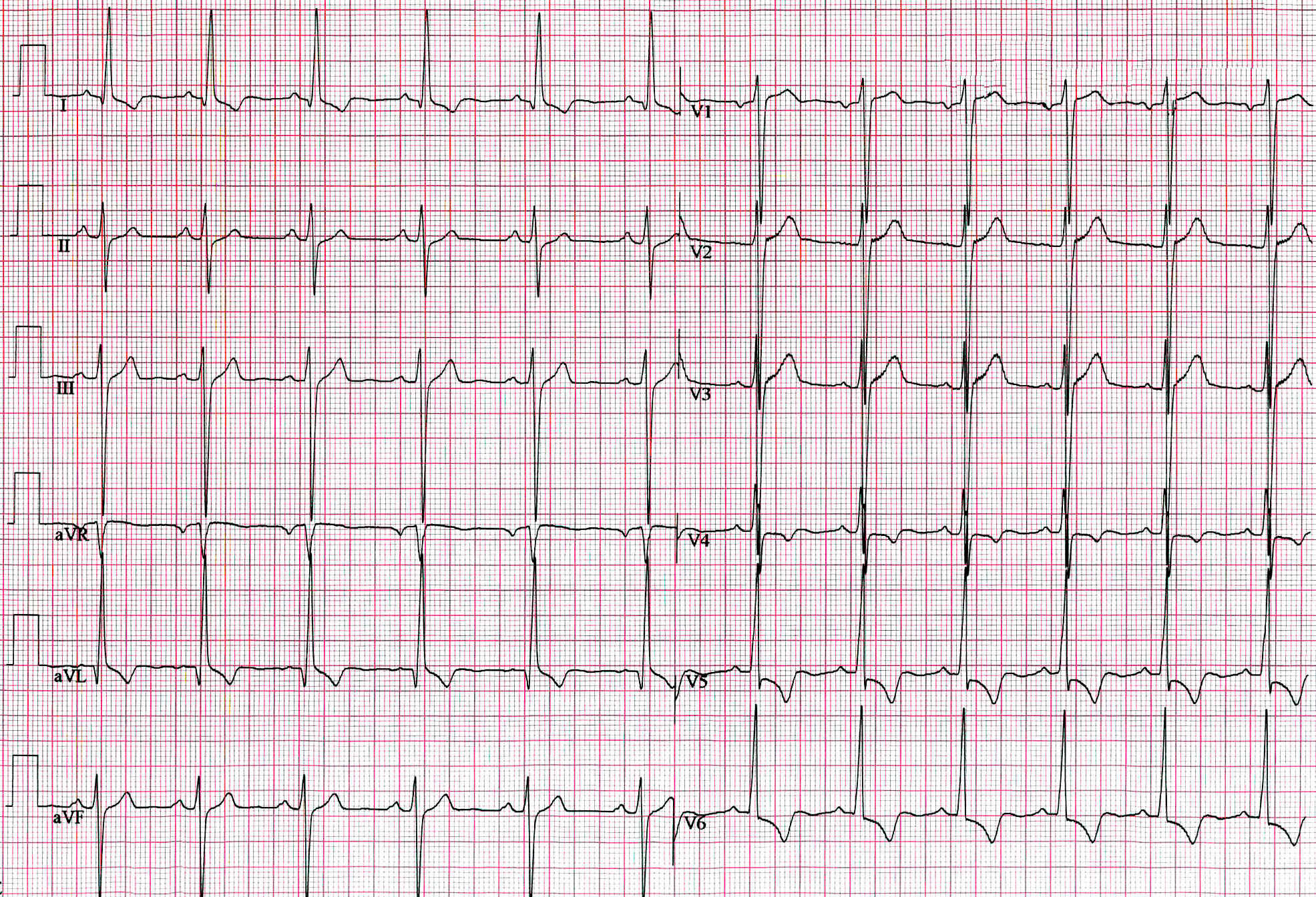
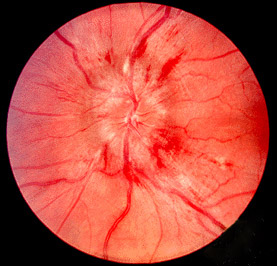
Fundus photograph, hypertensive retinopathyPapilledema (swollen optic disc, an emergency sign)LVH on ECG (the heart thickening against pressure)Hypertensive nephropathy (the kidney under pressure)Nephrosclerosis (thick-walled, narrowed arterioles)IV access (the route for a hypertensive emergency)
🧠
Brain
encephalopathy, stroke
▼
Acute
Hypertensive encephalopathy: headache, confusion, seizures. This is an emergency.
Chronic
Lacunar strokes and vascular cognitive decline from small-vessel disease.
Catch
In acute ischemic stroke you permit a high pressure rather than crashing it.
Hook
Confused plus seizing plus sky-high BP equals encephalopathy. IV drugs, gentle drop.
👁
Eyes
retinopathy, papilledema
▼
Findings
AV nicking, copper/silver wiring, flame hemorrhages, cotton-wool spots.
Red line
Papilledema means a hypertensive emergency until proven otherwise.
Why it matters
The retina is the one place you can directly SEE small-vessel hypertensive damage.
Hook
Swollen disc on the eye exam plus a high number means emergency, lower it now.
❤
Heart
LVH, HFrEF, ACS
▼
Chronic
Left ventricular hypertrophy from pumping against high pressure, then diastolic and later systolic failure.
Acute
Acute coronary syndrome or flash pulmonary edema can be the emergency presentation.
ECG clue
Tall QRS voltages with a strain pattern signal LVH.
Hook
A muscle that works harder gets thicker, then stiffer, then fails. LVH is the warning.
An acute rise in creatinine during a crisis is end-organ damage, so it is an emergency.
Two-way street
The kidney is both a victim of HTN and, via renal artery stenosis, a cause of it.
Hook
High pressure scars the filters; an ACEi protects them long-term but watch the potassium.
Build the Plan
Walk a High-BP Encounter
One patient, one decision at a time. Guess each branch before it opens. This is the reasoning the exam wants when it asks "the most appropriate next step" in a patient with a frighteningly high number.
From the Attending
When the number is scary, do not start with the drug. Start with one question: is an organ failing right now? Check the brain, the heart, the kidney, the eyes, the aorta. If yes, that is an emergency, so you go IV and lower the mean pressure by no more than a quarter in the first hour. If no organ is in trouble, it is urgency, and you slow down: oral therapy, gradual. The organ decides the speed, not the number. Every time.
Don't Kill the Patient
Five Quick Calls
Five rapid questions pulled from a bigger pool, reshuffled every visit. Cross out (right-click / long-press) and highlight (select text) as you read.
clinical Practice
Walk the Cases
Full clinical vignettes, one at a time, in a shuffled order. Progress saves to your account on this device. Cross out (right-click / long-press) and highlight (select text) as you go.
Your attending drops a chart in front of you on rounds.
Attending
"BP is 210 over 122. Resident wants to give a fast IV push to bring it to normal. Good idea?"
You
"The number is dangerous, so... lower it quickly?"
Attending
"Is an organ failing? No confusion, no chest pain, normal creatinine, clean eye exam. Then this is URGENCY, not emergency. Crash that pressure and you starve a brain that adapted to running high."
Attending
"Oral therapy. Gradual. The organ decides the speed, not the number. Read each of these the same way."
No acute end-organ damage means urgency: oral drugs, lower gradually. Find the organ before you touch the dial.
Tip: kill the wrong choices first, then read the explanation chain for every option.
2017 ACC/AHA Guideline for the Prevention, Detection, Evaluation, and Management of High Blood Pressure in Adults. Staging thresholds, treatment threshold, and BP goals.
First Aid for the clinical medicine. Cardiovascular pharmacology, hypertensive urgency vs emergency, secondary hypertension, and end-organ damage.
Harrison's Principles of Internal Medicine. Hypertensive vascular disease, compelling indications, and hypertensive crisis management.
JNC and ACC/AHA compelling-indication tables. Diabetes/CKD, HFrEF, post-MI, Black patients, and pregnancy drug selection.
Reviewed by Fatima Ali DO and Kaitlyn Cocuzzo MD. Vignettes are original clinical teaching cases; demographics, values, and answer order are written for practice. Always confirm treatment decisions against the current guideline at the point of care.
Bone Wizardry is an independent educational resource for visual learning in the medical sciences. It is not affiliated with, endorsed by, or sponsored by any licensing or examination board, contains no real or recalled examination questions, and does not guarantee any educational or examination outcome.