CARDIOLOGY

Cardiomyopathies

Three structural heart diseases that look different, fail differently, and kill differently

Opening Challenge

A 22-year-old athlete collapses during a basketball game. Echocardiogram shows asymmetric septal hypertrophy (3.0 cm), systolic anterior motion (SAM) of the mitral valve, and dynamic LVOT obstruction. Which of the following makes his obstruction WORSE?

A) Squatting
B) Leg raise
C) Standing up quickly (decreased preload)
D) Phenylephrine infusion
Decreased preload worsens HCM obstruction. HCM obstruction is dynamic. The LVOT is already narrowed by the hypertrophied septum. When preload drops (standing, Valsalva), the LV cavity gets smaller, pulling the septum and mitral valve even closer together. Less blood in the chamber = tighter tube = more obstruction. Squatting and leg raise increase venous return (preload), making the LV fuller and the obstruction less severe. Phenylephrine raises afterload, which also decreases the gradient. The rule: anything that makes the LV smaller worsens HCM. Anything that fills it up helps.
01 · The Three Types

Three Diseases, Three Failure Modes

Same organ. Completely different structural problems. Know the pattern before memorizing the details.

The one-liner framework: HCM = too thick, can't relax. DCM = too dilated, can't squeeze. Restrictive = too stiff, can't fill. EF is normal or high in HCM and Restrictive (the pump works, filling doesn't). EF crashes in DCM (the pump itself is broken).
Hypertrophic Cardiomyopathy
Asymmetric hypertrophy · Diastolic dysfunction · Dynamic LVOT obstruction
Pathology Asymmetric septal hypertrophy (septal:posterior wall ratio >1.5). The LV is thick and stiff. Diastolic dysfunction dominates: EF is preserved or elevated because systole is hyperdynamic, but the heart can't relax and fill properly.
Obstruction Dynamic LVOT obstruction from the hypertrophied septum plus SAM (systolic anterior motion) of the mitral valve leaflet. The Venturi effect during systole pulls the anterior mitral leaflet into the outflow tract. This is dynamic, not fixed.
Genetics Autosomal dominant. Two most common mutations: beta-myosin heavy chain (MYH7) and myosin-binding protein C (MYBPC3). Both are sarcomere proteins. Screen first-degree relatives with echo and genetic testing.
Echo Asymmetric septal hypertrophy, SAM of mitral valve, LVOT obstruction gradient. Septal:posterior wall ratio >1.5 is diagnostic.
Clinical Young athlete sudden cardiac death (SCD). Harsh crescendo-decrescendo murmur at LLSB. Dyspnea, syncope, chest pain. S4 gallop from stiff LV.
Maneuvers Worsen: Valsalva, standing (decreased preload). Improve: Squatting, leg raise, phenylephrine (increased preload or afterload). Remember: smaller LV = worse obstruction.
Young athlete SCD Preserved/High EF SAM of mitral valve LLSB murmur AD inheritance MYH7 / MYBPC3
Dilated Cardiomyopathy
Dilated chambers · Systolic dysfunction · Reduced EF
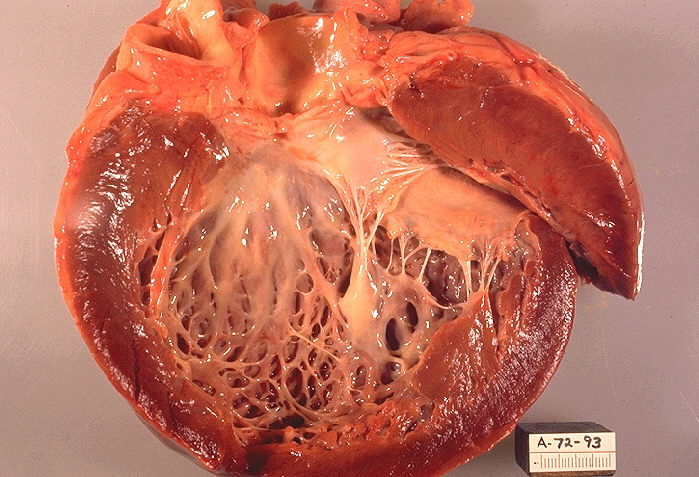
Pathology All four chambers dilate. Walls become thin. The pump fails: reduced EF (typically <40%) and global hypokinesis on echo. Systolic dysfunction is the dominant problem here.
Causes Idiopathic #1 (50%). Then: viral myocarditis (Coxsackie B), alcohol, doxorubicin (Adriamycin), Chagas disease (T. cruzi), peripartum cardiomyopathy (last month of pregnancy to 5 months postpartum), genetic (titin/TTN mutations most common familial form).
Memory "A, B, C, D, E" mnemonic: Alcohol, Beri-beri (thiamine deficiency), Coxsackie B myocarditis, Doxorubicin/drugs, Everything else (idiopathic, peripartum, Chagas, genetic).
Echo Dilated LV (and often all chambers), reduced EF, global hypokinesis, thin walls. No focal wall motion abnormalities (unlike ischemic cardiomyopathy).
Clinical Classic HF: dyspnea, fatigue, lower extremity edema. S3 gallop (volume overload). Can develop mitral and tricuspid regurgitation as chambers dilate. Risk of thrombus formation.
Treatment Standard HF management: ACEi/ARB, beta-blocker, diuretics. ICD if EF <35% for SCD prevention. Cardiac resynchronization therapy (CRT) if QRS >150ms with LBBB. Transplant for refractory cases.
Reduced EF S3 gallop Coxsackie B Peripartum ICD if EF <35% Global hypokinesis
Restrictive Cardiomyopathy
Normal/small chambers · Preserved EF · Severe diastolic dysfunction
Pathology Myocardial infiltration makes the walls stiff. Chambers are normal or small, EF is preserved, but diastolic filling is severely impaired. Elevated filling pressures back up into the venous system causing congestion despite a "normal pump."
Causes Amyloidosis #1 (AL from plasma cell dyscrasia, AA from chronic inflammation). Also: sarcoidosis, hemochromatosis, Loeffler endocarditis (eosinophilic), radiation fibrosis, glycogen storage diseases.
Echo Thickened walls with "granular sparkling" appearance (classic for amyloid). Small LV cavity. Preserved EF. Severe diastolic dysfunction. Dilated atria from elevated filling pressures.
Clinical S4 gallop (stiff ventricle). Elevated JVP. Kussmaul sign: JVP rises on inspiration (hallmark of elevated right-sided filling pressures). Peripheral edema, ascites. Dyspnea despite preserved EF confuses clinicians.
Key DDx vs. Constrictive Pericarditis: Both cause diastolic failure and Kussmaul sign. Distinguish by: BNP markedly elevated in Restrictive (suppressed in Constrictive), pericardial thickening on CT favors Constrictive, septal bounce on echo suggests Constrictive.
Amyloid #1 cause Granular sparkling Kussmaul sign Preserved EF High BNP S4 gallop
01B · Shape Map

Three Hearts, Three Shapes

Tap any card to open it in place. The SVG shows why EF differs across the three types.
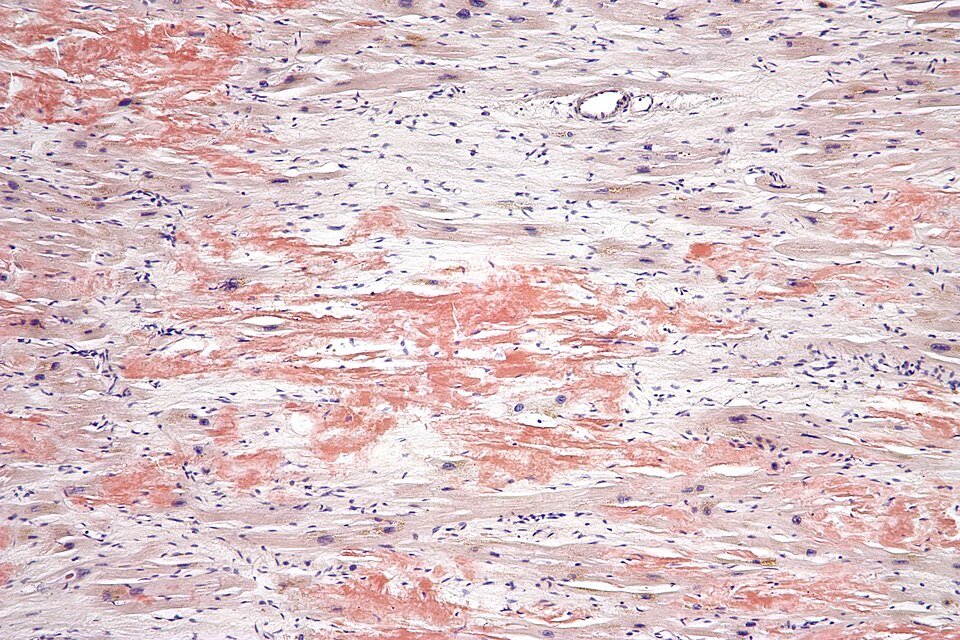
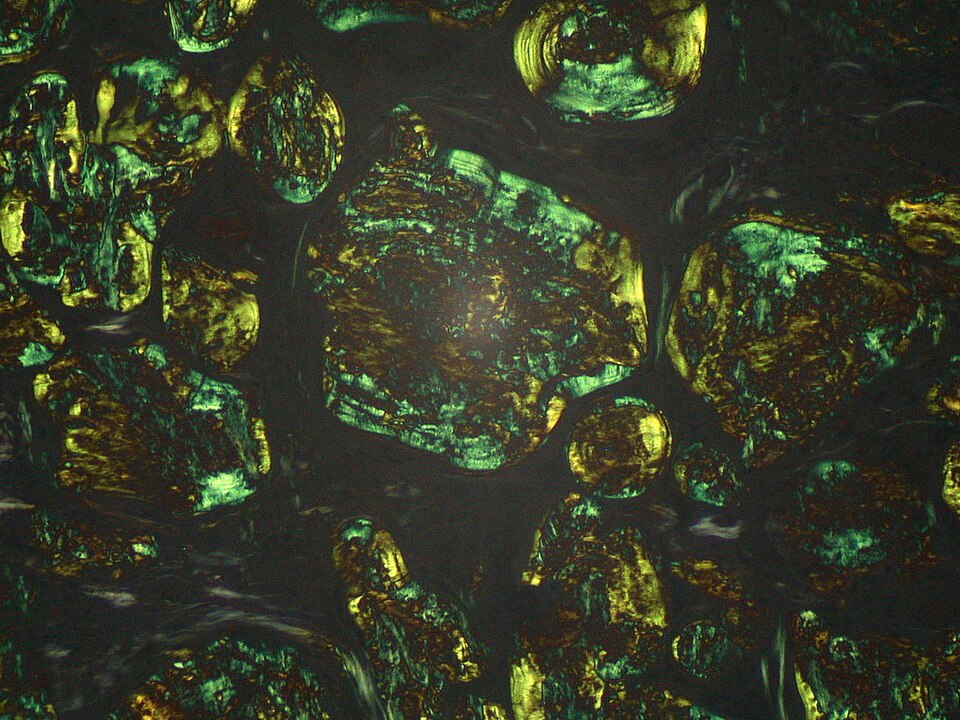
Cardiac amyloidosis histology
Amyloid in myocardium
Apple-green birefringence on Congo red
Apple-green birefringence
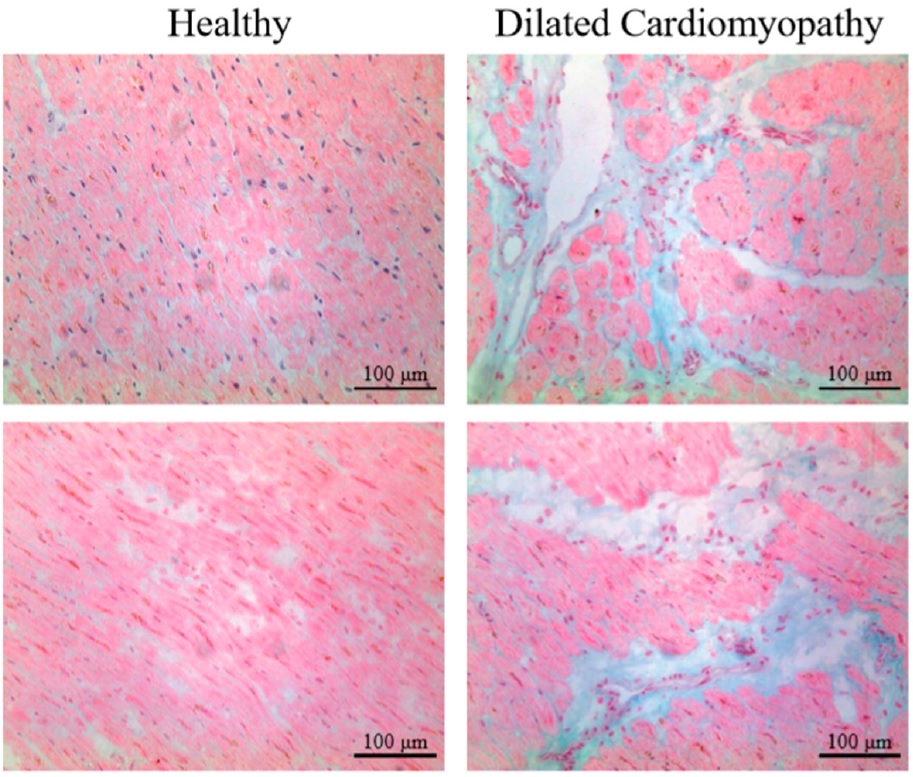
Interstitial fibrosis in DCM
DCM interstitial fibrosis
Dilated cardiomyopathy gross pathology
Dilated heart, gross
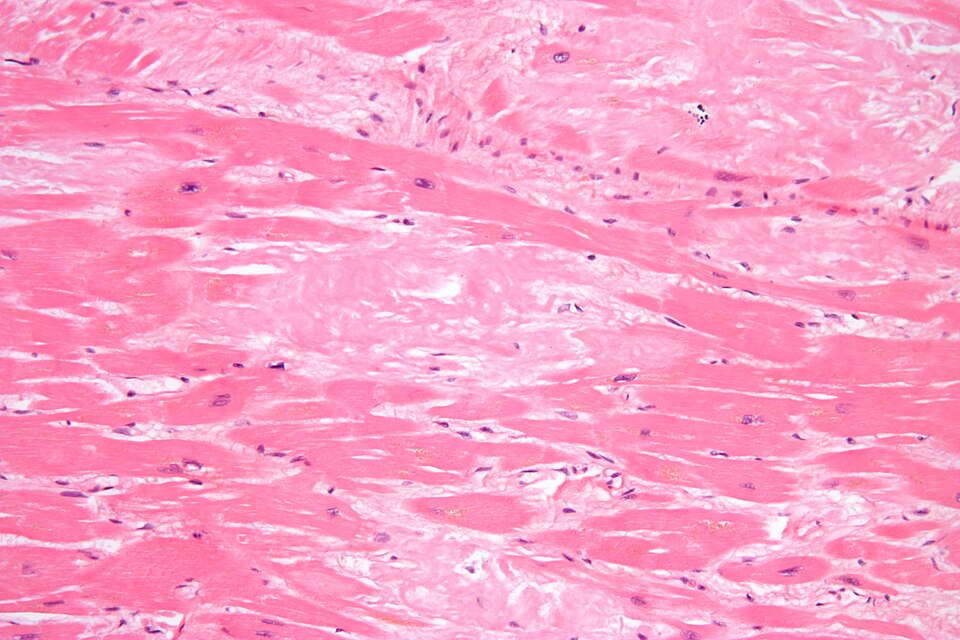
Cardiac amyloid high magnification
Amyloid, high power
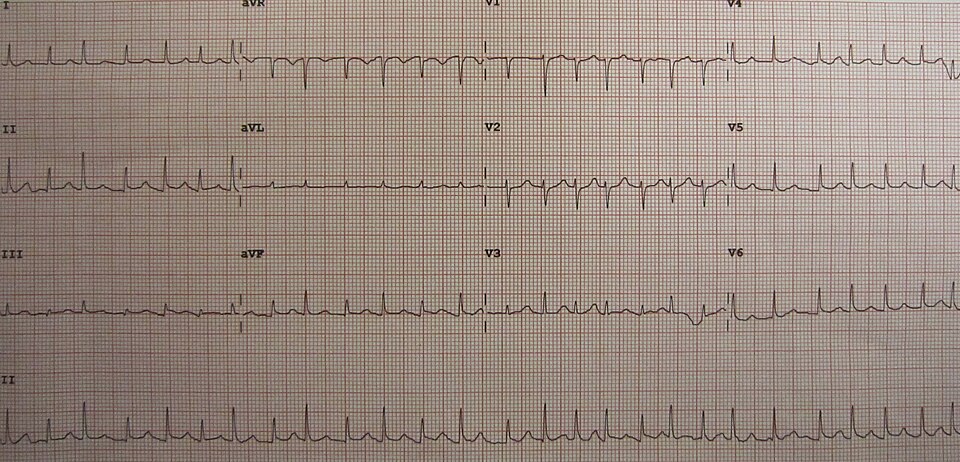
ECG electrical alternans
Low-voltage ECG
HCM Too thick EF: HIGH (60-80%) Can't RELAX · Diastolic Thick walls SAM DCM Too dilated EF: LOW (<40%) Thin walls Globe-shaped Can't SQUEEZE · Systolic RCM Too stiff EF: NORMAL (55-65%) Can't FILL · Diastolic Normal size Stiff walls CARDIOMYOPATHY: CHAMBER MORPHOLOGY
🧡
HCM
Hypertrophic
Tap to reveal

What's Wrong

Asymmetric septal hypertrophy · LV is too thick · can't relax · diastolic dysfunction · EF normal or HIGH

Key Genetics

Beta-myosin heavy chain (MYH7) or MYBPC3 · autosomal dominant · screen first-degree relatives

Board Murmur

Harsh LLSB murmur · LOUDER with Valsalva/standing (decreased preload) · softer with squat/leg raise · young athlete SCD

Treatment

Metoprolol or verapamil (slow HR, improve filling) · ICD (SCD prevention) · avoid vasodilators

Valsalva louder = HCM. Only murmur that does this.

😵
DCM
Dilated
Tap to reveal

What's Wrong

All 4 chambers dilated · thin walls · can't squeeze · systolic dysfunction · EF LOW (<40%)

ABCDE Causes

  • Alcohol
  • Beri-beri (thiamine def.)
  • Coxsackie B myocarditis
  • Doxorubicin (Adriamycin)
  • Everything else (idiopathic #1, Chagas, peripartum)

Treatment

ACEi + beta-blocker + diuretic · ICD if EF <35% · CRT if QRS >150ms + LBBB

S3 gallop + dilated chambers + low EF = DCM

🔳
Restrictive
Restrictive
Tap to reveal

What's Wrong

Stiff walls · can't fill · diastolic dysfunction · EF normal · elevated filling pressures in both ventricles

Causes

  • Amyloidosis (most common) · sparkling myocardium on echo
  • Sarcoidosis · granulomas
  • Hemochromatosis · iron deposits
  • Radiation, endomyocardial fibrosis

Clues

Kussmaul sign · low voltage on ECG but thick walls on echo · pericardial knock absent (not constrictive)

Low ECG voltage + thick echo walls = amyloid RCM

🏃
HCM Maneuvers
Board Trap
Tap to reveal

Worsen HCM (Louder)

  • Valsalva (decreases preload)
  • Standing up (decreases preload)
  • Amyl nitrite (decreases afterload)
  • Dehydration / diuretics

Improve HCM (Softer)

  • Squatting (increases preload + afterload)
  • Leg raise (increases preload)
  • Phenylephrine (increases afterload)
  • Fluid load

Rule: Smaller LV = worse obstruction = louder murmur. Bigger LV = less obstruction = softer.

Aortic stenosis does the OPPOSITE of HCM on maneuvers.

EF anchor: DCM = low EF (systolic). HCM and RCM = preserved EF (diastolic). The heart muscle still squeezes fine in HCM and RCM · the problem is filling (stiff/thick), not pumping.
02 · Murmur Logic

HCM vs. Aortic Stenosis

Both are harsh systolic murmurs. The maneuvers are how you tell them apart on the boards.

The one rule that wins the question: HCM is the ONLY murmur that gets louder with Valsalva or standing. Every other systolic murmur decreases with those maneuvers. If the question says Valsalva makes it louder, the answer is HCM.
Feature HCM Aortic Stenosis
Location LLSB RUSB
Radiation Apex (not carotids) Carotids
Valsalva / Standing LOUDER (decreased preload, smaller LV) Softer
Squatting / Leg Raise Softer (increased preload, larger LV) Louder
S4 gallop Present Present
EF Normal or High Normal early, low late
Pulse quality Bisferiens pulse (spike-and-dome) Pulsus parvus et tardus (weak, delayed)
Obstruction type Dynamic (varies with preload) Fixed (valve orifice)
Phenylephrine trick: Phenylephrine raises systemic vascular resistance (afterload). For HCM, increased afterload means more blood stays in the LV, increasing LV volume, which decreases the obstruction. This is counterintuitive: phenylephrine helps HCM and has no effect on the obstruction in AS.
Why HCM worsens with Valsalva: The strain phase of Valsalva increases intrathoracic pressure, reducing venous return. Less preload means the LV chamber is smaller. A smaller LV cavity lets the hypertrophied septum and the SAM-displaced mitral leaflet come closer together, creating more outflow obstruction. Same logic applies to standing: pooling in the legs reduces preload.
LVOT OBSTRUCTION IN MOTION Thick septum Mitral leaflet (SAM) Aortic outflow
Less preload (Valsalva, standing): the cavity shrinks, the anterior mitral leaflet swings into the septum, the tract narrows. Murmur gets LOUDER.
A harsh systolic murmur at the left sternal border gets LOUDER when the patient stands up. Which lesion is it?
Aortic stenosis
Hypertrophic obstructive cardiomyopathy
Mitral regurgitation
Standing pools blood in the legs and drops preload. A smaller LV brings the septum and the SAM leaflet together, tightening the tract. Only dynamic obstruction behaves this way. AS and MR both soften with reduced preload. Louder on standing or Valsalva equals HOCM, every time.
From the Attending

Stop memorizing maneuver lists. Ask one question: did the LV cavity get smaller or bigger? Smaller cavity (Valsalva, standing, dehydration) drives the septum into the SAM leaflet and the dynamic murmur screams. Bigger cavity (squat, leg raise, handgrip, fluids, phenylephrine) pulls them apart and it quiets down. HOCM is the one murmur that gets louder when you make the heart smaller.

02B · Signature Clues

The Words That Give It Away

When a stem drops one of these, the diagnosis is half written. They glow as you answer the walkthrough.

asymmetric septal hypertrophy systolic anterior motion of the mitral valve dynamic LVOT obstruction MYH7 / MYBPC3 sarcomere mutation autosomal dominant, young athlete sudden death S4 gallop, preserved EF louder with Valsalva and standing bisferiens spike-and-dome pulse low EF, S3 gallop, four-chamber dilation acetaldehyde toxicity, 12 beers daily postpartum new heart failure Coxsackie B viral prodrome doxorubicin cumulative dose cocaine, catecholamine excess wet beriberi high-output failure Chagas apical aneurysm, RBBB bronze diabetes, ferritin and transferrin saturation high titin TTN truncation LMNA conduction disease epsilon waves, fibrofatty RV, PKP2 granular sparkling myocardium low-voltage ECG with thick walls apical sparing global longitudinal strain Congo red apple-green birefringence abnormal serum free light chains tafamidis TTR tetramer stabilizer Tc-99m pyrophosphate cardiac uptake Loffler eosinophilic endomyocardial fibrosis mural thrombus, apical obliteration Kussmaul sign, septal bounce absent BNP high in restrictive, suppressed in constrictive Fabry alpha-galactosidase A, angiokeratomas Duchenne dystrophin deficiency scleroderma myocardial fibrosis athlete heart 13 to 15 mm gray zone alcohol septal ablation, first septal perforator mavacamten cardiac myosin inhibitor ICD for EF under 35 percent peripartum EF recovery and recurrence risk trastuzumab type II reversible cardiotoxicity doxorubicin type I dose-dependent toxicity Takotsubo apical ballooning, emotional stress cardiac sarcoid noncaseating granulomas, heart block hemochromatosis MRI T2 star under 20 ms phlebotomy and chelation reverse iron overload obesity volume overload plus OSA pulmonary hypertension disopyramide negative inotrope for HOCM avoid afterload reducers and diuretics in HOCM patisiran and inotersen silence TTR synthesis biatrial enlargement, restrictive filling
03 · Etiology Drill

Origins and Memory Hooks

Tap each card to reveal the detail. Know the cause, know the test, know the stain.

Autosomal dominant, 50% de novo mutations. Two most tested loci:

1. MYH7 (beta-myosin heavy chain): Motor protein of the thick filament. Mutations increase cross-bridge cycling, causing hypercontractility and compensatory hypertrophy. Generally presents earlier and more severely.

2. MYBPC3 (myosin-binding protein C): Regulatory protein that modulates cross-bridge kinetics. More common overall, but often later onset and milder phenotype. Both are sarcomere genes, reinforcing that HCM is a disease of the contractile apparatus.

Family screening protocol: Echo + genetic testing in all first-degree relatives. Echo every 12-18 months in at-risk adolescents during growth spurts (HCM can develop or worsen during rapid growth).

AD inheritance MYH7 · MYBPC3 Sarcomere proteins Screen first-degree relatives

A: Alcohol. Toxic dilated CMP. Dose-dependent. Abstinence can partially reverse it.

B: Beri-beri (thiamine/B1 deficiency). Wet beriberi = high-output heart failure. Causes peripheral vasodilation leading to high cardiac output, which eventually leads to dilated, high-output cardiomyopathy. Give thiamine first before glucose in any alcoholic presenting with HF.

C: Coxsackie B myocarditis. Viral infection directly damages myocytes. DCM can develop weeks to months after an acute viral illness. Associated with chest pain, troponin elevation, and new dilated LV.

D: Doxorubicin (Adriamycin). Cumulative dose-dependent cardiotoxicity. Causes free radical damage to cardiomyocytes. Lifetime dose limit. Dexrazoxane used for cardioprotection in certain cases.

E: Everything else. Idiopathic (most common, 50%). Peripartum (last month of pregnancy to 5 months postpartum, treat with standard HF therapy, may recover). Chagas disease (T. cruzi, apical aneurysm on echo is classic). Genetic/familial (titin/TTN mutations most common).

Alcohol B1 deficiency Coxsackie B Doxorubicin Idiopathic #1 Peripartum

Amyloidosis (most common cause): AL type (from plasma cell dyscrasia, think multiple myeloma) or AA type (from chronic inflammation). Diagnosis: Congo red stain shows apple-green birefringence under polarized light. Send serum/urine SPEP to look for monoclonal light chains in AL amyloid. Cardiac biopsy shows amyloid fibrils in the myocardium. Echo: granular sparkling appearance of the myocardium.

Sarcoidosis: Noncaseating granulomas infiltrate the myocardium. Can cause arrhythmias and conduction disease (heart block) in addition to restrictive physiology. Diagnosis: biopsy of accessible tissue (lung, lymph node, skin). Treat with steroids.

Hemochromatosis: Iron deposits throughout the body. Classic triad: bronze diabetes (iron in pancreas and skin), cirrhosis, cardiomyopathy (can be dilated or restrictive). Elevated transferrin saturation and serum ferritin. Prussian blue stain shows iron deposits. Treatment: therapeutic phlebotomy or deferoxamine.

Congo red stain Apple-green birefringence SPEP for AL amyloid Noncaseating granulomas Bronze diabetes Prussian blue (iron)
04 · Elimination Game

Work It Down

Apply the clues in order. Eliminate wrong answers. One correct diagnosis survives.

A 65-year-old man presents with progressive dyspnea over 8 months. Echocardiogram shows thickened walls with a "granular sparkling" appearance, small LV cavity, preserved EF at 65% (normal 55 to 70%), and diastolic dysfunction. The ECG shows low voltage despite the thick walls. BNP is 1,840 pg/mL (normal <100). Serum free light chains are abnormal. He has no history of hypertension severe enough to cause this degree of thickening.
Hypertrophic Cardiomyopathy
Restrictive CMP (Amyloid)
Dilated Cardiomyopathy
Constrictive Pericarditis
Granular sparkling + thickened walls + preserved EF = infiltrative process. HCM has asymmetric hypertrophy and preserved EF, but the granular sparkling texture is specific to infiltrative deposits (amyloid). HCM walls have disorganized myofibrils, not protein deposition, so no sparkling texture. DCM has dilated chambers with reduced EF. Both HCM and DCM are eliminated.
Elevated BNP + abnormal serum free light chains = Restrictive CMP, specifically AL amyloid. In constrictive pericarditis, BNP is typically normal or suppressed because the myocardium itself is healthy and not under wall stress. Markedly elevated BNP means the heart muscle itself is diseased. The abnormal free light chains point directly to AL amyloid from a plasma cell dyscrasia. Constrictive pericarditis is eliminated.
Restrictive Cardiomyopathy (Amyloid) confirmed.
Granular sparkling echo + preserved EF + high BNP + abnormal free light chains = AL cardiac amyloidosis. Next step: serum/urine SPEP, fat pad biopsy or cardiac biopsy with Congo red stain. Treatment depends on underlying plasma cell disorder.
Board-Style Walkthrough

25-Question Walkthrough

Original board-style vignettes. Shuffled, never-repeat, full Chicago explanations.