Which Nerve Feels That Tooth?

Three superior alveolar nerves carry the upper teeth, and the palate has its own wiring. Front teeth are ASA. Stop drifting to the molar nerve.

Board Vignette: A 10-year-old boy is brought to the office after he fell on the playground and chipped a front tooth one hour ago. On examination the maxillary right central incisor has a fractured crown with a pinpoint pink pulp exposure that is exquisitely sensitive to cold air. There is no palatal laceration and the gum on the roof of the mouth is normal. Which nerve is carrying the pain from this tooth?
A. Posterior superior alveolar nerve (PSA)
B. Anterior superior alveolar nerve (ASA)
C. Nasopalatine nerve
D. Greater palatine nerve
The anterior superior alveolar nerve (ASA) carries pulp sensation from the maxillary incisors and canine. A fractured front tooth with an exposed pulp drives pain straight up the ASA. The trap is the posterior superior alveolar nerve (PSA), the superior alveolar nerve most students name first, but the PSA serves the molars at the back of the arch. The nasopalatine and greater palatine nerves carry the soft tissue of the palate, not the pulp inside the tooth. Front maxillary tooth equals ASA. Every time.

The Tooth Map

Tap a tooth. Watch which superior alveolar nerve lights up and trace the signal up to the maxillary nerve and the trigeminal ganglion. Then flip to palate mode to separate pulp from the gum on the roof of the mouth.
Trigeminal ganglion Maxillary nerve V2 foramen rotundum Infraorbital canal Pterygopalatine fossa Nasopalatine anterior palate, incisive foramen Greater palatine posterior palate, greater palatine foramen Incisors and canine Premolars Molars
Tap any tooth
StartFront teeth are green (ASA), premolars are blue (MSA), molars are gold (PSA). Tap one and follow the signal up to the trigeminal ganglion.
ASA: incisors and canine
MSA: premolars
PSA: molars
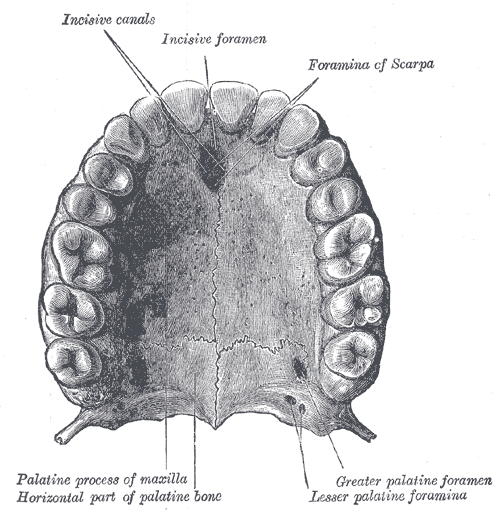
Permanent teeth of the upper dental arch seen from below
The real maxillary arch from below: incisors and canine in front (ASA), premolars in the middle (MSA), molars at the back (PSA). Tap to expand.
From the Attending

Three superior alveolar nerves, front to back. ASA for the incisors and canine. MSA for the premolars and the mesiobuccal root of the first molar. PSA for the molars. ASA and MSA branch off the infraorbital nerve inside the canal. PSA splits off V2 earlier, back in the pterygopalatine fossa. All of it is the maxillary nerve, V2. When a front tooth breaks, the pain is ASA. Do not drift to the molar nerve because it sounds familiar. Know your clues.

The Four Nerves

Three for the teeth, two for the palate, one for the face. Tap a tab.

ASA
MSA
PSA
PALATE

Anterior Superior Alveolar (ASA)

The front-tooth nerve, the one students forget
TeethMaxillary incisors and canine (pulp)
Comes offInfraorbital nerve, inside the infraorbital canal
ParentInfraorbital nerve → maxillary nerve (V2)
AnesthesiaASA or infraorbital block, or local infiltration over the incisor
Board trapDrifting to PSA because it is the superior alveolar nerve you remember first

Middle Superior Alveolar (MSA)

The premolar nerve, and it is often missing
TeethMaxillary premolars plus the mesiobuccal root of the first molar (pulp)
Comes offInfraorbital nerve, inside the canal
VariabilityAbsent in many people; then ASA or PSA covers the premolars
AnesthesiaMSA or infraorbital block
Board trapThe first molar is split: mesiobuccal root is MSA, the rest is PSA

Posterior Superior Alveolar (PSA)

The molar nerve, the one everyone names first
TeethMaxillary molars (pulp), except the mesiobuccal root of the first molar
Comes offMaxillary nerve (V2) in the pterygopalatine fossa
RouteEnters the posterior maxilla through the PSA foramina
AnesthesiaPSA block high behind the maxillary tuberosity
Board trapA PSA block can fail on the first molar mesiobuccal root, which is MSA

The Palate Nerves

Soft tissue on the roof of the mouth, not the pulp
NasopalatineAnterior hard palate mucosa and gingiva, lingual to the incisors
ExitIncisive foramen, behind the central incisors
Greater palatinePosterior hard palate mucosa and gingiva
ExitGreater palatine foramen, near the second or third molar
Board trapThese are gum, not pulp: a numb incisor is ASA, a numb palate behind it is nasopalatine
Alveolar branches of the superior maxillary nerve and the sphenopalatine ganglion
The anterior, middle, and posterior superior alveolar branches of V2 dropping into the maxilla to reach the tooth roots. Tap to expand.
From the Attending

Two questions split this whole topic. Is the problem the tooth or the gum? Tooth pulp is the superior alveolar nerves: ASA, MSA, PSA. Palatal soft tissue is the palatine nerves: nasopalatine in front, greater palatine in back. Then, which tooth? Front equals ASA, middle equals MSA, back equals PSA. Pulp versus palate, then front versus back. Answer those two and you never miss one of these.

Pulp vs Palate

The single distinction that defeats these questions. Each row shows the structure; the nerve, tissue, and exit start blurred. Predict each row, then tap to reveal.

read the structure, call the nerve, then tap that one row to check it

StructureNerveTissueExit
Incisors and canineAnterior superior alveolar (ASA)Tooth pulpOff infraorbital nerve in the canal
PremolarsMiddle superior alveolar (MSA)Tooth pulpOff infraorbital nerve in the canal
MolarsPosterior superior alveolar (PSA)Tooth pulpOff V2 in the pterygopalatine fossa
Gum behind the incisorsNasopalatinePalatal soft tissueIncisive foramen
Posterior palatal gumGreater palatinePalatal soft tissueGreater palatine foramen
Lower eyelid, side of nose, upper lipInfraorbitalFacial skinInfraorbital foramen
Distribution of the maxillary and mandibular nerves on the face
The maxillary nerve (V2) fanning across the midface. Its terminal infraorbital branch becomes pure facial skin once it leaves the foramen. Tap to expand.
From the Attending

Look at the third column. Three rows of pulp, two rows of palatal gum, one row of facial skin. The superior alveolar nerves never touch the roof of the mouth, and the palatine nerves never feel a toothache. The infraorbital nerve is the parent trunk on the face, and after it leaves the foramen it is pure skin: lower eyelid, side of the nose, upper lip. Mix up the columns and you pick the wrong answer. Keep them straight and the question answers itself.

Keep Going

Up one level
Anatomy
All anatomy deep dives.
Neuro
Cranial Nerves
The full CN V trigeminal deep dive: branches, exits, and deficits.
Home
All Topics
Pick another deep dive.
Medically reviewed by Fatima Ali, DO and Kaitlyn Cocuzzo, MD · Last reviewed June 2026
Bone Wizardry is an independent educational resource for visual learning in the medical sciences. It is not affiliated with, endorsed by, or sponsored by any licensing or examination board, contains no real or recalled examination questions, and does not guarantee any educational or examination outcome.