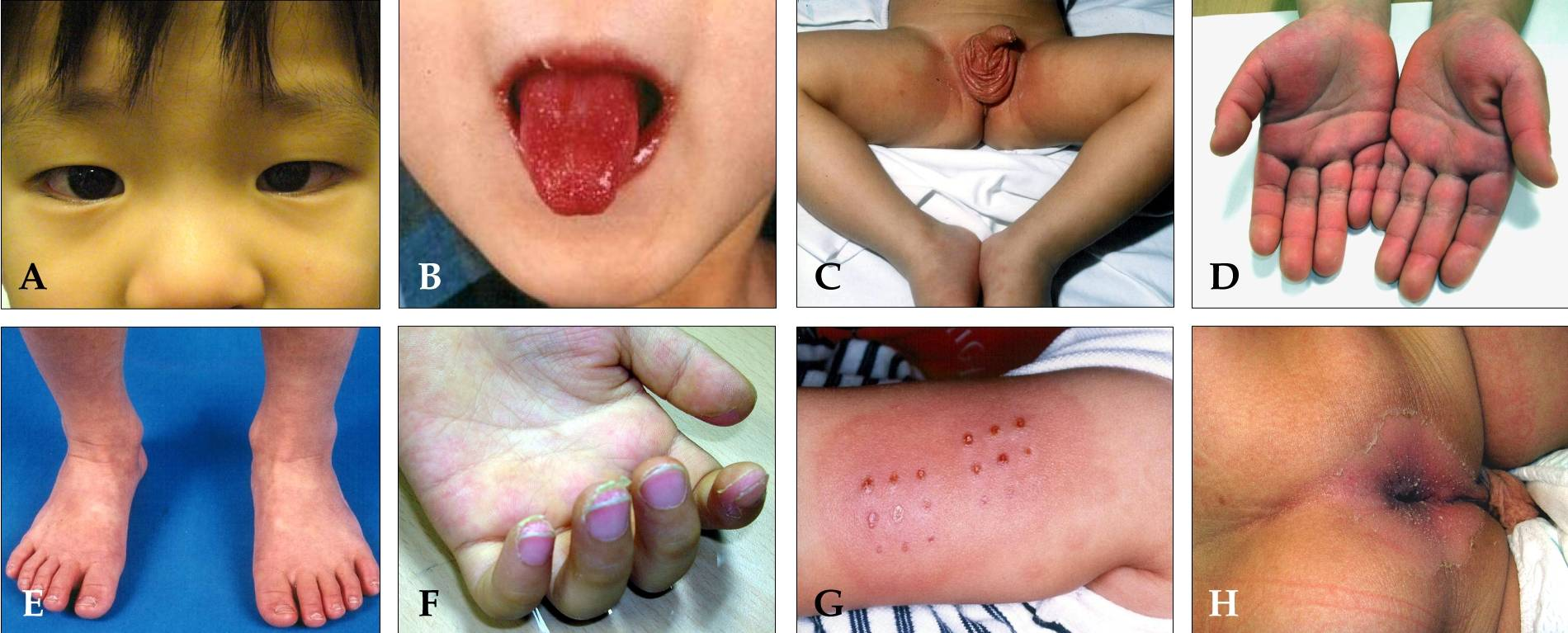
📷 Mucocutaneous findings of Kawasaki · tap to expand
📷 Manifestations and phase timeline · tap to expand
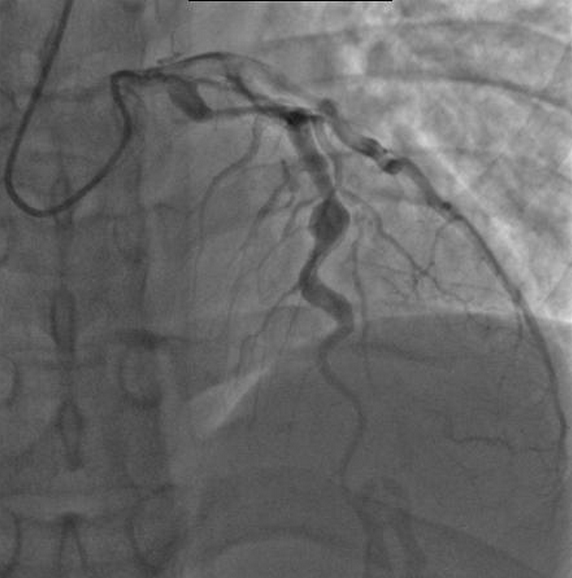
📷 Coronary aneurysm on angiography · tap to expand
❤️
Kawasaki Disease
A medium-vessel vasculitis that targets the coronary arteries of small children. Recognize it fast, get the echo, and give IVIG before day 10, or the heart pays the bill for life.
A 4-year-old boy is brought in on day 6 of a high spiking fever that has not broken with acetaminophen or ibuprofen. He is miserable and inconsolable. Exam shows red eyes with no discharge, a bright red bumpy tongue with dry cracked lips, red swollen palms and soles with a blotchy trunk rash, and one enlarged 1.8 cm node on the right side of his neck. Strep test and blood cultures are negative.
What is the single best diagnosis?
Scarlet fever
Kawasaki disease
Measles
Adenoviral infection
Pattern Recognition
Fever 5 Days, Plus 4 of 5
Kawasaki has no confirming blood test. The diagnosis is a checklist. Tap each card: front is the finding, back is why it happens and where the board hides the trap.
🧠The rule: Fever for at least 5 days plus 4 of 5 principal features. Mnemonic: CRASH and Burn.🔑Conjunctivitis, Rash, Adenopathy, Strawberry tongue and lips, Hands and feet, and Burn = the 5 days of fever.
C
Conjunctivitis
tap
Why it matters
Bilateral, nonexudative (no pus), with sparing of the rim around the iris (limbic sparing). Dry red eyes with discharge points to measles or adenovirus instead.
R
Rash
tap
Polymorphous
Any morphology except vesicles or bullae: maculopapular, scarlatiniform, or erythema multiforme like. Often starts on the trunk and the groin. Blisters point away from Kawasaki.
A
Adenopathy
tap
The rarest feature
Cervical node at least 1.5 cm, usually unilateral and single. This is the least common of the five, so its absence does not rule Kawasaki out.
S
Strawberry tongue
tap
Lips and mouth
Red cracked fissured lips, a strawberry tongue, and diffuse mouth redness. No oral ulcers or pseudomembranes: those belong to herpes or Stevens-Johnson.
H
Hands and feet
tap
Two-act finding
Acute: erythema and firm edema of palms and soles. Subacute (weeks later): periungual desquamation, the skin peeling off the fingertips and toes. The peel is the memory flag.
🔥
Burn (fever)
tap
The entry ticket
High spiking fever for at least 5 days, classically resistant to antipyretics, with marked irritability. No fever, no Kawasaki diagnosis (this is the one mandatory item).
Why the findings happen
Kawasaki is a vasculitis: an immune attack on the walls of medium-sized arteries. An over-firing immune system in a genetically susceptible young child inflames blood vessels and mucosal surfaces everywhere at once. That single idea explains the whole checklist.
Red eyes: inflamed conjunctival vessels dilate. No pus because it is inflammation, not infection.
Cracked lips and strawberry tongue: inflamed mucosal vessels → the lining swells, reddens, and splits.
Swollen red hands and feet: small-vessel inflammation → leaky capillaries → the firm edema and erythema of palms and soles.
The dangerous one, coronary arteries: the same vasculitis weakens the coronary artery wall → it balloons out into an aneurysm. That is the complication everything else is a warning sign for.
⚠
The findings do not all show up on the same day
Conjunctivitis, rash, and mouth changes come and go during the acute phase. A child can meet criteria over several days rather than all at once. Take a careful history of what the parents saw: a rash that already faded still counts. Kawasaki is a clinical diagnosis built over time, not a snapshot.
Timeline and Tests
Three Phases, One Echo Question
The illness moves through three phases. The peeling fingertips and the coronary aneurysms both live in the subacute window. The single most important test is the echocardiogram.
Week 1 to 2
Acute
High fever, red eyes, rash, cracked lips and strawberry tongue
Red swollen hands and feet, irritability
Highest risk of myocarditis
Week 2 to 4
Subacute
Fever resolves; periungual desquamation of fingers and toes
Thrombocytosis (platelets often 500k to over 1 million)
Coronary aneurysms form: highest risk of sudden death
Fever at least 5 days plus 4 of 5 CRASH features. There is no single confirming lab.
Why: Kawasaki is a clinical diagnosis. Tests support it; they do not make it.
Supportive labs
Elevated CRP and ESR, leukocytosis with left shift, normocytic anemia, later thrombocytosis, sterile pyuria, elevated transaminases, low albumin.
Why: these confirm a brisk systemic inflammation and are the tie-breaker when the picture is incomplete.
Echocardiogram (the best next step)
Get a baseline echo at diagnosis to measure the coronary arteries, then repeat at roughly 1 to 2 weeks and 4 to 6 weeks.
Why: coronary aneurysms are the whole reason this disease is dangerous. The echo finds them and tracks them.
Treat without waiting for proof
Start IVIG and aspirin as soon as Kawasaki is suspected on clinical grounds. Do not delay for a positive test that does not exist.
Why: the protective window for IVIG closes at about day 10. Waiting costs coronary arteries.
⚠
Incomplete (atypical) Kawasaki: the infant trap
Infants under 6 months often run a long fever with only 2 or 3 criteria, yet they carry the highest aneurysm risk of any group. Do not dismiss a prolonged fever just because the checklist is short. If fever lasts at least 5 days with high CRP or ESR and supportive labs, get the echo and treat as incomplete Kawasaki. The youngest, least classic patients are the ones who lose coronary arteries.
💚Board anchor: Kawasaki disease is the leading cause of acquired heart disease in children in developed countries. That single line is why the echo is never optional.
Stop the Aneurysm
IVIG plus Aspirin, and Why Both
Work through the three treatment decisions. Pick first, then read why. The order of reasoning is the whole point.
A 3-year-old meets criteria on day 6. Which therapy actually lowers the chance of coronary artery aneurysms?
IVIG is the aneurysm-sparing drug. A single 2 g/kg infusion, ideally before day 10, drops the aneurysm rate from about 25 percent untreated to roughly 4 to 5 percent. It works by dampening the runaway immune response that is attacking the vessel walls. Aspirin and antibiotics do not change the aneurysm rate; antibiotics do nothing for a non-infectious vasculitis.
Aspirin is normally avoided in children because of Reye syndrome. Why give it here?
Kawasaki is the named exception to the aspirin rule. High-dose aspirin in the acute phase calms inflammation; once the fever breaks, low-dose aspirin acts as an antiplatelet to keep clots from forming inside damaged or aneurysmal coronaries. The benefit outweighs the Reye risk here. Hold aspirin only if the child has active influenza or varicella. Aspirin does not shrink aneurysms; that is IVIG’s job.
It is now 48 hours after IVIG and the child is still spiking fevers to 39.5 C. Next step?
This is IVIG resistance. About 10 to 20 percent of children have persistent or recrudescent fever at least 36 hours after the first infusion. The standard move is a second dose of IVIG, with corticosteroids or infliximab added for refractory cases. IVIG resistance itself predicts higher aneurysm risk, so these children need closer echo follow-up.
The treatment logic in one chain
Vasculitis attacks coronary walls → IVIG quiets the immune attack → the wall is spared, so fewer aneurysms form. Meanwhile aspirin calms inflammation and keeps platelets from clotting on any vessel that did get damaged. IVIG protects the wall; aspirin protects the lumen. Give both, start early, and watch the coronaries with serial echoes.
⚠
Giant aneurysms change the plan
Coronary aneurysms 8 mm or larger are called giant aneurysms and carry the highest risk of thrombosis, stenosis, and myocardial infarction. These children need long-term antiplatelet plus anticoagulation (for example aspirin with warfarin) and lifelong cardiology follow-up. The size of the aneurysm on echo drives how aggressive the blood thinning gets.
Know the Lookalikes
The Mucocutaneous Lineup
Four febrile rashes that share a clue or two with Kawasaki. Tap each card to see the single feature that breaks the disguise.
🍓
Scarlet Fever
Strawberry tongue too, but a different cause
How to break it
Cause: group A strep, so the rapid strep or throat culture is positive.
Sandpaper rash, perioral pallor, Pastia lines in skin folds.
No conjunctivitis. Kawasaki has red eyes; scarlet fever does not.
Responds to penicillin. Kawasaki ignores antibiotics.
👶
Measles
Fever, rash, and red eyes as well
How to break it
The 3 C’s: cough, coryza, conjunctivitis, plus Koplik spots.
Conjunctivitis is exudative; Kawasaki is nonexudative.
Rash spreads cephalocaudal (face downward) after the prodrome.
Unvaccinated child or known exposure. No cracked lips or peeling hands.
💊
Stevens-Johnson
Mucositis and skin, but it erodes
How to break it
Drug or infection trigger days before (sulfa, anticonvulsants, mycoplasma).
Painful targetoid lesions with epidermal detachment, Nikolsky sign positive.
Mucosal erosions and bullae; Kawasaki lips crack but do not ulcerate.
Skin sloughs. Kawasaki rash never blisters.
🦠
Adenovirus
The most common mimic of all
How to break it
Fever, exudative conjunctivitis, pharyngitis, and rash.
Often has prominent cough and discharge; Kawasaki does not.
A positive respiratory viral panel argues against Kawasaki.
No cracked lips, no peeling hands and feet, fever usually breaks sooner.
💡The discriminator: the Kawasaki signature is nonexudative conjunctivitis (no pus) plus cracked lips or strawberry tongue plus red swollen or peeling hands and feet, all on a fever that will not quit. The lookalikes each break exactly one of those.
Prove It
Board Walkthrough
Original clinical vignettes, dealt 5 per round, answer choices shuffled, never repeating within a round. Tap a wrong answer first to see why it almost works, then read the glowing clues.
Medically reviewed by Kaitlyn Cocuzzo, MD and Fatima Ali, DO · Last updated July 1, 2026 at 10:03 PM ET
Bone Wizardry is an independent educational resource for visual learning in the medical sciences. It is not affiliated with, endorsed by, or sponsored by any licensing or examination board, contains no real or recalled examination questions, and does not guarantee any educational or examination outcome.