Four letters. Four junctions. One pattern that shows up on every OMM clinical practice.
scroll to learn the pattern
Challenge Yourself
A 32-year-old healthy woman presents for a wellness visit. Fascial screening reveals alternating rotation preferences at the four transitional zones. At the OA junction, the preferred rotation is:
Yes. In Zink's common compensatory pattern, the OA junction rotates LEFT. The full sequence is L-R-L-R from top to bottom. ~80% of healthy people show this pattern.
Good instinct · rotation direction matters here. Think of it like marching: you always start with the LEFT foot. The OA junction starts LEFT in the common pattern. Common = L-R-L-R. OA = Left.
Careful · that's a trap. The key word is "alternating." If all four zones rotate the same direction, that's non-compensatory, which means pathology (trauma, hospitalized patients). Compensatory patterns always alternate: L-R-L-R or R-L-R-L.
I see the logic, but Zink's patterns describe rotation preference, not restriction. Each junction prefers to rotate one direction more easily. In a healthy person, these preferences alternate. Alternating rotation = compensatory = normal.
The Pattern
Four Letters That Run the Whole Topic
Zink described how fascia rotates at four transitional zones in the spine. In most healthy people, these rotations alternate. That is the pattern you memorize. But there is a reason the body builds it this way, and the next screen is where it stops being four random letters.
MARCHING ORDER
L
R
L
R
L - R - L - R
Left foot first = Common pattern. Right foot first = Uncommon.
*
L-R-L-RMARCHING ORDER: Left-Right-Left-Right. You always start marching with your LEFT foot. Common pattern = marching. Uncommon = starting with the wrong foot (R-L-R-L). = Common pattern (80% of healthy people). Think marching order · left foot first, always alternating.
Common (80%)
L-R-L-R
~80% of healthy adults
OA: Left → CT: Right → TL: Left → LS: Right
"Marching order · left foot first"
Uncommon (20%)
R-L-R-L
~20% of healthy adults
OA: Right → CT: Left → TL: Right → LS: Left
"Started with the wrong foot"
*
BOTH patterns are compensatory · the key feature is alternating rotation. Common vs. uncommon just describes WHICH direction starts at OA. Both are found in healthy people.
The Reasoning
Why It Alternates At All
The letters are not random and they are not a rule someone invented. The body alternates for the same reason a stack of blocks alternates: so the thing on top stays balanced over the base.
Start with the picture
Your fascia is a continuous, interconnected web running skull to sacrum, so a rotational bias at one zone does not stay local: it shares tension with its neighbours. Here is how the osteopathic model reads the alternation. If every zone twisted the same direction, those biases would stack, and the head would tend to ride off the midline of the pelvis. Counter-rotate each zone against the one below it instead, and the twists cancel, so the eyes stay level over the base. It is a conceptual model rather than a measured force, but it reframes the four letters: alternation is not the pattern to memorize, it is the body keeping its own twist in balance.
Eyes level, weight stacked over the base. Each zone cancels the twist of the one below it. That is why a healthy spine alternates.
On Rounds
You
So I just memorize L-R-L-R and move on?
Attending
You can. You will also forget it by Thursday. Stack four blocks instead. Lean every block the same way and the top one walks off the table. Lean them in opposite directions and the top sits dead centre. That is the whole pattern. In the model, the body alternates so the head stays balanced over the pelvis.
You
So the letters are just the bookkeeping.
Attending
The letters are the receipt. The balancing is the reason. Memorize the receipt if you want the points. Understand the balance and you stop needing to.
The Deeper Reason
Built To Move Fluid
Balance is half the answer. The other half is why an osteopath cares about four fascial twists in the first place: those four zones sit on the body's four fluid pumps.
Zink did not study these zones to win a memorization game. He built them into his respiratory-circulatory model. Each transitional zone sits near one of the four transverse diaphragms, the horizontal fascial layers the model treats as fluid pumps for venous and lymphatic return. The respiratory diaphragm genuinely drives central venous return with every breath; the model extends the same logic to the other three. Its proposal: for the pumps to move fluid cleanly the fascia passing through them should be balanced, and alternating tension is balanced tension. So when a zone locks and the alternation breaks, the model holds that the diaphragm at that level stops gliding and fluid pools behind it.
OA · tentorium cerebelliThe cranial diaphragm, paired with the occipitoatlantal region and linked to venous drainage from the head.
CT · thoracic inletThe gateway for everything draining out of the head, neck, and arms. Free this first, or the rest backs up.
TL · respiratory diaphragmThe big one. Every breath drops it and drives the central fluid pump.
LS · pelvic diaphragmThe floor. Returns venous blood and lymph up from the legs and pelvis.
*
This is the part of the model the boards lean on lightly and clinicians lean on hard. You will be tested on the pattern. You will use the reason: a balanced, alternating fascial system keeps the four pumps gliding, and a broken one is where fluid stalls.
Anatomy
The Four Transitional Zones
Each zone is where the spine changes curvature. Fascia has a natural rotation preference at each junction.
Zone 1
OA
LEFT
Occipitoatlantal junction (skull ↔ C1)
Zone 2
CT
RIGHT
Cervicothoracic junction (C7 ↔ T1)
Zone 3
TL
LEFT
Thoracolumbar junction (T12 ↔ L1)
Zone 4
LS
RIGHT
Lumbosacral junction (L5 ↔ S1)
*
The pattern describes preferred fascial ROTATION at each junction · not sidebending, not flexion/extension. Fascial screeningThe provider places hands at each transitional zone and gently introduces rotation in both directions. The direction that moves more freely is the "preferred" rotation. tests which direction rotates more freely.
Interactive
The Spine Diagram
Click each zone to see its rotation. Toggle between common and uncommon patterns.
Left rotation Right rotation
!
Board Trap: Don't confuse "common" with "normal." BOTH common (L-R-L-R) and uncommon (R-L-R-L) are normal, healthy, compensatory patterns. The exam tests whether you know the ALTERNATING part matters more than which direction starts.
Clinical Pearl
When the Pattern Breaks
Non-compensatory = the pattern doesn't alternate. That's the red flag.
Non-Compensatory Pattern
If the fascial rotation at the four zones does NOT alternate · for example, L-L-R-L or R-R-R-L · that's a non-compensatory pattern.
This means the body has failed to self-correct and suggests:
Significant somatic dysfunction
Trauma (recent or old)
Hospitalized or decompensated patients
Structural pathology disrupting normal fascial compensation
*
Alternating = compensatory = healthy body self-correcting. Non-alternating = non-compensatory = pathology.
The direction (L-R-L-R vs R-L-R-L) just tells you common vs uncommon. The alternation tells you healthy vs sick.
!
Board Trap: A question describes a hospitalized patient with fascial rotation that does NOT alternate. They want you to recognize this as non-compensatory, not try to pick "common" or "uncommon." Non-alternating = neither. It's pathologic.
Same Idea, New Place
Structural vs Compensatory
A board favourite, and the exact spot the quiz trips people. When a spine has two curves, one is the problem and one is the body solving it. Here is how to tell them apart in three seconds.
Remember the whole point of compensation: keep the eyes level over the pelvis. A structural curve is fixed bone, wedged and rotated vertebrae that will not straighten. To keep you upright, the body adds a second curve above or below it, bending the opposite way. That second curve is compensatory (also called functional or nonstructural), and it exists for one job: balance. So it usually stays flexible, and when you remove the demand to stand up straight, it lets go. Leave it long enough and a compensatory curve can stiffen into a structural one, which is why you test rather than assume.
Standing, you see both curves: the rigid one up top, and the gentle one below that the body added to keep you level.
On exam
Structural
Compensatory
Forward bend (Adam's)
Curve and rib hump stay
Curve disappears
Flexibility
Rigid, fixed bone
Flexible, positional
Rotation
True rotation into the convexity, hence the rib hump
Little to none
Size
Usually larger, the primary curve
Smaller, just enough to balance
What it is
The problem
The body solving the problem
*
Tap any cell to reveal it. The single test that settles it: bend the patient forward. The curve that stays is structural. The one that vanishes was only ever compensating.
!
Board Trap: do not pick the curve by size alone. A compensatory curve can look impressive standing, then melt on forward bending. Rib hump that persists on Adam's test is the giveaway for the structural one, every time.
Retention
Memory Hooks
Stick these in working memory. Four letters is all you need.
*
MARCHING ORDER:L-R-L-R. You always start marching with your LEFT foot. Common pattern = marching. Uncommon = started with the wrong foot.
*
ALTERNATING = ALIVE: A healthy body compensates by alternating. If the pattern stops alternating, the body has given up. Think of it like walking · if both feet go the same direction, you're falling, not walking.
*
OA IS THE ANSWER: clinical questions almost always ask about OA. Common = OA rotated LEFT. That's the money answer. If they say "common compensatory pattern" and ask about OA, pick LEFT.
!
Board Trap: The question may describe the uncommon pattern without labeling it. If they say OA rotates RIGHT with alternating below · that's still compensatory, just the uncommon variant. Still healthy. Still normal.
Pattern Cards
Flip to Reveal
Each card covers one key concept. Tap to flip and check yourself before moving on.
👞
Common Pattern
What rotation starts at OA?
Common: L-R-L-R
OA rotates LEFT. Then CT right, TL left, LS right. Found in ~80% of healthy adults. Memory: marching order, left foot first. Both common and uncommon are compensatory because they alternate.
🔨
Uncommon Pattern
Mirror image of common. What starts at OA?
Uncommon: R-L-R-L
OA rotates RIGHT. Then CT left, TL right, LS left. Found in ~20% of healthy adults. Still compensatory because it still alternates. Memory: started with the wrong foot.
⚠
Non-Compensatory
What breaks the pattern?
Non-Alternating = Pathology
When zones do NOT alternate (e.g. L-L-R-L), the body has failed to self-correct. Seen in trauma, hospitalized patients, significant somatic dysfunction. The alternation is what matters, not the starting direction.
🅾
Type A Compensation
Which pattern does 80% of people have?
Type A = Common = L-R-L-R
Zink's "Type A" is another name for the common pattern. OA-Left, CT-Right, TL-Left, LS-Right. The left-first pattern. clinical questions may use "Type A" or "common" interchangeably.
📖
Four Zones
Name all four from top to bottom
OA → CT → TL → LS
OA: Skull to C1 ·
CT: C7 to T1 ·
TL: T12 to L1 ·
LS: L5 to S1. Each is a curvature transition. Fascia develops rotation preferences at these bends.
🔄
The Alternating Rule
What makes a pattern compensatory?
Alternating = Compensatory
The zones must switch directions at every level. L then R then L then R. If any two adjacent zones rotate the same direction, the pattern is non-compensatory. It does not matter which direction starts at OA.
💡
Tap each card to flip. The question is on the front. The rule is on the back.
Algorithm
Pattern ID Decision Tree
Walk through the algorithm. Tap each node to expand the branch.
Does the fascial rotation ALTERNATE at every transitional zone?
Tap to explore both branches
YES: it alternates
What direction does OA rotate?
OA rotates LEFT
Verify: CT right, TL left, LS right?
✅ Common Compensatory Pattern (L-R-L-R)
~80% of healthy adults. OA starts left, pattern alternates. Both common and uncommon are equally healthy. Board answer: "common compensatory."
OA rotates RIGHT
Verify: CT left, TL right, LS left?
✅ Uncommon Compensatory Pattern (R-L-R-L)
~20% of healthy adults. OA starts right, pattern alternates. Still compensatory and still normal. Board answer: "uncommon compensatory."
NO: two or more adjacent zones rotate the same direction
Check patient context: any trauma, hospitalization, or decompensation?
⚠ Non-Compensatory Pattern
The body has lost its ability to self-correct. Non-alternating rotation at the transitional zones = pathology. Common contexts: trauma, hospitalized patients, significant somatic dysfunction. This is the board red flag.
!
Decision trap: The tree asks about ALTERNATION first, not direction. Direction (left or right at OA) only matters after you confirm it alternates. A non-alternating pattern is never common or uncommon, regardless of where it starts.
Visual Reference
Spinal Anatomy
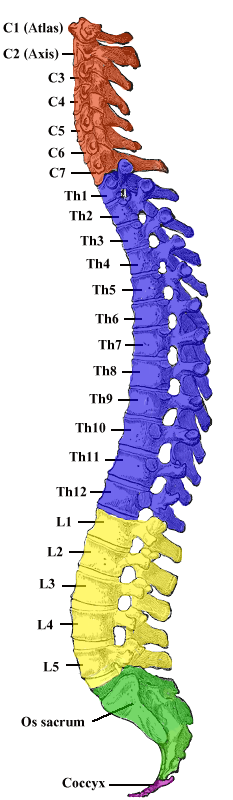
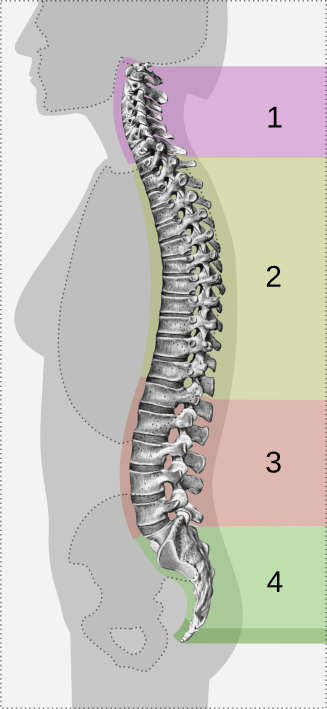
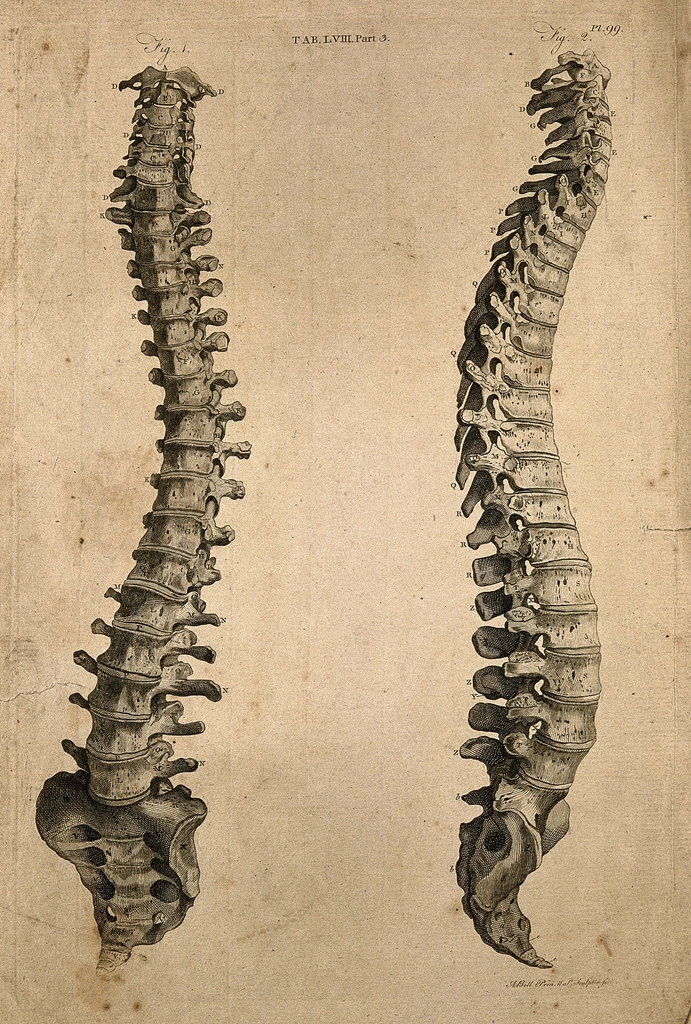
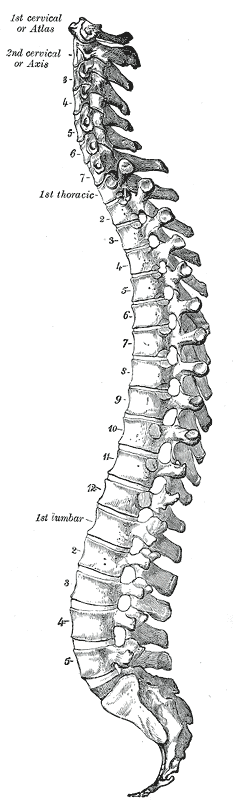
The four transitional zones in anatomical context. Tap any image to expand.
Four colours, four zones: each colour change is a Zink junction.
The four curves. A zone sits where one reverses into the next.
The lateral S-curve is why strain piles up at the transitions.
Lateral profile of the column and its compensating curves.
🔎
Each transitional zone sits where one spinal curve ends and the next begins. Fascia naturally develops rotation preferences at these bends because they carry the highest mechanical load transfer.
Memory Hooks
Tap Each Hook
Five trigger phrases. Each one unlocks a board-relevant rule. Tap to expand the memory.
💡
MARCHING ORDERLeft foot first = Common pattern (L-R-L-R). Right foot first = Uncommon (R-L-R-L). Both are healthy. Both alternate. You just started on different feet. The clinical medicine want you to know OA = LEFT in the common pattern.
The common pattern always starts its march with the LEFT foot at OA.
💡
ALTERNATING = ALIVEA healthy body distributes mechanical stress by switching rotation direction at every level. If it stops alternating, the body has lost its compensation mechanism. Non-alternating = non-compensatory = pathology. The alternation IS the health marker, not the specific direction.
Any pattern that alternates is compensatory, regardless of direction.
💡
OA IS THE ANSWERclinical questions almost always ask about OA because it is the top of the chain. Common pattern: OA = LEFT. Uncommon pattern: OA = RIGHT. If they say "common compensatory" and ask about OA, pick LEFT. If they say "uncommon" and ask about OA, pick RIGHT.
Common = OA left, uncommon = OA right.
💡
HOSPITALIZED = NON-COMPWhen the clinical medicine describe a patient who is hospitalized, post-trauma, or decompensated, and ask about their fascial pattern, the expected answer is non-compensatory. The body under major stress loses its ability to self-regulate through fascial alternation. Non-alternating in a sick patient = non-compensatory.
Trauma and critical illness kill the alternating pattern.
💡
THE MIRROR RULECommon (L-R-L-R) and uncommon (R-L-R-L) are exact mirror images. Every zone flips. If you memorize common, you know uncommon for free: just reverse every letter. Zone 1 = OA. Zone 3 = TL. Odd zones match OA. Even zones match CT. The pattern always alternates.
Uncommon is just common with every direction flipped.
!
Board Trap: A question describes a patient with fascial rotation at OA right and alternating below. They want you to classify this as the uncommon compensatory pattern, not pathologic. Starting right is fine. Not alternating is the problem.
Test Yourself
Clinical Questions
5 random questions from a bank of 10. All original. Worked explanations on every wrong answer.
Each question targets a different angle on Zink's patterns. Miss one? Scroll back up · the answer is on this page.
Medically reviewed by Fatima Ali, DO and Kaitlyn Cocuzzo, MD · Last updated July 1, 2026 at 10:03 PM ET
Bone Wizardry is an independent educational resource for visual learning in the medical sciences. It is not affiliated with, endorsed by, or sponsored by any licensing or examination board, contains no real or recalled examination questions, and does not guarantee any educational or examination outcome.