Anterior or posterior: one rule, two directions, one joint. Play the catch game to make both dysfunctions yourself, then run the board drill until neither catches you.
Quick Test 1 / 4
Nice. You can already feel the rule. Now let's anchor it with the anatomy and the chain.
The Joint Nobody Draws
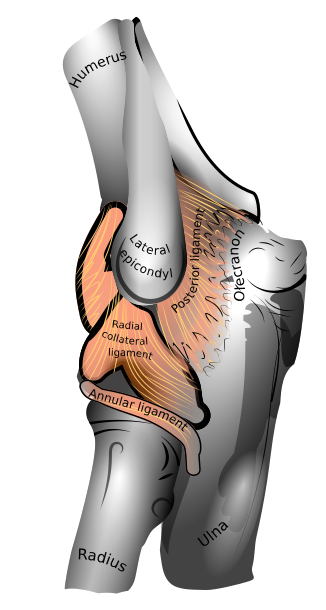
The forearm is two bones: the radiusLateral forearm bone, runs from elbow to thumb. It is the only bone of the forearm that rotates around the other. on the thumb side, and the ulnaMedial forearm bone, runs from elbow to pinky. Forms the main hinge of the elbow with the humerus. on the pinky side. The elbow has three joints stacked in one capsule. The one we care about is the proximal radioulnar joint: the radial head sitting in a notch on the side of the ulna, held there by a tiny ring called the annular ligamentRing of fibrous tissue that wraps around the radial head and holds it against the radial notch of the ulna. It is the gate. When it slips, the radial head pops out (nursemaid's elbow)..
When you turn a doorknob, your radius is what spins. The ulna stays still. The radius rolls over and under the ulna at this little proximal joint. The distal end of the radius drags your wrist along for the ride. If the radial head can't glide, the forearm can't rotate.
Save Maya. Choose your catch.
A girl is falling off a cliff. How you catch her decides which dysfunction you create. Pick palm-up for anterior, palm-down for posterior. Both paths run the full diagnostic chain.
Chapter One
She slipped.
Sunset on a cliff. Maya hangs by one hand. You're the only one close enough to reach her.
Chapter Two · The Catch
You grab her hand.
Time slows. Force has to travel somewhere. How does her palm meet yours?
Attending
Smash cut · Cabin · Candle
█
Maya is on the table. Rotate her forearm. Find the wall.
Rotate the forearm. Find the wall.
Watching
Chapter Three · Palpate
"Find the bump, doctor."
Drag your finger across her elbow. Tap when you feel the displaced head.
Drag (touch or mouse) across the elbow. Tap when you feel the bump.
Watching
Chapter Four · Name It
"Now name what you found."
Three lines. Lock them in. The rule does the rest.
Direction
Restricted Motion
Trace It
Approves
Reward · Card Drawn
ANTERIOR RADIAL HEAD
Trace ItPalm-up FOOSH
RestrictedPronation
BumpAnterior
"Named for ease. Where it went is where it goes free."
You felt it. Most don't. Keep the card.
The Directional Rule (one line)Dysfunction is named for the direction the head WENT: that direction is also where motion is FREE.
The opposite direction is the restrictive barrier (where you treat).
🔑
Anterior head loves Supination. Posterior head loves Pronation. A&S, P&P.
The Directional RuleThe name of the dysfunction = the direction the radial head WANTS to go = the direction motion is FREE.
The opposite direction is the restrictive barrier (where you treat).
🔑
Anterior head loves Supination (radius is stuck supinated, so supination is free, pronation is jammed). Posterior head loves Pronation. A & S, P & P.
Board Trap
Students name the dysfunction by where it's restricted. Wrong. Somatic dysfunctions are named by the direction of ease. If pronation is restricted and supination is free, the head is jammed anterior, not posterior. Name where it WENT, not where it can't go.
1 / 5
Two Dysfunctions, One Rule
Same joint. Opposite directions. Memorize one, the other is the mirror.
Palpation: radial head feels prominent on the posterior aspect of the elbow
Test
Anterior
Posterior
Pronation
Restricted
Free
Supination
Free
Restricted
Anterior glide of head
Free
Restricted
Posterior glide of head
Restricted
Free
Trauma history
Forced supination (palm-up fall)
Forced pronation (palm-down fall)
Diagnose It in Three Moves
Walk through one decision at a time. Pick before you reveal.
Step 1: Patient cradles their forearm. You ask them to turn their palm down. They wince and stop halfway. Which motion is restricted?
Pronation
Supination
Right. Palm-down means pronation. They couldn't get there, so pronation is the restricted motion.
Other way. Palm-DOWN is pronation (think pour soup, you'd spill it). Palm-UP is supination (you carry soup in a supinated hand).
Step 2: Pronation is restricted. Apply the directional rule. Where is the radial head jammed?
Anterior
Posterior
Yes. Restricted pronation = stuck supinated = head jammed anterior. The radius lives in the supinated position right now.
Re-check the rule. The dysfunction is named for the direction of ease. If supination is free, the head is anterior. If you said posterior, you were naming the restriction direction.
Step 3: Confirm with palpation. Where will the radial head feel most prominent?
Anterior aspect of elbow
Posterior aspect of elbow
Locked in. The patient has restricted pronation, a history of forced supination (palm-up fall), and now you feel a bony prominence on the anterior aspect of the elbow that the other side doesn't have. The radius is stuck in the supinated position, pushing the radial head forward. Diagnosis confirmed: anterior radial head somatic dysfunction. Treatment goal: restore pronation by moving the head posteriorly.
If it were posterior, supination would be the restricted motion. You already established pronation was the problem. Anterior dysfunction = anterior prominence on palpation.
Cross-Domain Connection
Wrist pain on the same side? Probably related. The radius drags the wrist with it. A jammed proximal radial head can cause ipsilateral wrist symptoms through force transmission down the radius and the interosseous membrane. Always check the wrist when the elbow is the chief complaint, and check the elbow when the wrist is.
2 / 5
Treatment, Three Ways
Same dysfunction. Three doors out. Direct techniques push to the restrictive barrier; indirect takes the patient AWAY from it.
Anatomy · What rotates
Ulna · still
Radius · rotates
Supination · Palm up
The radial head pivots in place at the elbow while the distal radius swings around the ulna. When the radius crosses over, the palm flips down. That crossover IS pronation.
Direct push to barrierIndirect away from barrier
Exam Read
Position the joint at the barrier. Patient pushes AWAY from it.
Correction Path
1
Take the forearm to the restrictive barrier (the direction motion stops).
2
Patient pushes back toward the direction of ease for 3 to 5 seconds, isometric.
3
Patient relaxes. Take up the new slack into more of the barrier.
4
Repeat 3 to 5 reps. Recheck motion.
High-Yield Detail
Anterior dysfunction
Physician pronates to barrier. Patient supinates against resistance.
Posterior dysfunction
Physician supinates to barrier. Patient pronates against resistance.
Treatment Action
Post-isometric relaxation lets the radial head glide to the side OPPOSITE the dysfunction.
Exam Read
Stack the joint to the barrier. Fast, short thrust through it.
Correction Path
1
Cradle the forearm. Thumb on the side opposite the dysfunction.
2
Stack to the restrictive barrier, loading the joint up to it.
3
Thrust through the barrier with a posterior or anterior glide vector. Short, fast, controlled.
4
Cavitation is nice, not required. Recheck motion.
High-Yield Detail
Anterior dysfunction
Thumb on posterior radial head. Stack pronation. Thrust posterior.
Posterior dysfunction
Thumb on anterior radial head. Stack supination. Thrust anterior.
Treatment Action
Fast, short, controlled thrust through the barrier (never INTO it).
Contraindicated over fracture, instability, infection, severe osteoporosis, or acute post-op. Pediatric nursemaid's elbow gets the reduction maneuver in the next section, not HVLA.
Exam Read
Position INTO ease until the tender point softens. Hold 90 seconds. Slow return.
Correction Path
1
Find the tender point. Light pressure, patient rates it 10/10.
2
Move the joint INTO the direction of ease until tender point drops to 2/10 or below.
3
Hold 90 seconds. Don't talk much. Let the tissue settle.
4
Return to neutral slowly. Fast return re-triggers the spasm.
High-Yield Detail
Anterior dysfunction
Tender point at anterior radial head. Position in supination + mild flexion.
Posterior dysfunction
Tender point at posterior radial head. Position in pronation + mild extension.
Treatment Action
Gentle, indirect, almost universally safe. Pick this for the acute, painful, or fragile patient.
3 / 5
Nursemaid's Elbow (Pulled Elbow)
Pediatric variant. Different mechanism, different fix. Same joint.
What actually happens
A toddler gets jerked up by the wrist or hand while their forearm is pronated. The annular ligament (the ring that holds the radial head against the ulna) is loose and stretchy in kids. The yank slides the head distally, and the annular ligament slips OVER the top of the radial head and gets pinched in the joint. Not a fracture. Not a true dislocation. A subluxation with the ligament in the wrong place.
Classic stem: A 3-year-old is brought in by a parent who lifted her over a curb by one hand. She is now refusing to use the right arm. She holds it close to her body, slightly flexed, with the forearm pronated. There is no swelling, no obvious deformity, and X-rays are normal.
That stem screams nursemaid's elbow. Age 1 to 4. Mechanism is the longitudinal pull on a pronated forearm. Position is the giveaway: pronated and slightly flexed, refuses to use it, no swelling, no fracture.
Don't Confuse
Nursemaid's elbow has no swelling and no point tenderness. If the stem mentions either, you're probably looking at a supracondylar fracture instead (especially after a fall onto an outstretched hand). Get the X-ray. Don't reduce a fracture by pronating it.
The reduction
Two techniques. Current evidence favors hyperpronation: faster, less painful, higher first-attempt success. Supination-flexion is the older method.
Hyperpronation Preferred
Cradle the elbow with one hand, your thumb over the radial head.
With your other hand, hold the wrist.
Hyperpronate the forearm (turn palm down, then keep going past neutral pronation).
You may feel or hear a small click. Child usually starts using the arm within 5 to 30 minutes.
Supination & Flexion Alternate
Cradle the elbow with one hand, thumb over the radial head.
Hold the wrist with your other hand.
Fully supinate the forearm.
Then flex the elbow all the way to the shoulder.
Listen and feel for a click. Same recovery window.
If reduction is successful, the child returns to using the arm normally within minutes (often before they leave the room). No splint or sling required. Counsel the parent: avoid yanking on the arm to prevent recurrence. Some kids are repeat customers; the ligament stays lax until about age 5.
🔑
Pulled Pronated. Etiology is a pull on a pronated forearm. Treatment is more pronation. Mechanism rhymes with treatment.
Nursemaid vs Adult Radial Head Dysfunction
Nursemaid's elbow is a true subluxation with the annular ligament in the wrong place. Adult anterior/posterior radial head somatic dysfunction is a positional restriction, not a subluxation. Nursemaid is a single-event mechanical fix. Adult somatic dysfunction is a movement pattern that responds to OMM.
Clinical reference images
English-captioned anatomy from Wikimedia Commons. Tap to enlarge.
Elbow joint · tap to expand
Annular ligament · tap to expand
Radius & ulna · tap to expand
In supination · tap to expand
In pronation · tap to expand
4 / 5
Board Drill
Five questions, drawn from a pool of eight. Refresh for a new set. Each wrong-answer breakdown ends with a one-line elimination rule.
0/5
Tap an answer above to start.
5 / 5
Medically reviewed by Fatima Ali, DO and Kaitlyn Cocuzzo, MD · Last updated July 1, 2026 at 10:03 PM ET
Bone Wizardry is an independent educational resource for visual learning in the medical sciences. It is not affiliated with, endorsed by, or sponsored by any licensing or examination board, contains no real or recalled examination questions, and does not guarantee any educational or examination outcome.