The building block for everything else. Core Tenets, TART, Acute vs Chronic, barriers, Fryette's Laws. Skip this and the rest of OMM is a blur.
★ Classic Board Stem
A 34-year-old pitcher presents with right shoulder pain that has gradually worsened over two years. On exam, the affected area feels cool, ropey, and fibrotic. He reports dull, achy discomfort but no pain with range of motion. An asymmetry in shoulder height is present but appears compensated. Which of the following best characterizes his somatic dysfunction?
✓ Correct.Clue chain: two years of symptoms → body had time to adapt → asymmetry is compensated. Tissue feels cool, ropey, fibrotic (not hot and boggy) → dull ache, not sharp → no pain with ROM. Vascular payoff: chronic SD builds neovascularization (new vessels over time). Acute SD instead shows venous congestion from fresh inflammation. Same shoulder hurt yesterday would be hot, boggy, sharp, uncompensated, and painful with motion.
The Blueprint
Four Core Tenets that define osteopathic medicine, plus the exam findings that prove a patient has somatic dysfunction.
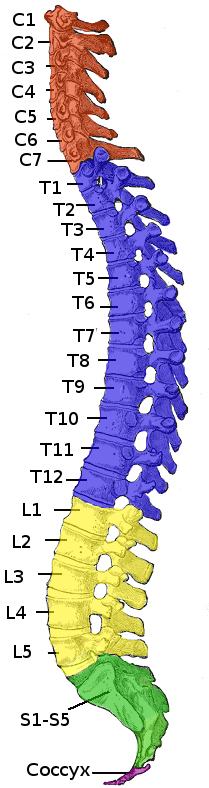
📷 Vertebral Column · tap to expand
These four tenets are the philosophical foundation of every OMM question. If the answer involves treating the whole patient, self-regulation, or structure-function, you're hearing these tenets applied.
TENET I
🧡
Body is a Unit
Structure, mind, and spirit as one
🔍 Treating one part affects the whole
tap for why it matters in clinical practice →
Why This Matters
The body isn't a bag of separate parts. Treating T4 can affect cardiac function via sympathetics. A visceral problem can show up as back pain. in clinical practice, this is why OMT is justified even when the chief complaint seems unrelated to the spine.
Viscerosomatic reflexes → somatic findings → OMT addresses the root → organ improves
TENET II
🌼
Self-Healing & Self-Regulation
Inherent capacity to heal and maintain homeostasis
⚡ The body wants to fix itself
tap for clinical application →
The Physician's Job
The DO doesn't heal the patient. The DO removes the obstacle so the body can heal itself. Somatic dysfunction is the obstacle. OMT is the removal. This tenet justifies a hands-on exam for patients with systemic illness.
This is why the structural exam matters. A compressed vertebra doesn't just hurt. It disrupts the nerves passing through it, the muscles it anchors, and the organs those nerves supply. Structure IS function. Function IS structure. They're the same thing.
Misaligned vertebra → nerve compression → organ dysfunction → disease
TENET IV
🔬
Rational Treatment
Treatment based on understanding the first three tenets
⚙ Tenets 1-3 inform all OMT decisions
tap to see the logic →
Why It's Tenet Four
Treatment must be rational, meaning based on understanding the first three tenets. You choose OMT because the body is a unit (I), it can self-heal (II), and structure affects function (III). Treatment without understanding these is just guessing. This tenet is the application of the other three.
Understand tenets 1-3 → apply rationally → treat the cause → not just symptoms
TART Criteria
The four signs you use to IDENTIFY somatic dysfunction. Any ONE of these is enough.
Tissue texture changes · Asymmetry · Restricted range of motion · Tenderness
Now use it. Which step in the Osteopathic Structural Exam uncovers each TART finding?
Step 1 of the Structural Exam: you just look at the patient. What are you looking for?
Visual inspection catches asymmetry (TART: A). You can see a raised shoulder, forward head posture, pelvic tilt. You can't feel temperature by looking, and you can't test motion just by looking.
That's step 2 (touch) or step 4 (motion). Step 1 is purely visual. Eyes only.
The skin drag test and red reflex are "special tests." What are they for?
Hint: they're not your main diagnostic tools.
Exactly. Skin drag test and red reflex tell you ACUTE vs CHRONIC, not which TART criteria are present. for clinical practice, you don't need deep detail on these tests, just know what they're for.
Restricted motion = motion testing (step 4). These special tests are about timing: is this SD fresh or long-standing?
✓ Structural Exam summary: Look → Touch → Special Tests (acute vs chronic) → Motion Testing (barriers)
Hot vs Cold
Acute and chronic somatic dysfunction look completely different. The board question tells you which one via the clinical description. Your job: read the clues.
📷 Spinal Column · lateral view · tap to expand
This entire comparison is extremely high-yield. Memorize every row. A single mismatched descriptor in a vignette tells you which type you're dealing with.
TissueHot · Boggy · Edematous
TendernessSharp pain
AsymmetryUncompensated (body hasn't adapted yet)
Range of MotionPain with ROM
Skin DragIncreased drag
VascularVenous congestion (acute inflammation)
TissueCool · Ropey · Fibrotic
TendernessDull ache
AsymmetryCompensated (body learned to adapt)
Range of MotionNo pain with ROM
Skin DragDecreased drag
VascularNeovascularization (new vessels formed)
The pitcher analogy: hurt your shoulder yesterday → hot, boggy, sharp, uncompensated. Same shoulder two years later → cool, ropey, dull, compensated, no pain with motion. Same structure, completely different story.
Now eliminate. Which somatic dysfunction am I describing?
Two patients walked in. I'll give you clues. Tap the one who gets eliminated by each clue. Last one standing is the right answer.
COOL: Cool & ropey, Old injury = compensated, Old vessels (neo), Less drag + dull pain
tap to reveal
🧠
Vascular Logic Hook
Acute = fire, veins get CONGESTED with the firefighters. Chronic = abandoned building, body builds NEW roads (neovascularization) to route around the damage.
tap to reveal
The Motion Stack
Three barriers define how far any joint can move. Only one of them is the problem in somatic dysfunction. Know the difference cold.
📷 Spinal Curvature · normal architecture · tap to expand
Shoulder Abduction Barrier Model
Tap each barrier to see where it falls and what happens if you go beyond it.
Select a barrier above to see where it sits in the range of shoulder abduction and what it means clinically.
Rotation Barriers · Top-Down
Toggle SD on. One arc collapses. That short red arc is the restrictive barrier.
SP points straight posterior. Both TPs symmetric. Rotation range is equal both directions (green arcs). No restrictive barrier.
Active vs Passive Motion
These definitions show up in question stems and answer choices. Know the difference instantly.
Type
Who moves it
Barrier it reaches
Active
Patient alone
Physiologic barrier
Passive
Physician assists
Anatomic barrier
Active = Alone (patient). Passive = Physician assists. Two letters, two seconds, never miss it again.
⚠ Board Trap: The restrictive barrier is NOT the physiologic barrier. When a patient has somatic dysfunction, their active motion hits the restrictive barrier FIRST, which is less than the normal physiologic barrier. The physiologic barrier is what they should be able to achieve. The restrictive barrier is what they can achieve with the SD present.
🧠
Three Barriers in Order
PAR: Physiologic (active, normal) → Anatomic (passive, hard stop) → Restrictive (SD present, less than physiologic). Remember PAR = the normal baseline. SD makes you below par.
tap to reveal
🛠
Anatomic Barrier = Bone
Beyond anatomic barrier → tissue damage (fracture/dislocation). Think of it as the bony wall you'd crash through. You can't push past anatomy without breaking something.
tap to reveal
🚫
Restrictive Barrier = The Problem
This is the ONLY barrier OMT cares about. OMT pushes toward or through the restrictive barrier to restore normal motion. Physiologic and anatomic barriers are just reference points. Restrictive is the target.
tap to reveal
Name It & Treat It
Fryette's Laws tell you whether side-bending and rotation go the same or opposite direction. Once you know that, you can name any spinal somatic dysfunction and pick direct vs indirect treatment.
📷 Vertebral Column · classic anatomy 1909 · tap to expand
Fryette's Laws apply ONLY to thoracic and lumbar spine. Not cervical. Not sacrum. Thoracic + lumbar only. This is extremely high yield.
Neutral Group → Opposite Directions
When a group of segments is neutral (not flexed, not extended), sidebending and rotation occur in opposite directions.
Example: T3-T6 N SR RL = Neutral, sidebent Right, rotated Left. Opposite = Type I = Group of segments.
Memory: Neutral → Not the same direction = Opposite. "No-same-outs."
Flexed/Extended Single Pair → Same Direction
When a single pair of segments is flexed or extended, sidebending and rotation occur in the same direction.
Example: T6 F SL RL = Flexed, sidebent Left, rotated Left. Same = Type II = Single pair, Flexed or Extended.
Memory: Flexed/Extended → everything goes the Same. "FES = Same."
Motion in One Plane Reduces Motion in Others
When a spine moves in one plane (e.g., extension), motion in other planes (e.g., sidebending) is decreased.
Example: Extension decreases how far the spine can sidebend. Flex it forward, and sidebend opens up again.
Lower yield than Laws I and II, but still tested. Usually in the context of why certain OMT positions work.
Fryette’s Laws Visualized
Toggle. Watch the rotation arrow flip while the sidebend stays the same.
Law I · Neutral GROUP. Sidebend and rotation go OPPOSITE directions. Sidebend left, rotate right. Classic: T3-T6 N SL RR.
Name the Dysfunction
Work through the logic. Same steps every time.
A vertebra's right transverse process is more posterior than the left. What does this tell you about rotation?
Imagine the vertebra as a spinning top. Which way is it turned?
Right. When a vertebra rotates right, the right TP swings posteriorly and becomes more superficial (you'd feel it more easily on a prone patient). Left TP goes anterior and deeper. Posterior TP = rotation toward that side. Always.
Posterior TP = that side is rotating toward you. Think of the vertebra spinning: if it rotates right, the right TP sweeps backward (posterior). The left TP goes forward (anterior).
✓ Right posterior TP → rotated RIGHT. Left posterior TP → rotated LEFT.
The asymmetry resolves when you put the patient in a sphinx (extended) position. What is the ease?
Somatic dysfunctions are named for the position they PREFER (the ease).
Exactly. When the asymmetry resolves in a position, that position IS the ease. Sphinx = extended. The segment prefers extension. That makes it an EXTENDED dysfunction.
Sphinx position = extended. When the asymmetry resolves in extension, the vertebra prefers extension. We name it extended.
✓ Ease = Extension + Right Rotation. Now apply Fryette Law II (single segment, flexed or extended → same direction).
Single vertebra, extended, rotated right. By Fryette's Law II, what direction does it sidebend?
Law II: single pair + flexed or extended = sidebend and rotation in the SAME direction. Rotated right → sidebent right. Full name: T6 Extended, Rotated Right, Sidebent Right (T6 ERSR).
Law II is for single segments that are flexed or extended. Same direction. Rotated right = sidebent right. Law I (opposite) only applies to neutral GROUPS.
✓ T6 Extended Rotated Right Sidebent Right. You just named a somatic dysfunction. That's the whole process.
Direct vs Indirect Treatment
Flip the cards. One goes toward the problem. One goes away from it.
DIRECT
🎯
Toward the Bind
Directed into restriction
→ Away from ease
tap for example →
Direct Example
T2 Extended SL RL. Ease = Extended SL RL. Bind = Flexed SR RR. Direct technique: position the patient into Flexion + Sidebent Right + Rotated Right.
Ease → opposite = Bind → Direct goes there
INDIRECT
😊
Toward the Ease
Exaggerates preferred position
→ Away from bind
tap for example →
Indirect Example
Same T2 Extended SL RL. Indirect technique: exaggerate the ease → position into Extension + Sidebent Left + Rotated Left. Let the tissue release from the comfortable side.
Ease → go further into ease → Indirect goes there
Direct → Don't let it be comfortable. Go into the restriction. Indirect → It gets what it wants. Go into the ease.
Board Walkthrough
Five full clinical vignettes per round. Choices shuffle. Right-click or long-press to cross out distractors. Every wrong answer teaches why.
The Toolkit
Facet orientation governs what each region can do. Muscle contractions define how OMT works. Treatment classification tells you what bucket every technique lives in. Know these and you stop memorizing; you start predicting.
Facet Orientation by Region
Every technique is exploiting facet geometry. Three regions, three orientations. The mnemonic: BUM, BUL, BUM. Thoracic is the odd one out.
Cervical: BUM
Facets oriented Backward, Upward, Medial. This geometry allows a lot of rotation but limits pure flexion/extension.
BUM = Backward Upward Medial. Cervical spine lets you look over your shoulder because of this orientation.
Both Cervical and Lumbar = BUM. Thoracic = BUL. If you only remember one exception: Thoracic is Lateral.
Thoracic: BUL
Facets oriented Backward, Upward, Lateral. The Lateral orientation is what makes thoracic different from both cervical and lumbar.
BUL = the one exception. Lateral instead of Medial. This favors rotation in the thoracic spine. Think: thoracic is the most rotatable region of the spine.
Board trap: thoracic facets favor rotation because they are lateral. Lumbar facets LOCK rotation because they are medial. Opposite effects from a one-letter change.
Lumbar: BUM
Facets oriented Backward, Upward, Medial. Same letters as cervical but completely different mechanical result: medial facets lock rotation in the lumbar spine.
Lumbar BUM locks rotation. This is why you don't get much rotation in the lower back. The medial orientation mechanically blocks it.
⚠ Board Trap: Cervical and Lumbar both = BUM, but they don't behave the same. In the cervical spine, BUM allows rotation due to overall geometry. In the lumbar spine, BUM locks it. Same mnemonic, opposite result. Context matters.
Muscle Contractions: How OMT Actually Works
Every OMT technique uses one of these contraction types. Flip the cards. Know which technique uses which.
ISOMETRIC
⚖
Equal Force
Patient = Operator force
No movement occurs
tap →
MET Technique
Muscle Energy Technique uses isometric contractions. Patient pushes against operator's resistance with equal force. No movement, and the effort fatigues the muscle, releasing the SD after relaxation.
Patient force = Operator → no motion → post-isometric relaxation → barrier releases
ISOLYTIC
💥
Operator Overpowers
Operator > Patient force
Controlled lengthening
tap →
Breaks Fibrosis
Operator overpowers the patient's contraction, forcibly lengthening the muscle. Used to break up fibrotic/chronic tissue. The patient is trying to resist but the operator wins. More aggressive than MET.
Operator force > Patient → forced lengthening → fibrosis disrupted
ISOTONIC
🏃
Same Tension
Movement happens
Constant force, changing length
tap →
Constant Load
Isotonic = same (iso) tension (tonic) throughout the motion. The force stays constant while the muscle length changes. This includes both concentric and eccentric subtypes below.
Constant tension → muscle shortens (concentric) or lengthens (eccentric) → movement occurs
CONCENTRIC
🐻
Shortens
Subtype of Isotonic
Origin and insertion approach
tap →
Classic Contraction
The muscle shortens as it contracts. Origin and insertion move toward each other. Think: bicep curl brings hand to shoulder. This is what most people mean by "muscle contraction."
Contraction → origin and insertion approach → joint flexes/extends
ECCENTRIC
🌊
Lengthens Under Load
Subtype of Isotonic
Controlled lengthening while resisting
tap →
Braking Contraction
The muscle lengthens while still contracting (resisting the load). Think: slowly lowering a weight. The bicep is active but the arm is straightening. This is the hardest on muscle fibers, which is why DOMS hits hardest after eccentric work.
Load exceeds force → muscle resists but lengthens → controlled motion
Sort the Treatments
One technique at a time. Tap the correct quadrant. Direct vs Indirect. Active vs Passive. Table 1.4 encoded.
Sort this technique:
Loading...
Treatment Planning: Red Light / Green Light
Certain patient profiles change what you can do. Two decisions, every time.
A 78-year-old with known osteoporosis has a T6 somatic dysfunction. She reports the pain is worse with movement. Which treatment approach is safest?
Think about the absolute contraindications first, then match to the mechanism.
Exactly. Osteoporosis and metastatic cancer to bone are absolute contraindications to HVLA. The reason is simple: a thrust on bone that can't handle it = pathologic fracture. Indirect techniques avoid force entirely. They work by positioning, not by thrusting. This distinction shows up directly in clinical practice: "which patient gets HVLA" vs "which patient does not."
Osteoporosis is an absolute contraindication to HVLA. A high-velocity thrust into fragile bone can cause a pathologic fracture. Even if MET feels "safe," direct techniques still apply force to the restriction and carry higher risk. Indirect techniques are the go-to for fragile patients.
✓ Osteoporosis + Metastatic bone disease = NO HVLA. Go indirect. This is absolute.
The sequence rule: when treating the thoracic spine AND ribs in the same session, which do you treat first?
Right. Thoracic spine before ribs. The rib heads articulate with the thoracic vertebrae, so correcting thoracic dysfunction first removes a driver of rib dysfunction. If you do ribs first, you may just be resetting the same problem. Same logic: upper thoracic before cervical. Treat the root before the branch.
Thoracic goes first. Rib heads attach to thoracic vertebrae. If the vertebra is dysfunctional, it's often driving the rib problem. Treating the rib first without fixing the driver just sets you up to redo the work.
Cervical = BUM, Thoracic = BUL, Lumbar = BUM. The L in BUL stands for Lateral AND it's the one that lets the thoracic spine rotate. Medial locks. Lateral unlocks. One letter, opposite behavior.
tap to reveal
⚖
Iso = Same, Lytic = Break
Isometric = same length (no movement). Isotonic = same tension (movement okay). Isolytic = operator breaks the patient's contraction by force. The "lytic" suffix means destruction/breaking, same as "hemolytic" = breaking red blood cells.
tap to reveal
🚫
HVLA Absolute Contraindications
Osteoporosis, metastatic cancer to bone, acute fracture, Down syndrome (atlantoaxial instability), severe rheumatoid arthritis (C1-C2). The common thread: bone or ligament that cannot absorb a thrust. Any fragile structural element = no HVLA.
tap to reveal
📄
Treatment Sequence Rules
Always treat proximal before distal: Thoracic before Ribs. Upper thoracic before Cervical. Structural before visceral. And: elderly/fragile = indirect techniques first, direct (especially HVLA) last or not at all. These rules are explicitly tested.
tap to reveal
📋
Counterstrain is Indirect + Passive
Counterstrain: physician moves the patient to the position of ease (indirect = toward ease, passive = physician does the moving). MET is Direct + Active (patient contracts toward bind). HVLA is Direct + Passive (physician thrusts, patient relaxes). Know these three cold.
tap to reveal
Medically reviewed by Fatima Ali, DO and Kaitlyn Cocuzzo, MD · Last updated July 5, 2026 at 8:04 PM ET
Bone Wizardry is an independent educational resource for visual learning in the medical sciences. It is not affiliated with, endorsed by, or sponsored by any licensing or examination board, contains no real or recalled examination questions, and does not guarantee any educational or examination outcome.
Mechanism contrast.
Compare the objective finding with the nearest distractor, then commit to the answer that explains the HPI, exam, and objective result together.
Elimination checkpoint.
Reject any option that explains only the symptom while missing the discriminating objective finding.