TRAP. Pillrolling tremor at rest. A dying patch of substantia nigra that took the dopamine with it. Levodopa walks the patient back from the cliff. Lewy bodies are the receipt.
TRAPSubstantia NigraLewy BodiesLevodopa
Opening case · 67 yo Man
A 67-year-old retired carpenter is brought in by his daughter. Over the past nine months his right hand has been rolling pills when it rests in his lap, but the shaking quiets the moment he reaches for a coffee cup. On exam, his right wrist gives a ratchety, cogwheel resistance when you bend it. His face is flat. He takes small, shuffling steps and barely swings his right arm.
What is the single best diagnosis?
Lock it in: Parkinson disease.
The cluster is asymmetric rest tremor that vanishes with action, cogwheel rigidity, masked facies, and a shuffling gait with decreased arm swing. That is TRAP, with the asymmetric onset that screams idiopathic Parkinson over every imitator. Essential tremor shakes when the hand is doing something, not when it rests. Huntington brings chorea and a strong family history, not a flat face. Wilson hits in the twenties with a Kayser-Fleischer ring. Drug-induced parkinsonism mimics this picture but appears symmetrically within weeks of starting a dopamine-blocking drug, and our carpenter is on none.
The Clues
Four ways the stem hands it to you
Any one of these in a vignette is enough. Two of them is the answer. Stop reading at the second clue and pick Parkinson.
Clue 01
TRAP cluster
Tremor at rest, Rigidity (cogwheel), Akinesia or bradykinesia, Postural instability with shuffling gait. Three of the four is the floor for a clinical diagnosis.
Clue 02
Pillrolling at rest
A 4 to 6 Hz thumb-against-finger tremor that shows up when the hand sits still and improves the second the patient grabs for something. Asymmetric. Worse on one side first.
Clue 03
Lewy bodies on path
Round, eosinophilic, cytoplasmic inclusions of aggregated alpha-synuclein inside surviving neurons of the substantia nigra. Pathognomonic for idiopathic Parkinson.
Clue 04
Levodopa walks them back
The motor signs improve dramatically on levodopa. If a patient's symptoms do not budge on a real dose, the diagnosis was probably not Parkinson to begin with.
The Mnemonic
TRAP, one letter at a time
Tap each letter. The cluster locks in faster when you say it out loud.
T · Tremor at rest
Pillrolling, 4 to 6 Hz, asymmetric, present when the limb is supported and at rest. Quiets the second the patient reaches for something. Goes away in sleep.
Stem giveaway: "rolling a pill between thumb and index finger" or "tremor disappears when she reaches for the cup."
The Anatomy
Substantia nigra, healthy vs dying
Axial cross-section through the midbrain at the level of the superior colliculi. Toggle the state.
Healthy. The substantia nigra pars compacta is jet black on a fresh midbrain section because its dopaminergic neurons are packed with neuromelanin. Two crescent strips sit on top of the cerebral peduncles, projecting forward into the striatum.
The Pathology
Lewy body, photo and schematic
Real H&E on the left so you know what it looks like under the scope. Schematic on the right so you know what is happening inside.
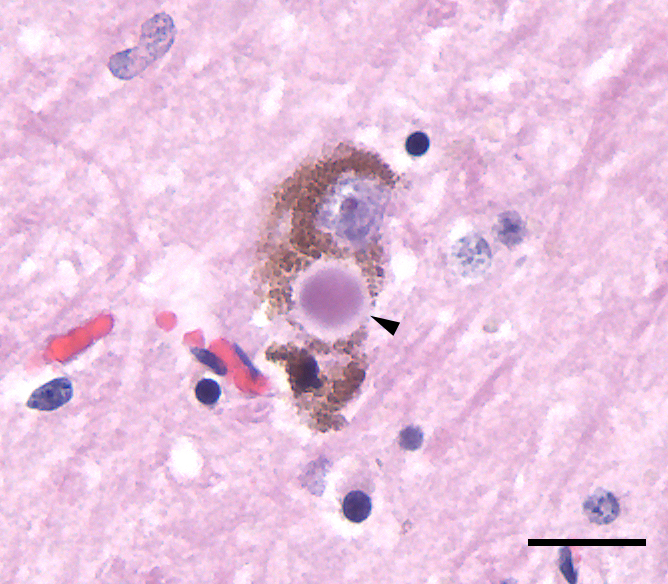
Real photo · H&E
Substantia nigra neuron with a round, eosinophilic Lewy body in the cytoplasm. Public domain · Wikimedia Commons.
Schematic · idealized
What you are looking at: aggregated alpha-synuclein clumps in the cytoplasm of a surviving substantia nigra neuron. On H&E it reads as a round, pink, eosinophilic ball with a pale halo, sitting beside a pushed-aside nucleus. Idiopathic Parkinson disease cannot leave without depositing one of these.
The synucleinopathies family: alpha-synuclein is THE protein that links three diseases. Parkinson disease (Lewy bodies in substantia nigra), Lewy body dementia (Lewy bodies in cortex too, which is why the cognitive piece arrives early), and multiple system atrophy (alpha-synuclein in glial cells instead of neurons, with early autonomic failure). Same protein, different real estate, three different clinical pictures.
The Cascade
Alpha-synuclein, monomer to Lewy body
Five stages from a normal folded protein to the toxic inclusion that kills the neuron. Tap a stage.
Monomer. The native folded form. Alpha-synuclein normally lives at the presynaptic terminal of healthy neurons, where it helps recycle synaptic vesicles. In this state it is harmless. Then a hit (genetics, oxidative stress, a misfolding seed) flips one molecule into a wrong shape, and the cascade begins.
Why it matters: the protein that becomes the Lewy body starts as a normal, useful piece of the synapse. Parkinson is what happens when housekeeping breaks.
The Gait
Upright vs stooped, side by side
Two figures, same scale. The Parkinson silhouette is what a clinician sees walking down the hallway.
Normal
Head over hips, trunk upright
Arms swing through full stride, opposite to leg
Heel strike with regular step length
Smooth turn on a single pivot
Parkinson
Stooped trunk, head pulled forward
Arms flexed at elbows, decreased or absent arm swing
Small shuffling steps, festinating (speeding up)
Turns in many tiny steps (en bloc), retropulsion on pull test
The Treatment
Treatment ladder
Climb from the cleanest motor win to the heavier hardware. Tap a rung.
Levodopa crosses BBB
>
Brain converts it to dopamine
>
Carbidopa blocks peripheral conversion
Why it worksDopamine cannot cross. Levodopa can.
Send the precursor across the BBB, then let the brain finish the synthesis.
Why add carbidopaKeeps levodopa out of the gut/blood leak.
Less nausea, vomiting, orthostasis, arrhythmia. More dose reaches brain.
Long-term trapOn-off swings + dyskinesias.
Later: anxiety, agitation, and visual hallucinations as the window narrows.
Pearl: if a patient with suspected Parkinson does not improve on an adequate levodopa trial, reconsider the diagnosis. Atypical parkinsonism barely budges.
ExamplesPramipexole, ropinirole, rotigotine
Directly stimulate striatal D2 receptors.
Best nicheYounger patient, under 65
Delay cumulative levodopa exposure when symptoms allow it.
Pearl: the impulse-control side effect is the discriminator in clinical questions; a Parkinson patient with new compulsive gambling on a new drug is almost always on a dopamine agonist.
ExamplesSelegiline, rasagiline, safinamide
Block MAO-B in the brain synapse.
UseEarly mild disease or wearing-off add-on
Leftover dopamine lingers longer between doses.
Side noteSelegiline can cause insomnia
Partly metabolized to amphetamine-like compounds.
Pearl: combining any MAO-B inhibitor with an SSRI, SNRI, or meperidine risks serotonin syndrome. Screen the med list.
ExamplesEntacapone, opicapone, tolcapone
CAPONE cue = COMT blocker.
UseAdd-on only
Extends levodopa. Does nothing without levodopa on board.
TrapTolcapone = liver checks
Rare fatal hepatotoxicity. Entacapone is the standard pick.
Pearl: COMT inhibitors smooth out end-of-dose wearing-off. They do not work without levodopa already on board.
Main useLevodopa-induced dyskinesias
NMDA antagonism cools involuntary movements.
AlsoMild anti-Parkinson effect
Modest symptomatic help, not a core long-term anchor.
Side effectsLivedo reticularis
Also ankle edema and hallucinations in older patients.
Pearl: if a board stem mentions livedo reticularis in a Parkinson patient, the drug is amantadine.
RLS augmentationEarlier, stronger symptoms that spread beyond the legs.
That means the dopamine agonist is worsening the disease pattern. Switch to gabapentin or pregabalin.
Pearl: a Parkinson or RLS patient who started a new dopamine agonist and developed compulsive gambling on top of it is not a coincidence. The drug is doing it. Reduce the dose or switch class.See restless leg syndrome >
Drug Class · Deeper Cut
COMT inhibitors, the levodopa extender
Block the second peripheral leak. More levodopa to brain, longer dose half-life, smoother motor day.
Class · COMT inhibitor"Al CAPONE COMiT crimes"
EntacaponeStandard pick · given with each levodopa dose
Periphery: levodopa to 3-O-methyldopa. Synapse: dopamine clearance.
Inhibitor effectSmoother dose curve
More levodopa reaches brain, fewer wearing-off troughs.
Use ruleAdd-on only
No levodopa on board means COMT blockade has nothing useful to extend.
Al CAPONE COMiT crimesOrange urine is harmlessTolcapone needs LFTs
Pearl: COMT inhibitors smooth out wearing-off, they do not work as monotherapy. Tolcapone is the one to memorize for rare fatal hepatotoxicity (LFT monitoring required); entacapone is the safe everyday pick.
The Circuit
Direct vs indirect pathway
Two basal ganglia loops, opposite jobs, both run on dopamine. Toggle healthy vs Parkinson to see why movement collapses.
Direct · D1 · "GO"
Cortex fires the striatum. The striatum (GABA) inhibits the GPi. GPi normally brakes the thalamus, so quieting GPi releases the thalamus, which fires the cortex back. Net: more movement.
Indirect · D2 · "STOP"
Cortex fires the striatum, which inhibits the GPe. With the GPe quieted, the STN is unleashed (glutamate) and drives GPi harder. GPi brakes the thalamus more. Net: less movement.
Healthy. Substantia nigra dopamine stimulates D1 (turns the direct GO pathway up) and blocks D2 (turns the indirect STOP pathway down). Both pushes net to more movement. The two loops stay balanced, the patient walks normally.
The Hardware
Deep brain stimulation (DBS)
Electrodes into the basal ganglia. For patients who still respond to levodopa but have stopped getting smooth days from it.
Consider whenFluctuations or dyskinesias persist
Medical therapy is optimized but the day is still on-off.
Must haveClear levodopa response
That proves the diagnosis and predicts DBS benefit.
Does not doCure or stop progression
It smooths swings and can lower the levodopa dose.
Rule of thumb: DBS improves the symptoms levodopa already improves. If levodopa never helped, DBS will not either.
The Fork
Tremor at the bedside, three forks
Commit to an answer before the reveal opens. Each fork narrows the lineup the way you would at the bedside.
A 68-year-old arrives with a hand tremor. You have not touched the patient yet. Work the tree one fork at a time and choose before you tap open the reasoning.
The one tell: autonomic collapse out of proportion to the motor signs. Parkinson's autonomic trouble is mild and late.
Drug-induced parkinsonism
PatternSymmetric rigidity/bradykinesia
Both sides together, not one hand first.
TriggerD2-blocking drug
Antipsychotics or metoclopramide within weeks.
FixStop the offending drug
No Lewy bodies, no nigral cell loss.
The one tell: a culprit drug plus symmetric onset. Parkinson is asymmetric and not tied to a new prescription.
Wilson disease
PatientUnder 40 + liver disease
Behavioral change or dysarthria can ride along.
TremorWing-beating proximal tremor
Not the tiny pillrolling rest tremor.
Confirm/treatKF ring, low ceruloplasmin
High urinary copper. Chelation plus zinc.
The one tell: young age plus hepatitis plus a copper ring. Parkinson is a disease of the 60s with no liver story.
Under The Scope
What it actually looks like
The gross brain, the histology, and the bedside posture. Tap any image to enlarge.
Substantia nigra histology. Loss of neuromelanin-rich dopaminergic neurons in the pars compacta. Public domain · Wikimedia Commons.The dopamine pathway. Nigrostriatal projection from the substantia nigra to the basal ganglia that dies back in Parkinson. CC BY · Wikimedia Commons.The parkinsonian posture. Stooped, flexed stance with the arms held close, the bedside silhouette of advanced disease. Public domain · Wikimedia Commons.
The Hooks
Five things that stick
Short handles for the traps the stem leans on.
Hook 01
TRAP at rest
Tremor, Rigidity, Akinesia, Postural instability. The tremor is the one that quiets when the hand starts moving. Action tremor is the imitator.
Hook 02
Carbidopa rides the bus
Carbidopa cannot cross into the brain. It guards levodopa in the periphery so the dose survives the trip, cutting nausea and dropping the total levodopa needed.
Hook 03
CAPONE blocks COMT
Entacapone and tolcapone block COMT. Orange urine is harmless. Tolcapone is the one that needs liver enzyme checks for rare hepatotoxicity.
Hook 04
One protein, three addresses
Alpha-synuclein in nigral neurons is Parkinson, in cortical neurons is Lewy body dementia, in glial cells is multiple system atrophy. Same culprit, different zip code.
Hook 05
DBS only copies levodopa
Stimulate the STN for the full motor win, the GPi when dyskinesia or mood drives the choice. DBS improves only what levodopa already improved.
Test Yourself
Ten vignettes, all original
No question is lifted from any qbank. Pure board logic, written for this page.
Ten questions. Read the stem, tap your pick. Each wrong choice gets its own elimination rule so you walk away smarter than you came.
Keep Going
Continue studying
Parkinson lives in the neuro block. Walk to the rooms next door.
Medically reviewed by Kaitlyn Cocuzzo, MD and Fatima Ali, DO · Last updated July 1, 2026 at 10:03 PM ET
Bone Wizardry is an independent educational resource for visual learning in the medical sciences. It is not affiliated with, endorsed by, or sponsored by any licensing or examination board, contains no real or recalled examination questions, and does not guarantee any educational or examination outcome.