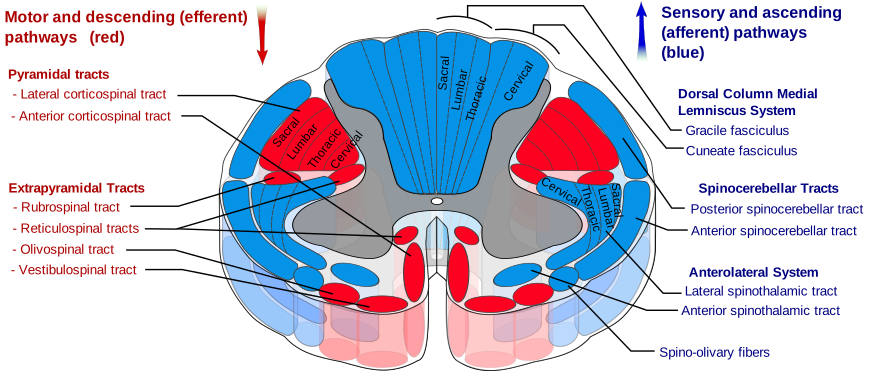
If you only remember three things on cord questions, remember these.
The Decussation Cheat
Motor (CST) crosses HIGH at the lower medulla (pyramidal decussation). Lesion above the cross gives contralateral weakness; lesion below gives ipsilateral weakness.
Fine touch / vibration / proprioception (DCML) rides the SAME side all the way up the cord, then crosses HIGH at the medulla (internal arcuate fibers).
Pain / temperature / crude touch (Spinothalamic) crosses LOW within 1 to 2 spinal segments of where it enters. That mismatch with DCML is the engine behind every Brown-Sequard question.
Section 2 · The Cord, Axially
Tap a Tract on the Axial Cord
Cervical-level cross-section. Motor tracts in red and orange. Sensory tracts in blue and purple. Tap any shaded zone to see what it carries, where it crosses, and what falls out when it dies.
Cervical Cord · Axial View
Posterior up · Anterior down · Left = patient's left
Tap any colored tract
Tract
Pick a tract
Carries· · ·
Crosses· · ·
If killed· · ·
Visual Anchors · Verified References
Cord tracts: motor and sensory columns in axial view
Cord cross-section: tracts and cord-injury syndromes (central, anterior, Brown-Sequard)
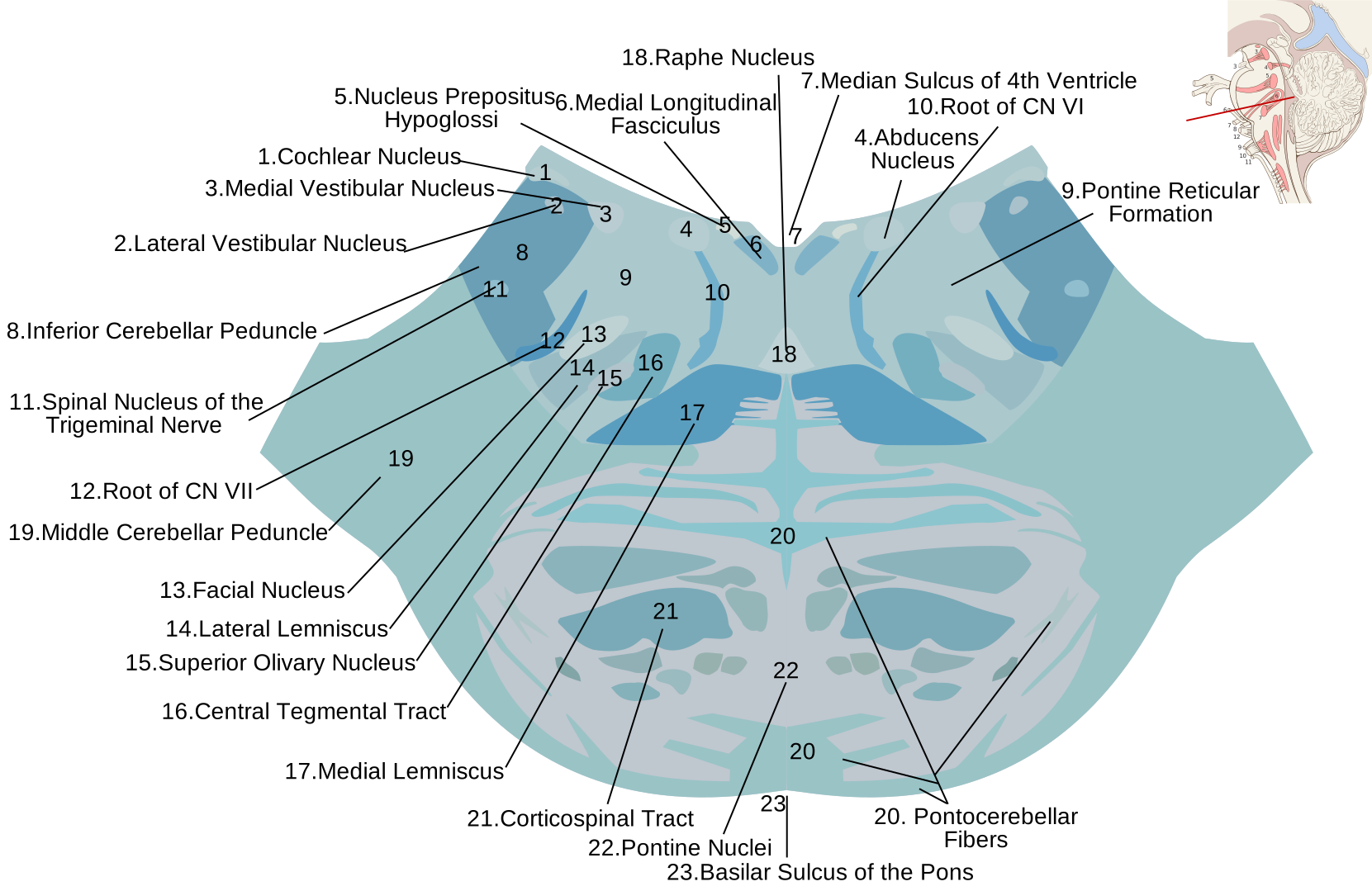
Brainstem crossing context: tract pathways before the cord
Section 3 · Pyramidal
CST vs CBT: Limbs vs Face
Both pyramidal. Both voluntary motor. CST drives the body. CBT drives the face. The trap is bilateral innervation.
Four extrapyramidal tracts plus a corticorubral feeder. All involuntary motor: posture, reflexes, balance, head turning. Tap each letter.
Mnemonic Walk
Tap a letter to load the tract
C
Corticorubral · feeds the rubrospinal
Cortex talks to the red nucleus. Net effect: inhibits extension in the upper limb. Damage here unmasks extensor posturing.
R
Rubrospinal · flexors of the upper limb
Red nucleus (midbrain) → contralateral flexor bias in the arms. Cut above the red nucleus and you get decorticate posturing (arms flex up). Cut below = decerebrate (arms extend).
R
Reticulospinal · reflexes and posture
Pontine reticulospinal facilitates extensors; medullary reticulospinal inhibits them. The push-pull balance is automatic posture control. Also gates spinal reflex loops.
V
Vestibulospinal · balance
Inner ear → vestibular nuclei → cord. Activates anti-gravity extensors to keep you upright when the head tilts. Lesion = falls toward the side of damage.
A
Tectospinal · Alert reflex
Superior colliculus (midbrain tectum) → cervical cord. Turns head and neck toward a sudden sight or sound. The orienting reflex. Lesion: head no longer snaps toward stimulus.
All four tracts carry posture, reflex, and involuntary motor traffic · not voluntary movement
Section 5 · Where The Wires Cross
DCML High · Spinothalamic Low
Same input, opposite crossing site. The reason Brown-Sequard splits the sensory exam by side.
Fine touch, vibration, proprioception
DCML
Crosses at the medulla
Same side up the cord. Internal arcuate fibers cross to the contralateral medial lemniscus. Cord hemisection = IPSILATERAL loss below the lesion.
Pain, temperature, crude touch
Spinothalamic
Crosses at the spinal cord
Crosses immediately via the anterior white commissure, 1 to 2 segments above entry. Cord hemisection = CONTRALATERAL loss below the lesion.
Section 6 · Modality Map
Which Tract Carries What
Match the symptom to the tract. This is the question stems on every cord vignette.
Spinothalamic
Pain, temp, crude touch, pressure
Sharp and dull pain
Hot and cold
Tickle and itch
Light pressure (crude)
Cross at cord (1 to 2 levels)
Dorsal Column / Medial Lemniscus
Fine touch, vibration, proprioception
Two-point discrimination
Vibration (tuning fork)
Joint position sense
Fine localized touch
Cross at medulla
Spinocerebellar
Unconscious proprioception
Limb position (subconscious)
Muscle spindle feedback
Coordinates smooth movement
Goes to cerebellum, not cortex
Ipsilateral (effectively no cross)
Section 7 · Clinical Patterns
When Tracts Die in Patterns
Three classic cord syndromes. Tap each card. The tract anatomy you just learned predicts every finding.
Brown-Sequard (hemisection)
One side of the cord cut. Side-split signs.
Tap
CausePenetrating trauma (stab, gunshot), MS plaque, lateral cord tumor or disc.
MotorIpsilateral UMN weakness below the lesion (lateral CST already crossed at medulla).
DCMLIpsilateral loss of fine touch, vibration, proprioception below the lesion (still on same side until medulla).
SpinothalamicContralateral loss of pain and temperature, starting 1 to 2 levels below the lesion (crossed at cord).
PearlIf the sensory exam splits across the body, the lesion is in the cord, not the brain. Best prognosis of the incomplete syndromes; patient often walks.
CauseAortic surgery, hypotension, atherosclerosis, anterior burst fracture. ASA feeds the anterior two-thirds of the cord.
MotorBilateral weakness below the lesion (both lateral CSTs in the anterior territory).
SpinothalamicBilateral loss of pain and temperature below the lesion (anterolateral tracts).
DCMLSpared: vibration and proprioception intact. Posterior columns feed off the posterior spinal arteries.
PearlWorst prognosis of the incomplete syndromes. Patient cannot walk but knows where her feet are.
Central cord (syringomyelia)
Cyst expands from the central canal outward.
Tap
CauseArnold-Chiari I (most common), post-traumatic, intramedullary tumor. Cyst grows in the central canal.
First fiber hitThe anterior white commissure, right next to the cyst. That is where spinothalamic fibers cross.
SpinothalamicBilateral pain and temperature loss in a cape distribution (shoulders, upper arms). Crossing fibers knocked out before they get a chance to ascend.
DCMLSpared early (posterior columns sit far from the central canal).
PearlSuspended sensory level: pain and temp lost in a band but preserved above and below. Pathognomonic.
Section 8 · Localization
Name the Level Before the Tract
Tract questions get easier when the first move is anatomy level, not memorized syndrome name.
Cord
Same-side motor and dorsal column loss
A cord hemilesion keeps corticospinal and dorsal column signs on the lesion side below the injury, while pain and temperature are lost on the opposite side after crossing in the anterior white commissure.
What will you do next time? Compare vibration with pinprick
Brainstem
Crossed face and body signs
Cranial nerve findings live in the brainstem. A face finding on one side with body weakness or sensory loss on the other side points above the cord and below the cortex.
What will you do next time? Inspect eyes, face, palate, tongue
Peripheral nerve
One named nerve territory
Peripheral lesions do not respect long tract crossing rules. They follow a nerve, root, or plexus map with lower motor neuron weakness at the supplied muscles.
What will you do next time? Match muscle plus reflex plus dermatome
Section 9 · Crossing Logic
Use the Crossing Site as the Answer Key
When a vignette gives side of injury and side of deficit, the crossing site tells you which tract got hit.
Dorsal Column
Fine touch, vibration, proprioception
Tap
CrossesMedulla, not cord.
Cord lossIpsilateral vibration and joint position loss below the lesion.
MoveIf the tuning fork is lost on the lesion side, think dorsal column.
Spinothalamic
Pain and temperature
Tap
CrossesCord, usually 1 to 2 segments after entry.
Cord lossContralateral pain and temperature loss below the lesion.
MoveIf pinprick is lost opposite the lesion, the spinothalamic tract is the side-split clue.
Corticospinal
Voluntary limb motor
Tap
CrossesLower medulla before entering the lateral cord.
Cord lossIpsilateral upper motor neuron weakness below the lesion.
MoveHyperreflexia plus Babinski below a cord lesion follows the lateral corticospinal tract on that side.
Section 10 · Quiz
Drill the Tracts
Six original clinical vignettes. Pick the best answer. The explanation walks the chain from clue to diagnosis.
Medically reviewed by Kaitlyn Cocuzzo, MD and Fatima Ali, DO · Last updated June 26, 2026 at 5:20 PM ET
Bone Wizardry is an independent educational resource for visual learning in the medical sciences. It is not affiliated with, endorsed by, or sponsored by any licensing or examination board, contains no real or recalled examination questions, and does not guarantee any educational or examination outcome.
clinical Walkthrough
clinical Walkthrough
Original clinical vignettes. Shuffled, never-repeat, full explanations for every choice.