Motor neurons die. Sensory stays untouched. Eye muscles work until the end. The signature: UMN and LMN signs in the SAME muscle group.
Upper Motor Neuron+Lower Motor Neuron
Opening Case
A 58-year-old man presents with six months of progressive right foot drop. On exam he has visible twitching of his tongue and wasting of the small muscles of his right hand. His biceps reflex on the left is 4+ with sustained clonus at the ankle. Sensation is intact everywhere. He can move his eyes in every direction without issue. Bladder and bowel function are normal.
What is the most likely diagnosis?
UMN signs (brisk reflex, clonus) PLUS LMN signs (fasciculations, atrophy) in a patient with intact sensation = ALS until proven otherwise.
MS is demyelinating, hits younger women, and brings sensory and cerebellar signs. Cervical cord compression would dent sensation too and would show on MRI. Myasthenia fatigues with use and spares reflexes. Guillain-Barre is ascending, areflexic, and follows an infection.
The tongue fasciculations plus spared eye movements, bladder, and sensation are the classic ALS signature. Death is usually from respiratory failure.
Motor Neuron Visual Anchors
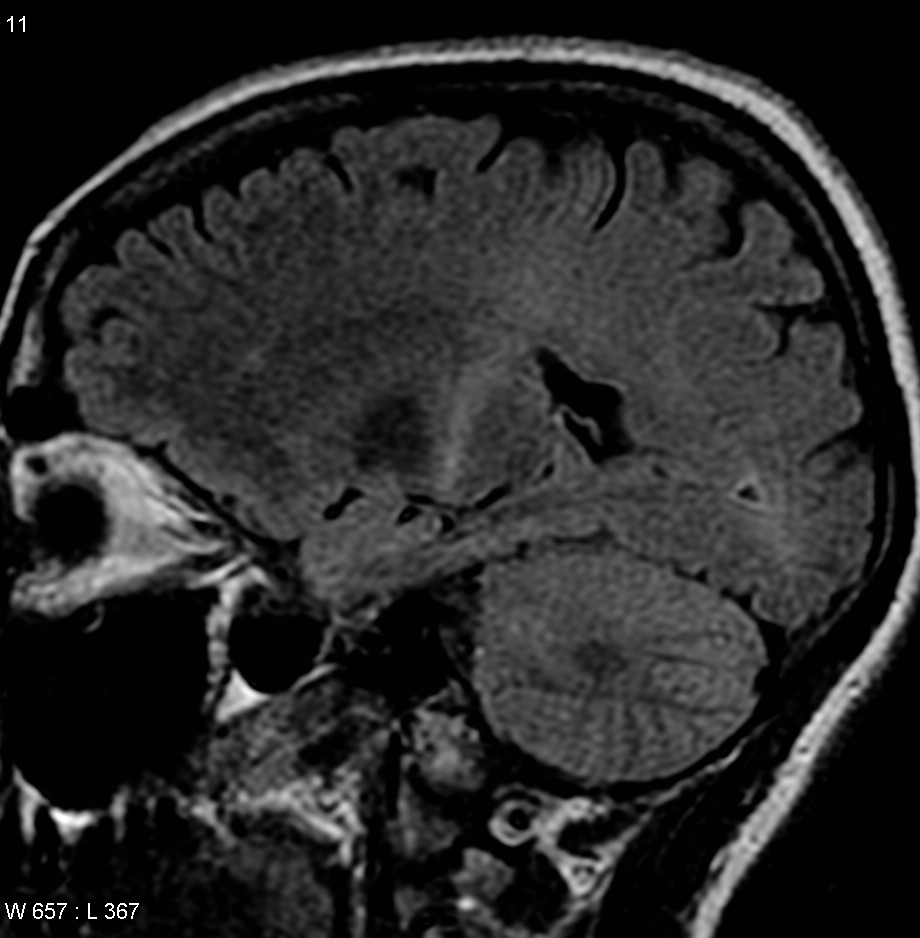
ALS cord section
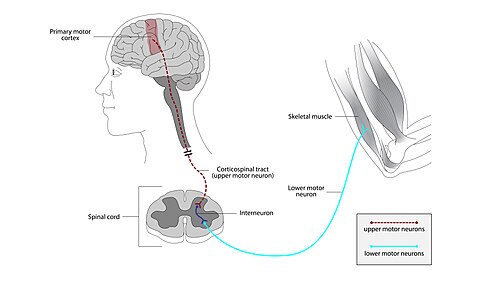
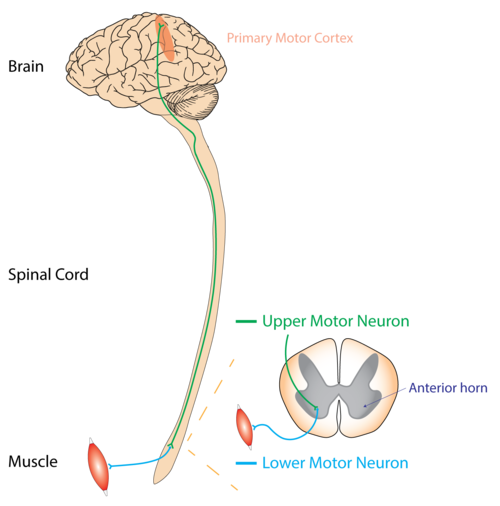
Motor pathway stack
UMN and LMN split
Pattern Recognition
The Clue Cluster
Five fingerprints. Spot any two together in the same patient and ALS jumps to the top of the list.
Clue 01
Pure motor only
Weakness, atrophy, twitching, stiffness. No numbness. No tingling. Sensation is untouched. If sensory findings show up, it is not ALS.
Clue 02
UMN + LMN in the SAME muscle
A wasted, fasciculating hand with brisk reflexes in that same arm. This is the pathognomonic mix. One lesion alone cannot do this.
Clue 03
Tongue fasciculations
Ask the patient to relax the tongue on the floor of the mouth. Worms-under-the-skin twitches are bulbar LMN failure. Highly specific.
Clue 04
Eyes and sphincters spared
Extraocular muscles and bladder/bowel control are preserved until very late. If the patient cannot move their eyes or is incontinent early, look elsewhere.
Clue 05
Adult progressive motor pattern
Adult onset, asymmetric, relentlessly progressive. 90% sporadic. The familial 10% can carry an SOD1 mutation. Cognition stays intact.
Anatomy
Where the Damage Lives
Two motor neurons stacked top-to-bottom. ALS kills both. Tap a button to see which neuron fires which signs.
Upper Motor Neuron Signs
Spasticity, hyperreflexia, positive Babinski, pseudobulbar affect. The UMN cell body sits in the motor cortex. Its axon travels down the lateral corticospinal tract and dies along the way. Without UMN braking, the LMN below fires unchecked = spastic tone.
Microscopy
The Spinal Cord Slide
A real ALS spinal cord on the left. A drawn schematic on the right. Notice the pale lateral columns and the empty anterior horns.
Real Specimen
Coronal section through a spinal cord affected by ALS. The pale wedges in the lateral columns are demyelinated lateral corticospinal tracts. The anterior horns are shrunken. Sensory tracts in the posterior columns stay normally stained.
Wikimedia Commons · CC BY-SA 3.0
Schematic
Two findings, both in the same slide. Anterior horn dropout (LMN cell death) and pale lateral corticospinal tracts (UMN axon loss). Posterior columns, where sensory information travels, are spared.
Drug of Choice
Riluzole: Quiet the Glutamate
Motor neurons in ALS are drowning in glutamate. Too much excitatory drive = excitotoxic death. Riluzole blocks the sodium channels that drive presynaptic firing, so the glutamate vesicle never gets dumped. Tap GIVE RILUZOLE to watch.
The lungs can still exchange gas. The diaphragm and bulbar muscles lose the motor drive needed to move air safely.
Early signal
Orthopnea, morning headache, weak cough, and falling forced vital capacity mean nocturnal hypoventilation is starting.
Ventilation decision
Use noninvasive ventilation when the pump cannot keep up. Oxygen alone can hide the problem while carbon dioxide rises.
Why it matters
Most deaths come from respiratory failure or aspiration. Swallowing, cough strength, and ventilation are not side issues.
What ALS Spares
The Negative Clues Are Diagnostic
ALS is not just weakness. It is pure motor neuron failure with very specific territories left alone.
Finding
ALS fit?
Why
Vibration, pinprick, proprioception loss
No
Sensory tracts are not the primary target. Sensory loss should push you toward cord, peripheral nerve, or demyelinating disease.
Early ophthalmoplegia
No
Eye movements are classically spared until very late. Early eye weakness should make myasthenia or brainstem disease louder.
Fasciculations plus hyperreflexia
Yes
LMN death makes fasciculations and atrophy. UMN loss removes the brake, so reflexes rise in the same patient.
Test Yourself
Board Vignettes
Five questions. New mix every time. Take your time, the explanations are the lesson.
Medically reviewed by Kaitlyn Cocuzzo, MD and Fatima Ali, DO · Last updated June 30, 2026 at 1:10 AM ET
Bone Wizardry is an independent educational resource for visual learning in the medical sciences. It is not affiliated with, endorsed by, or sponsored by any licensing or examination board, contains no real or recalled examination questions, and does not guarantee any educational or examination outcome.