AIDS Dementia Complex

Multinucleated giant cells. Trojan horse entry. The autopsy finding that wins the board.

Other dementias · Demyelinating disease

Classic Board Stem · Opener
A 55-year-old man with HIV for 15 years, nonadherent to antiretroviral therapy, presents with progressive memory loss, slowed speech, and flat affect over the past 6 months. On exam he has ataxic gait and diffuse hyperreflexia. Vital signs: T 37.1°C, HR 82, BP 116/72. He is admitted and dies 3 weeks later. Which of the following is most likely found on autopsy?
Multinucleated giant cells are the pathological hallmark of AIDS Dementia Complex. HIV-infected macrophages and microglia fuse into these giant multinucleated cells throughout the subcortical gray matter. The distractors each require something the stem does NOT give: ring enhancement and CD4 <100 for toxoplasmosis, fever and acute onset for HSV, an animal bite for rabies, and rapidly progressive dementia without HIV context for CJD.

The Trojan Horse: How HIV Gets Into the Brain

HIV cannot enter neurons directly. It uses infected monocytes as a ferry. Tap through the chain to see every step. 🔑Trojan Horse: HIV rides INSIDE the monocyte across the BBB. The monocyte looks normal from the outside. The guard lets it through.

STEP 1 OF 7
HIV Infects Circulating Monocytes
HIV enters monocytes via CCR5 co-receptor binding in the periphery. Macrophage-tropic strains (R5 viruses) are the dominant CNS invaders. The monocyte is now a carrier. Its surface looks normal; the immune system has no reason to flag it.
FULL CHAIN
HIV + Monocyte (CCR5) BBB crossing Microglial infection Macrophage fusion Multinucleated giant cells gp120 + Tat neurotoxicity Subcortical dementia

RevealBeat: Pathology to Clinic

One beat at a time. Tap each answer to unlock the next. This is how the clinical medicine will test it.

Five CNS Disasters in Advanced HIV

Same host. Wildly different lesions and timelines. One tap separates the killing clue for each.

AIDS Dementia Complex
HIV-associated neurocognitive disorder · HADC
Onset
Subacute over weeks to months. NOT sudden.
CD4 Context
Typically <200, but can occur at higher counts. Years of HIV + nonadherence is the setup.
Classic Exam Findings
Memory loss, flat affect, psychomotor slowing. Gait disturbance + hyperreflexia from subcortical and white matter involvement.
Pathology (clinical medicine Answer)
Multinucleated giant cells (microglial and macrophage fusion). Microglial nodules. Diffuse subcortical and gray matter atrophy.
Imaging
Diffuse white matter signal, cortical and subcortical atrophy. No ring enhancement. No mass effect.
Treatment
HAART with high CNS penetration (zidovudine, abacavir). The CNS penetration-effectiveness (CPE) score matters here.
CNS Toxoplasmosis
Toxoplasma gondii reactivation · CD4 <100
Onset
Days to weeks. More acute focal onset than AIDS dementia.
CD4 Context
CD4 <100 is the floor. Reactivation of latent cysts from prior exposure.
Classic Findings
Focal neurologic deficits (hemiparesis, seizure). Headache. Fever is common.
Pathology
Ring-enhancing necrotic lesion on MRI. Central coagulative necrosis. Tachyzoites identifiable. NOT multinucleated giant cells.
Board Discriminator
Ring-enhancing lesion in HIV patient = Toxo until proven otherwise. Treat empirically: pyrimethamine + sulfadiazine. No response in 2 weeks = biopsy for lymphoma.
Treatment
Pyrimethamine + sulfadiazine + leucovorin. Lifetime prophylaxis with TMP-SMX once CD4 >200 is sustained.
HSV Encephalitis
Herpes simplex virus 1 · Temporal lobe tropism
Onset
ACUTE. Hours to days. Fever, headache, altered mental status with rapid progression.
CD4 Context
Occurs in immunocompetent AND immunocompromised patients. Not CD4-dependent.
Classic Findings
Fever + personality change + temporal lobe signs (memory, behavior). Olfactory hallucinations, seizures.
Pathology
Hemorrhagic necrosis of temporal lobes. Cowdry A intranuclear inclusions in neurons. NOT multinucleated giant cells.
Board Discriminator
FEVER + ACUTE onset + temporal lobe MRI signal = HSV. Send CSF PCR immediately. Start IV acyclovir before results.
Treatment
IV acyclovir. Early treatment dramatically improves survival and reduces morbidity.
Progressive Multifocal Leukoencephalopathy
JC virus reactivation · White matter demyelination
Onset
Subacute over weeks. Asymmetric focal cortical deficits without fever.
CD4 Context
CD4 <200 typical. JC virus reactivation from latent infection.
Classic Findings
Focal cortical signs: limb weakness, aphasia, visual field defects. No fever. No mass effect.
Pathology
Demyelinating white matter lesions. Enlarged oligodendrocyte nuclei with ground-glass viral inclusions. NOT multinucleated giant cells.
Board Discriminator
White matter lesions WITHOUT ring enhancement + HIV = PML. JC virus PCR in CSF. IRIS can paradoxically worsen on HAART initiation.
Treatment
HAART to restore immune function. No specific antiviral. IRIS monitoring required.
Creutzfeldt-Jakob Disease
Prion disease · PrPSc conformational misfolding
Onset
Rapidly progressive dementia. Death in months. NOT linked to HIV.
CD4 Context
CD4 count is irrelevant. Prion disease, not opportunistic infection. HIV context is a distractor.
Classic Findings
Rapidly progressive dementia + myoclonus + startle. Cerebellar ataxia. Periodic sharp wave complexes on EEG.
Pathology
Spongiform vacuolation of gray matter. Status spongiosus. No inflammation. NOT multinucleated giant cells.
Board Discriminator
CJD = prion, no HIV link, spongiform on path. DWI MRI shows cortical ribboning. 14-3-3 protein in CSF. Always fatal.
Treatment
No treatment. Supportive care. Median survival 4 to 6 months from symptom onset.

HIV Neuro: Acute vs. Subacute Algorithm

Two nodes cover 90% of clinical questions. Walk through both every time you see an HIV neuro stem.

NODE 1. Is the onset ACUTE (hours to days) with fever?
NODE 2. What does imaging show?
DIAGNOSIS

Pathology You Need to Recognize

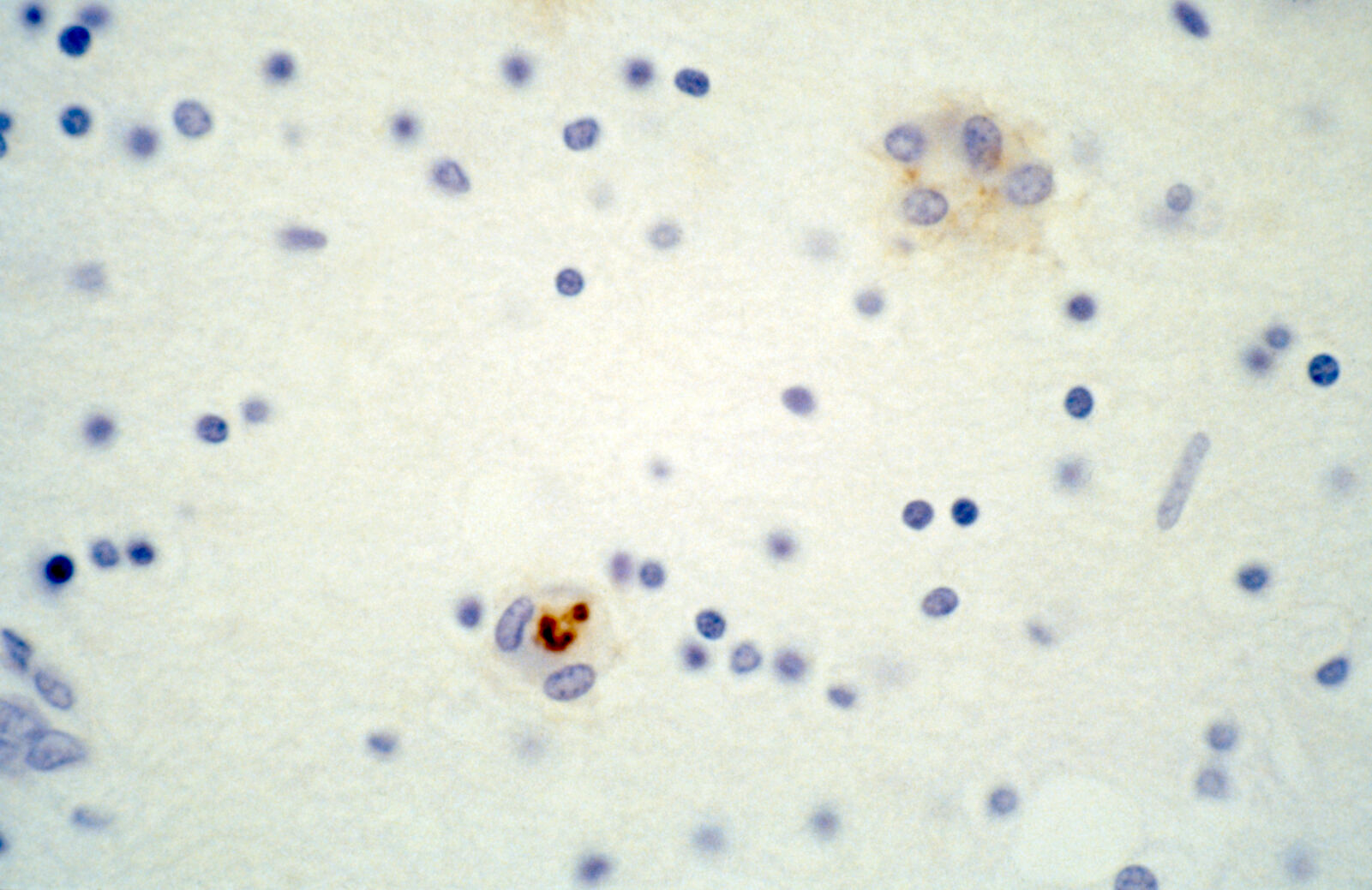
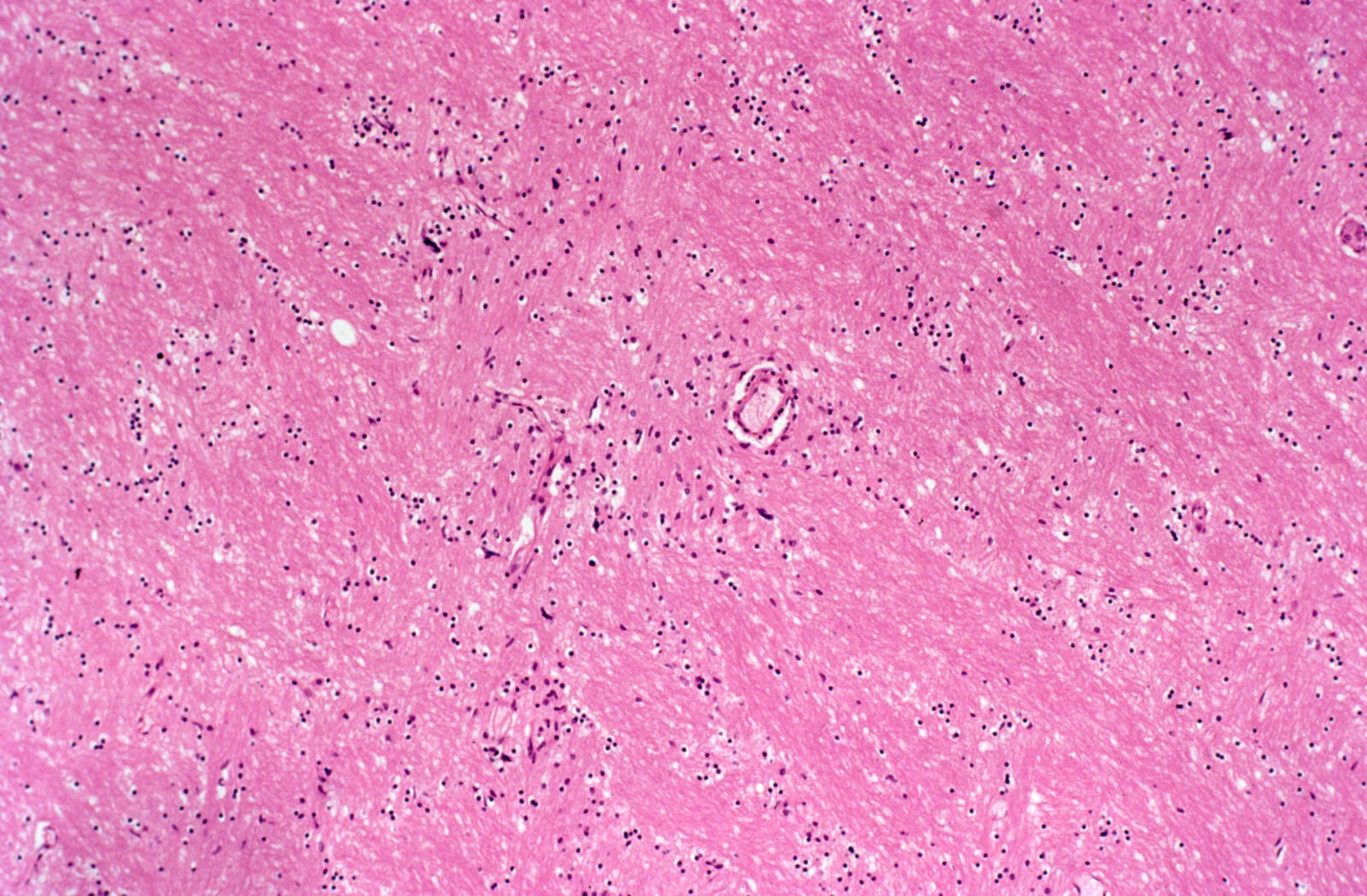
HIV encephalitis histology: microglial nodules and multinucleated giant cells. Tap to expand.
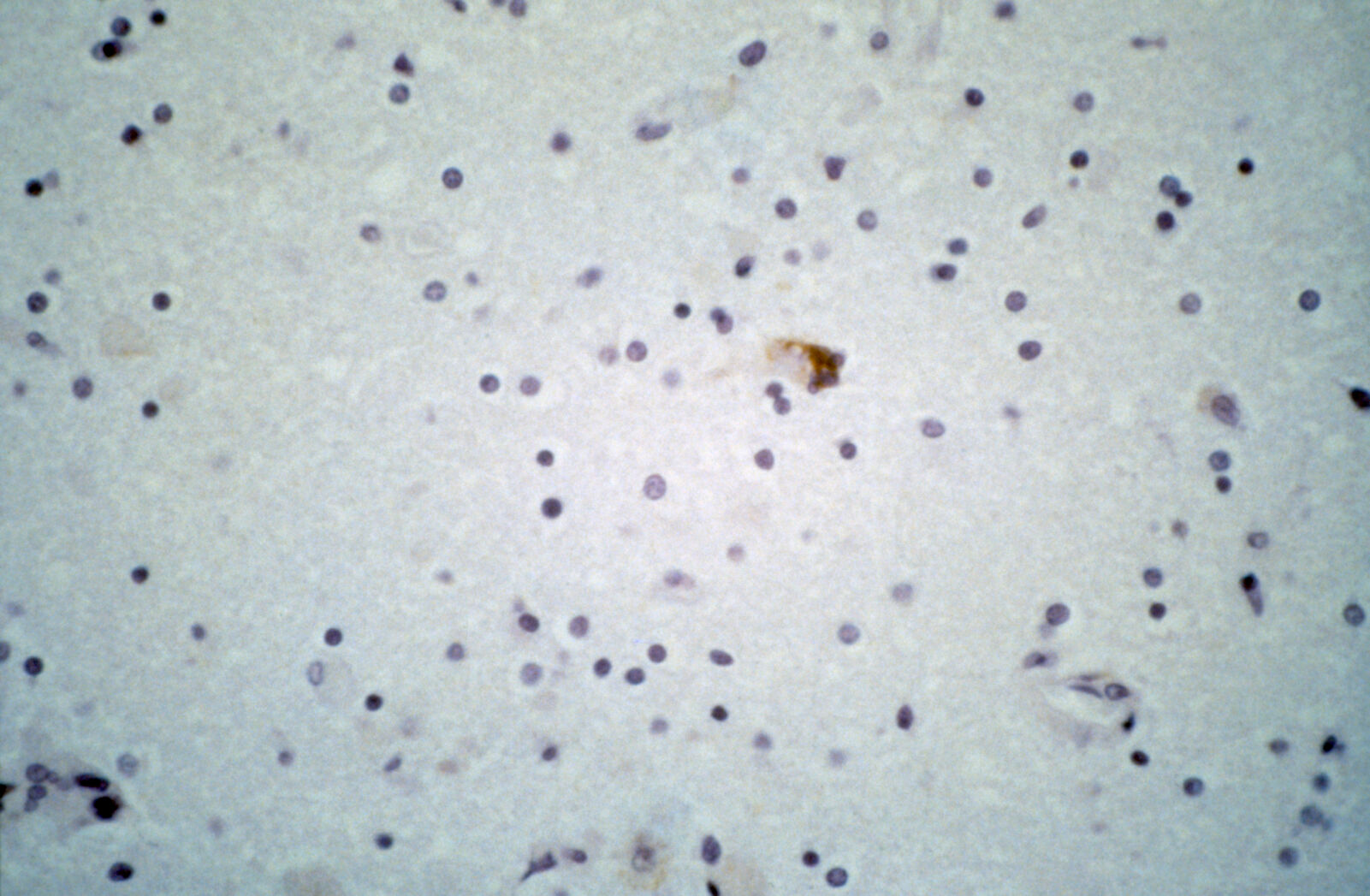
Brain: HIV encephalitis, immunostain highlighting infected microglia and macrophages
Brain · HIV Encephalitis (immunostain)
Brain: HIV encephalitis, microglial nodule with a multinucleated giant cell
Brain · Microglial Nodule and Giant Cell
Brain: HIV encephalitis, hematoxylin and eosin of cerebral white matter with reactive gliosis
Brain · White Matter (H and E)
What multinucleated giant cells look like: Macrophages and microglia infected with HIV fuse together into cells with multiple nuclei arranged at the periphery. Surrounding tissue shows pallor from white matter loss. No ring enhancement, no abscess, no necrosis. The histology is diffuse, not focal.
Trap alert: "Microglial nodules" and "multinucleated giant cells" go together. The clinical medicine use either term. Microglial nodules = clusters of activated microglia at sites of neuronal injury. The giant cells are the fusion product of those macrophages and microglia. If you see either in an HIV patient, the answer is HADC.

Three Hooks. Tap to Reveal.

Tap any card to uncover the mnemonic. These are the board-test-day retrievals.

HOOK 1 · Tap to reveal
The Trojan Horse
HIV cannot enter the brain through the front door. The BBB blocks it. So HIV hitches a ride INSIDE an infected monocyte. The monocyte migrates normally across the BBB as part of routine immune surveillance. HIV is the hidden passenger. Once inside, it infects microglia and macrophages, which replicate and fuse.

Board memory: "Trojan horse = monocyte carrying HIV across the BBB." Every time you see HIV dementia, say it.
HOOK 2 · Tap to reveal
SUBCORTICAL = No Cortical Signs
AIDS dementia is subcortical. That means: NO aphasia, NO agnosia, NO cortical sensory signs. What you DO get: psychomotor slowing, gait abnormality, hyperreflexia, mood changes, flat affect.

Board memory: Patient forgets words but can still name objects. Patient shuffles but has no focal weakness. That combination screams subcortical. Cortical dementia (Alzheimer's) gives you aphasia and agnosia early.
HOOK 3 · Tap to reveal
Distractor Kill Rule: What Is MISSING
Every wrong answer requires something the stem does NOT give you:
Toxo needs ring-enhancing lesion + CD4 <100.
HSV needs FEVER + ACUTE onset.
Rabies needs an animal bite.
CJD needs rapidly progressive + no HIV context.

Board memory: Before you pick a distractor, ask: "Does the stem GIVE me the one thing that diagnosis requires?" If not, eliminate it. Multinucleated giant cells wins by default once everything else is stripped.

5 Vignettes. One at a Time.

Right-click or long-press to cross out choices. Double-tap to highlight. Premium third-order stems.

clinical Vignette Bank

5 original vignettes. Shuffle on every run. Never repeat until bank is exhausted.

Medically reviewed by Kaitlyn Cocuzzo, MD and Fatima Ali, DO · Last updated July 1, 2026 at 10:03 PM ET
Bone Wizardry is an independent educational resource for visual learning in the medical sciences. It is not affiliated with, endorsed by, or sponsored by any licensing or examination board, contains no real or recalled examination questions, and does not guarantee any educational or examination outcome.