
The Basics
What Enzymes Actually Do
Four things. That's it.
Think of it like a dating app. Two molecules need to meet, but the body is huge and they'd never find each other on their own. The enzyme grabs both and holds them together → in space and time.
Picture a hill. The substrate needs to climb over it to become a product. Without the enzyme, it's Everest. With the enzyme, it's a speed bump. The reaction is now probable, not just possible.
At the top of that hill, the substrate is in a high-energy intermediateA fleeting, unstable form of the substrate at the peak of the reaction. If it's not stabilized, it flies apart instead of becoming product. state → like balancing a ball on a peak. Without help, it falls backward. The enzyme holds it steady until the reaction slides down to product.
90% of reactions in your body probably wouldn't happen without enzymes. Sure, they're technically possible → but you'd be waiting a thousand years. Enzymes turn "maybe someday" into "right now."
Two Sites
Every Enzyme Has Two Binding Sites
Where things bind determines what happens
The Big Comparison
Competitive vs Non-Competitive
This is THE board question. Know it cold.
| Competitive | Non-Competitive | |
|---|---|---|
| WHERE | Active site (same as substrate) | Regulatory / allosteric site |
| LOOKS LIKE SUBSTRATE? | Yes → that's why it fits | No → different shape entirely |
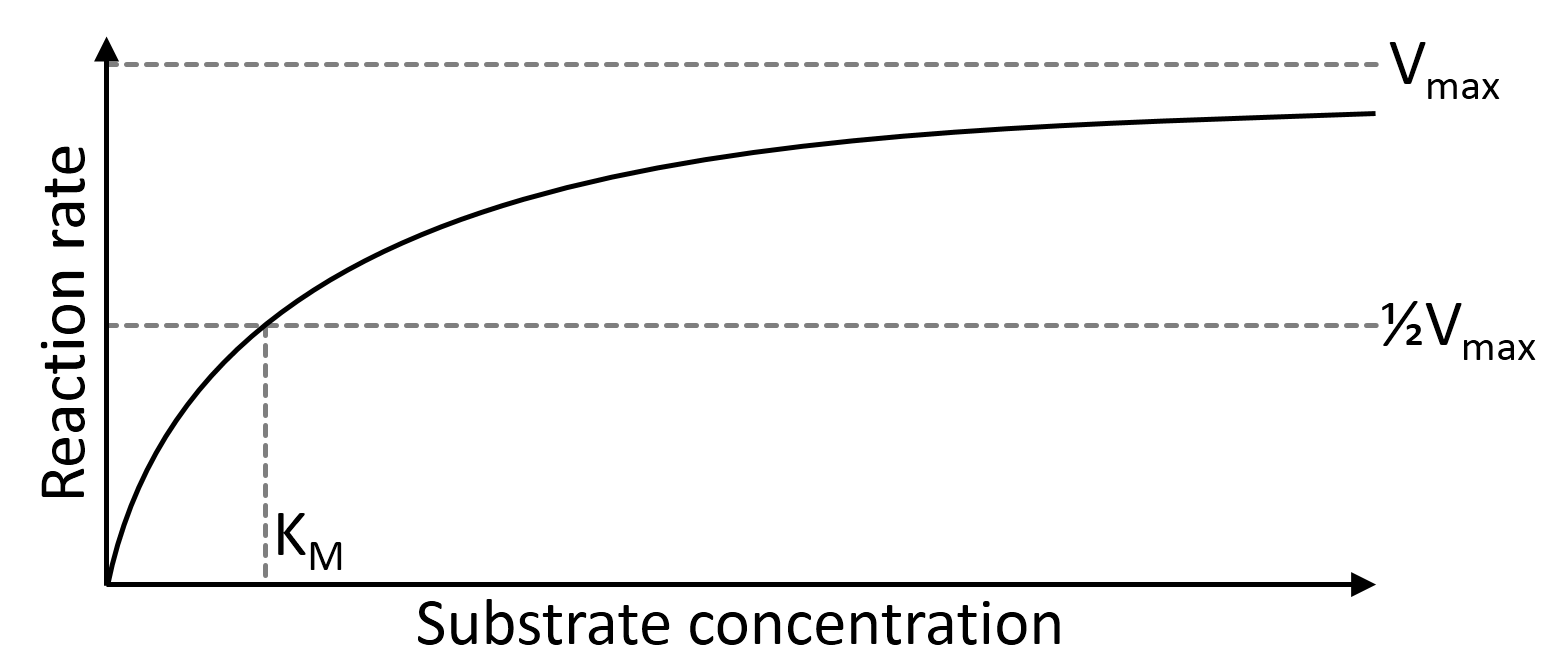
| Km | ↑ increases (less affinity) | No change |
| Vmax | No change | ↓ decreases |
| OVERCOME IT? | Yes → add more substrate | No → you're stuck |
| % OF DRUGS | ~90% (reversible = safe) | Reserved for deadly diseases |
| DRUG ANALOGY | Km = 1/Potency, Vmax = Efficacy | Km = same, Vmax ↓ = less efficacy |
Thermodynamics
Delta G → Is This Reaction Gonna Happen?
Negative = yes. Positive = no. That's 80% of it.
ΔG negative → spontaneous, favorable, energy left over
ΔH = heat (enthalpy) • T = temperature • ΔS = entropy (randomness)
The chain: Higher temperature → larger TΔS → more negative ΔG → reaction more favorable. That's why fever speeds up your metabolism. But push past 42°C (107°F) and enzymes denature → game over.
ΔG is additive. A bad reaction can be dragged forward by coupling it with a very favorable one (like ATP hydrolysis). This is how the body runs thermodynamically unfavorable reactions.
Most stable bonds: Carbon-carbon bonds (that's why fat stores so much energy → lots of C-C bonds to break).
Redox
OIL RIG
Oxidation Is Loss, Reduction Is Gain → of electrons
| Reducing Agent | Oxidizing Agent | |
|---|---|---|
| ΔE | Negative (has electrons to give) | Positive (wants electrons) |
| WHAT IT DOES | Gives away electrons | Accepts electrons |
| WHAT HAPPENS TO IT | Gets oxidized | Gets reduced |
The Electron Transport Chain
Where 90% of Your ATP Gets Made
Tap each complex to see what it does
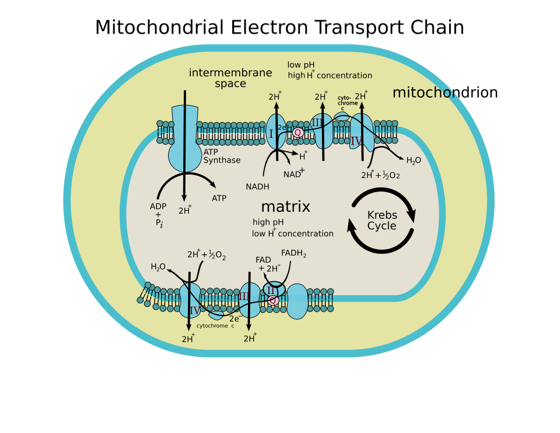
Complex I → NADH Dehydrogenase
- NADH drops off electrons here → regenerates NAD+
- Pumps H⁺ into the intermembranous space
- Electrons then ride Coenzyme Q to Complex III
Inhibitors: Amytal, Rotenone
Rotenone is a pesticide that kills bugs by shutting down their Complex I. Amytal is a barbiturate. Both block NADH from donating electrons, so the whole chain stalls.
Coenzyme Q (Ubiquinone)
- Electron carrier floating in the inner membrane lipid bilayer
- Shuttles electrons from Complex I/II → Complex III
- Also called CoQ10 (yes, the supplement)
- Destroyed by statins → that's one reason statins cause myopathy
Complex II → Succinate Dehydrogenase
- Double agent: it's BOTH a Krebs cycle enzyme AND part of the ETC
- Converts succinate → fumarate, producing FADH2
- Does NOT pump H⁺ → that's why FADH2 = 2 ATP (actually 1.5)
- Sends electrons to CoQ, then same path as Complex I electrons
Inhibitor: Malonate
Malonate looks like succinate (it's a structural analog), so it competes for the active site. Classic competitive inhibition at Complex II. Board question: "What type of inhibition does malonate cause?" → competitive, because adding more succinate overcomes it.
Complex III → Cytochrome bc1
- Receives electrons from CoQ
- Uses heme as part of its structure
- Pumps H⁺ into intermembranous space
- Passes electrons to Cytochrome C
Inhibitor: Antimycin
Antimycin is a fish poison (piscicide) used in lake management. Blocks electron transfer inside Complex III. Not commonly tested by name, but shows up as a distractor.
Cytochrome C
- Second electron carrier, floats in the inner membrane
- Shuttles electrons from Complex III → Complex IV
- Also involved in apoptosis (when released into cytoplasm = cell death signal)
Complex IV → Cytochrome Oxidase
- Where oxygen is finally used → attaches 4 electrons to O₂ → 2 H₂O
- Contains heme and copper
- Pumps H⁺ into intermembranous space
- This is why you need to breathe → O₂ is the final electron acceptor
Inhibitors: CO, Cyanide, Chloramphenicol
CO binds heme iron 200x stronger than O2 (competitive at Complex IV). SpO2 looks normal (pulse ox can't tell the difference). Treat with 100% O2. Cyanide also binds Complex IV iron. Cherry-red skin. Treat with hydroxocobalamin or nitrites+thiosulfate. Chloramphenicol is an antibiotic that inhibits mitochondrial ribosomes (related to Complex IV function). Causes aplastic anemia + gray baby syndrome.
Complex V → ATP Synthase
- Not really electron transport → this is where phosphorylation happens
- H⁺ flows back through Complex V (like a turbine in a dam)
- The flow of protons spins the enzyme and generates ATP
- This is the chemiosmotic theoryPeter Mitchell's Nobel Prize idea: the proton gradient across the inner membrane is the energy source that drives ATP synthesis. Protons flow down their concentration gradient through Complex V, and that flow powers ATP production.
Inhibitor: Oligomycin
Oligomycin plugs the proton channel in Complex V. H+ can't flow through, so ATP synthase stops spinning. The proton gradient builds up, which ALSO stalls the electron transport chain (because you can't pump more H+ against an already maxed gradient). Result: both ETC and ATP production halt. Distinct from uncouplers, which let H+ leak back WITHOUT making ATP.
FADH2 = 2 ATP (actually 1.5) → drops off at Complex II, only 2 pumping chances
ETC Poisons
Inhibitors vs Uncouplers
Both kill ATP production. Different mechanisms.
| Inhibitors | What They Block |
|---|---|
| Amytal, Rotenone | Complex I |
| Malonate | Complex II |
| Antimycin | Complex III |
| CO, Cyanide, Chloramphenicol | Complex IV |
| Oligomycin | Complex V (ATP synthase) |
| Uncoupler | Clinical Relevance |
|---|---|
| DNP (Dinitrophenol) | Was used as a weight loss drug (burns fat → heat). Killed people. |
| Aspirin (high dose) | Reye's syndrome → uncouples in liver mitochondria |
| Free fatty acids | Brown fat in babies → intentional uncoupling to generate heat |
| Thermogenin | The protein in brown fat that does the uncoupling |
Uncouplers cause: Body temp rises → muscles can't relax → malignant hyperthermia and neuroleptic malignant syndrome
Microsteatosis (small fat droplets in liver): Pregnancy, Tylenol poisoning, Reye's syndrome
Macrosteatosis (big fat droplets in liver): Obesity, Alcohol
Enzyme Naming
How to Name Any Enzyme
First name = substrate. Last name = what you did to it. 90% of the time.
TAP TO REVEAL what each enzyme type does
Challenge
Elimination Game: Name That Poison
A patient is dying. Clues are coming in. Eliminate suspects until you find the killer.
Final Boss
Clinical Vignettes
6 patients just walked in. Don't panic → you know this.
The Board Quiz
Enzyme Classes: Board Style
Two vignettes. One concept each. Tap an answer to check.