Every blood cell you have, the bacteria killer, the antibody factory, the red cell carrying oxygen, traces back to one ancestor in the marrow. Learn the family tree once and the markers, the leukemias, and the lineage traps fall into place.
Medically reviewed by Fatima Ali, DO & Kaitlyn Cocuzzo, MD
A medical student is shown a simplified blood cell family tree and asked one question. Red blood cells and platelets keep oxygen moving and plug leaks, so they feel like a separate non-immune crew. But every blood cell shares one origin. Which progenitor gives rise to both the red blood cells and the platelets?
Common lymphoid progenitor
Common myeloid progenitor
Mast cell progenitor
A separate non-immune stem cell
Both come from the common myeloid progenitor. Here is the part students miss: red cells, platelets, granulocytes, monocytes, and mast cells are ALL myeloid. The lymphoid side is small and exclusive: B cells, T cells, and NK cells, that is it. The red cell rides through the megakaryocyte-erythroid progenitor, and the platelet buds off the megakaryocyte. If it is not a B, T, or NK cell, it is myeloid.
Begin
Where It All Starts
The Hematopoietic Stem Cell
One cell in the marrow can become any blood cell. It does two things: copies itself and commits to a path. Watch it decide.
Bone marrow: the factory floor where every blood line is born. The giant cell is a megakaryocyte.tap to enlarge
The hematopoietic stem cellHSC. The master blood stem cell. It self-renews (makes more of itself) and differentiates (commits down a path). It carries the marker CD34, which is how transplant teams find and collect it. (HSC) is the founder. It is multipotent: it can build every blood and immune cell. Its badge is CD34, the marker collected for a stem cell transplant.
When the HSC commits, it picks one of two roads. That single fork explains most of the lineage map: common myeloid progenitor (the big, broad crew) or common lymphoid progenitor (the small, exclusive crew). Tap a road below and watch the path draw.
Pick a road. Myeloid is the broad crew (granulocytes, monocyte, mast cell, megakaryocyte, red cell). Lymphoid is the short list (B, T, NK).
Memory hookLymphoid is the short guest list: B, T, NK. Everything else crashes the myeloid party. If you cannot name it as B, T, or NK, write myeloid.tap to reveal
Why this fork matters clinically
Leukemias are named by the road. A cancer of the myeloid crew is a myeloid leukemia (think granulocytes, monocytes). A cancer of the short list is a lymphoid leukemia or lymphoma (B and T cells). Knowing which cell sits on which road tells you which disease family you are in.
The Whole Family
Tap Any Cell on the Tree
The full map, top to bottom. Tap a node to see its one job, its key markers, and the board trap that hides in it.
monocyte to
megakaryocyte to
B cell to
T cell splits
Hematopoietic Stem Cell
JobThe founder. Self-renews and gives rise to every blood and immune cell.
MarkersCD34 positive, multipotent. Lives in red bone marrow.
Board trapCD34 positive cells are what get mobilized and harvested for a stem cell transplant. Tap a cell to drill down.
The split is the whole game. Left road (myeloid) is crowded: it builds the granulocytes, the monocyte, the mast cell, the platelet maker, and the red cell. Right road (lymphoid) is tiny: B, T, NK, and a dendritic subset. Dendritic cells come from BOTH roads, which is why they get their own trap later.
The Broad Road
The Myeloid Crew
Three granulocytes look alike under the scope until you learn the giveaway. Tap each tab and read the picture.
Neutrophil
Eosinophil
Basophil
Neutrophil
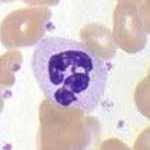
Neutrophil: a multilobed nucleus (2 to 5 lobes).tap to enlarge
The most abundant white blood cell (40 to 70 percent). First responder to bacteria. Nucleus has 2 to 5 connected lobes, so it is also called a segmented cell or a poly.
Giveaway: many lobes, pale pink granules, and it dominates the smear. Acute bacterial infection drives the count up.
Eosinophil
Eosinophil: a bilobed nucleus packed with red-orange granules.tap to enlarge
Two lobes (a bilobed nucleus) and bright red-orange granules. Rises with parasites and allergy. Driven by IL-5.
Giveaway: the red granules look like a bag of cherries. Think worms, wheezing, and weird drug reactions.
Basophil
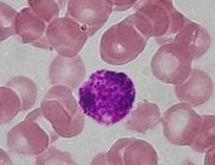
Basophil: dark granules so dense they hide the nucleus.tap to enlarge
The rarest white blood cell (under 1 percent). Carries histamine and heparin in dark blue-black granules. Binds IgE and joins allergic reactions.
Giveaway: granules so dark you can barely see the nucleus. Basophilia is a clue for chronic myeloid leukemia.
The Myeloid Surprises
These three feel like outsiders, but they are pure myeloid. This is where the points hide.
Monocyte
The blood form of the macrophage
Monocyte: largest WBC, kidney-shaped nucleus.tap to enlarge
Largest white cell, CD14 positive, horseshoe nucleus. In tissue it becomes a macrophage and can become a dendritic cell.
Mast cell
The tissue allergy cell
Mast cells live resident in tissue.tap to enlarge
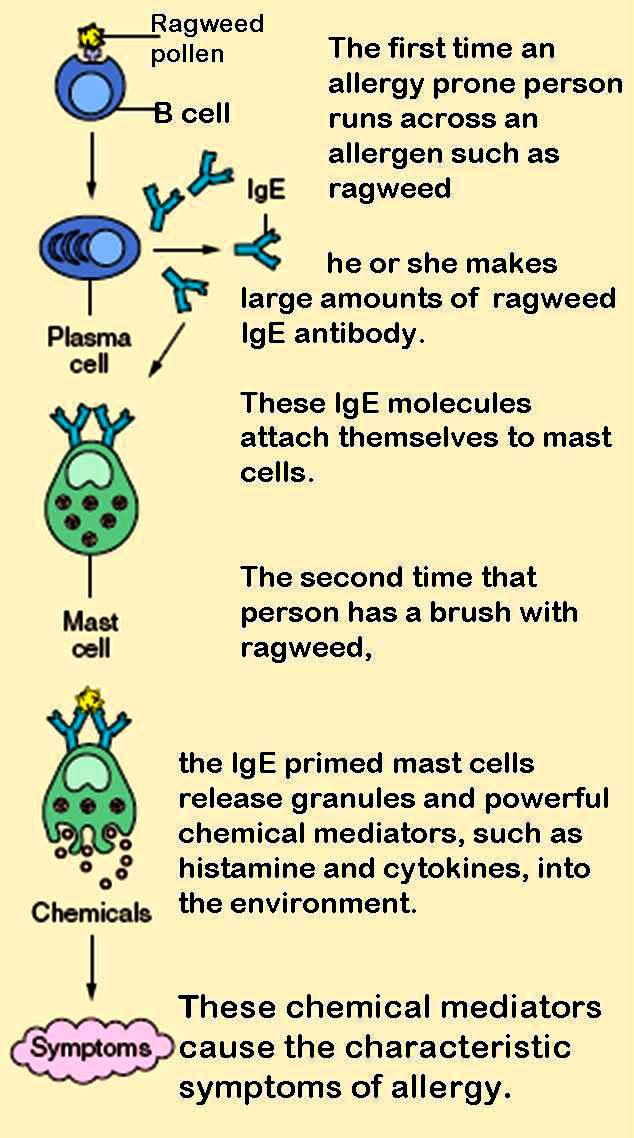
Lives resident in tissue (skin, gut, airway). Loaded with histamine, binds IgE. Myeloid, and NOT a basophil that moved into tissue.
Megakaryocyte & red cell
Platelets and oxygen, both myeloid
Red cells and platelets, sitting next to an eosinophil. All three are myeloid.tap to enlarge
The megakaryocyte sheds platelets; the red blood cell carries oxygen. Both come from the myeloid road.
Memory hookOrder of WBC counts, most to least: Neutrophils, Lymphocytes, Monocytes, Eosinophils, Basophils. Never Let Monkeys Eat Bananas. Neutrophil on top, basophil at the bottom.tap to reveal
The Short Guest List
The Lymphoid Crew & The Traps
Three core cells, two famous traps. Then prove you have it with a challenge and an elimination round.
B cell
The antibody line
A lymphocyte: large round nucleus, thin rim of cytoplasm.tap to enlarge
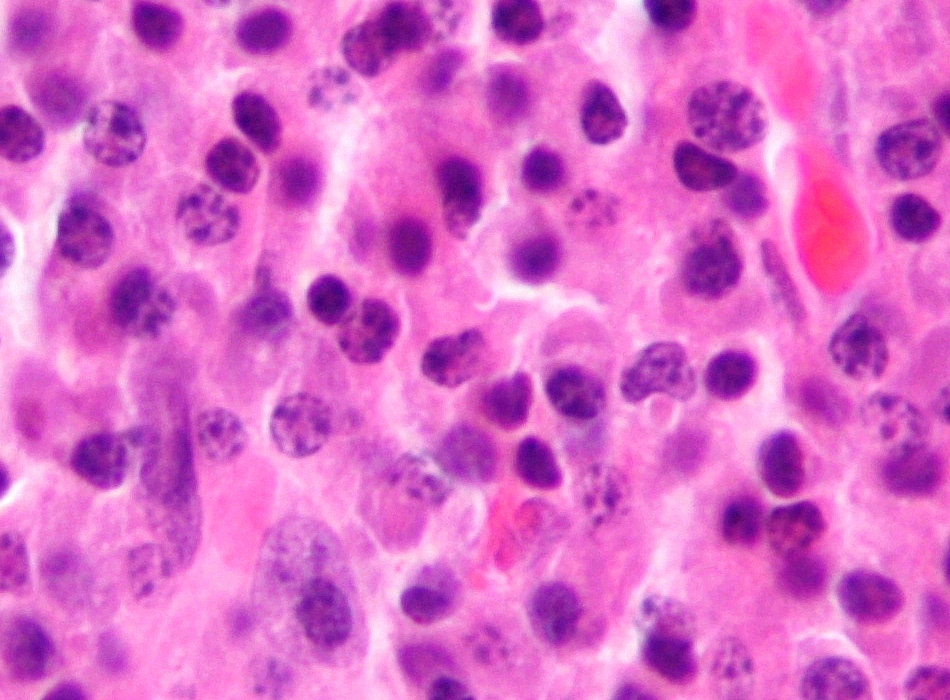
Matures in bone marrow. Markers CD19, CD20. When activated it becomes a plasma cell, the antibody factory.
T cell
The command line
Plasma cells: the B cell endpoint, an off-center clock-face nucleus.tap to enlarge
Matures in the thymus. Marker CD3. Splits into CD4 helper (the coordinator) and CD8 cytotoxic (the killer).
NK cell
The lymphoid that acts innate
Marker CD16, CD56. Lymphoid by birth, but it kills on sight with no antigen needed. It reads missing selfHealthy cells display MHC class I. Virus-infected and tumor cells often drop it. The NK cell kills any cell that fails to show its MHC class I, so it is on patrol for missing-self.: a cell that drops its MHC class I gets killed.
Trap 1: Mast cell vs basophil
They share IgE and histamine, so the board pairs them. The split: a basophil circulates in blood; a mast cell lives resident in tissue. A mast cell is its own cell, not a basophil that crawled into tissue. Blood granulocyte equals basophil; tissue resident equals mast cell.
Trap 2: NK cell, lineage vs job
The NK cell is lymphoid by lineage (it shares the common lymphoid progenitor with B and T cells) but innate by function (no antigen specificity, no memory). Lymphoid family, innate job. Do not let the family name fool you on the function question.
Trap 3: dendritic cells come from both roads
The conventional (myeloid) dendritic cell rises from the monocyte side; the plasmacytoid dendritic cell sits on the lymphoid side. If a question asks the single lineage of all dendritic cells, the trap is that there is not one; they arise from both.
A bone marrow study tracks a cell that makes platelets. Before you read on, which progenitor is its parent?
A skin biopsy is full of histamine-loaded cells living in the tissue. Quick: which cell, and which road built it?
Elimination round. Clues drop one at a time. Knock out the cell that does not fit until one is left standing.
Neutrophil
multilobed, bacteria
NK cell
CD56, innate
B cell
CD19, antibodies
Red blood cell
carries oxygen
Memory hookNK has no K-nowledge. It needs no specific antigen and keeps no memory. Lymphoid by birth, innate by behavior.tap to reveal
Five Quick Hits
Rapid Review
Five questions pulled fresh each visit, answer order shuffled. Low pressure. Just checking it stuck.
One Patient at a Time
Board Walkthrough
Real board-style cases, one at a time. Double tap to highlight a clue, long press to cross out an option. Tap Remix to reshuffle the deck.
References: standard histology, hematology, and immunology board texts. Images: Wikimedia Commons (see each lightbox for attribution).
Medically reviewed by Fatima Ali, DO and Kaitlyn Cocuzzo, MD. Vignettes are original clinical teaching cases; demographics, values, and answer order are written for practice. Confirm management against current references at the point of care.
Bone Wizardry is an independent educational resource for visual learning in the medical sciences. It is not affiliated with, endorsed by, or sponsored by any licensing or examination board, contains no real or recalled examination questions, and does not guarantee any educational or examination outcome.