Three rejection clocks run on different schedules and different immune hardware. Read the timer and the biopsy, and the type names itself. Then meet the drugs that buy the graft time.
Commit before you scroll. A 47-year-old man with type 2 diabetes and progressive diabetic nephropathy receives a living-donor kidney transplant. Eight days later he feels achy and feverish, his urine output drops, and serum creatinine climbs to 2.4 mg/dL from 1.1 two days earlier. Doppler shows the graft is well perfused. Biopsy reveals a dense interstitial infiltrate of mononuclear lymphocytes. Which mechanism is most likely responsible?
Recipient T cells sensitized against donor MHC antigens
Donor B cells attacking host MHC antigens
Proliferation of graft vascular smooth muscle from chronic injury
Good instinct reaching for antibodies, because a failing graft fast feels like an antibody job. You know how a transfusion reaction explodes in minutes because the antibodies were already loaded and waiting? But preformed antibodies cause thrombosis and a dead, blue graft within minutes, not a cellular infiltrate on day 8. And this is host-versus-graft: donor immune cells are not the ones attacking. A dense mononuclear (lymphocytic) infiltrate a week in is T-cell driven. Days to weeks plus a mononuclear infiltrate means acute cellular rejection: host T cells against donor MHC.
Section 1 of 5
The Three Rejection Clocks
Three flip cards. Front: the timer. Tap to flip: the hardware, the morphology, the trap.
The prize. A kidney graft moments before implantation. Everything on this page is the fight to keep tissue this alive inside someone else.
Minutes to hours
Hyperacute
Onset: within minutes of reperfusion
Preformed antibodies fire on contact. Vessels thrombose. Graft dies in front of you.
tap to flip →
The hardware
How it fires
Type II hypersensitivity. Recipient antibodies that already existed before transplant (anti-ABO or anti-HLA) bind donor endothelium and activate complement on contact.
Morphology
Widespread vascular thrombosis, fibrinoid necrosis of vessel walls, ischemic necrosis. A blue, flaccid, dead graft.
Outcome
Irreversible. The graft must come out. Prevention is ABO and HLA crossmatching before surgery.
Weeks to months
Acute
Onset: days to weeks, within 6 months
The common one. Usually cell mediated: T cells flood the graft. Reversible with drugs.
tap to flip →
The hardware
Cellular route (most common)
Type IV hypersensitivity. Recipient CD8+ and CD4+ T cells get sensitized to donor MHC and attack. The dense interstitial lymphocytic infiltrate you see on biopsy is them.
Humoral variant
Antibodies form after transplant and deposit in vessels. Biopsy shows C4d in peritubular capillaries plus vasculitis and neutrophils.
Outcome
Usually reversible. Prevent and treat with immunosuppressants (calcineurin inhibitors, mycophenolate, steroids).
Months to years
Chronic
Onset: months to years later
Slow. Vessels thicken from the inside out. The graft quietly scars and shrinks.
tap to flip →
The hardware
How it smolders
Both cellular and humoral (Type II and IV). Recipient CD4+ T cells react to donor peptides on allogeneic MHC, release cytokines, and drive vascular smooth muscle proliferation.
Morphology
Arteriosclerosis of graft vessels: fibrointimal proliferation narrows the lumen. Parenchymal atrophy and interstitial fibrosis follow. A small, scarred kidney.
Outcome
Largely irreversible. More immunosuppression does not fix established vascular scarring. Retransplant is often the answer.
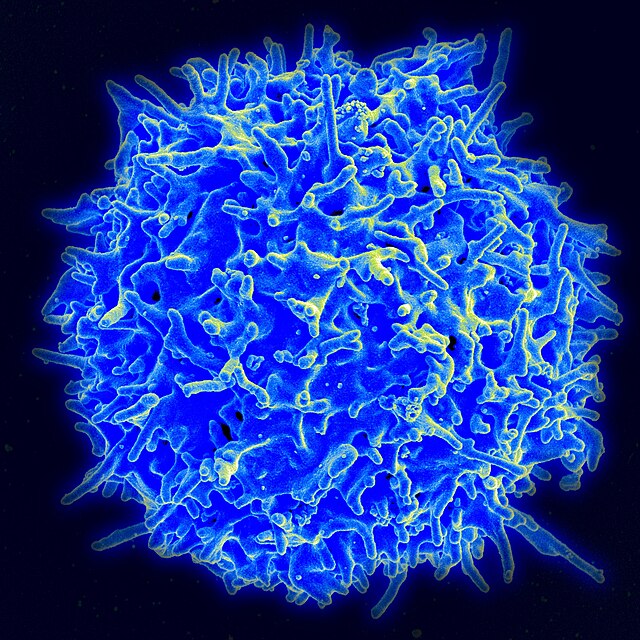
The cellular engine of acute rejection. A T lymphocyte. When it recognizes donor MHC as foreign, it recruits this entire cell family into the graft interstitium.
PATHOLOGY · acute cellular rejection, renal graft biopsy · tap to expand
Board trap. Timing is the single strongest clue. Minutes and a thrombosed graft is hyperacute. Days to weeks with a mononuclear infiltrate is acute. Months to years with vessel wall thickening is chronic. A rising creatinine alone does not pick the type. Read the clock and the biopsy together.
Section 2 of 5
Stage It On The Timeline
A case loads. Read the clock and the finding. Predict the type before the marker slides.
Graft Ward Rounds
transplant surgery ward round
Hyperacutemin to hr
Acutewk to mo
Chronicmo to yr
Section 3 of 5
Map The Drug To Its Target
Tap a drug, then tap the molecular step it blocks. Six drugs, six steps along T-cell activation.
0 of 6 placed correctly
Section 4 of 5
Memory Hooks
Tap to unblur. Test yourself before you peek.
⏱
Rejection timing
Minutes (hyperacute, antibody, thrombose). Weeks (acute, T cell, cellular). Years (chronic, slow vessel wall thickening). The clock calls the type before the biopsy does.
tap to reveal
🧪
Calcineurin duo (cyclosporine, tacrolimus)
Both block calcineurin, so NFAT never turns on, so IL-2 is never transcribed. Cyclosporine binds cyclophilin. Tacrolimus binds FKBP. Same downstream door, different handles.
tap to reveal
💬
Sirolimus vs tacrolimus
Both bind FKBP, but sirolimus walks past calcineurin and hits mTOR. So tacrolimus stops IL-2 from being made; sirolimus stops the T cell from responding to IL-2. Make versus answer.
tap to reveal
🧬
Mycophenolate and azathioprine
Both starve lymphocytes of purines. Mycophenolate blocks IMPDH (IMP to GMP). Azathioprine becomes 6-MP then 6-TGN. Lymphocytes have no salvage path, so they are selectively caught starving.
tap to reveal
Section 5 of 5
Walkthrough
Original board-style stems, one at a time. Tap a choice to commit. Right-click or long-press to cross out. Double-click or double-tap to highlight.