Too much cortisol, too many problems. The syndrome with a 3-step algorithm that tells you exactly where the cortisol is coming from.
A 34-year-old woman presents with progressive weight gain concentrated in her abdomen and face, easy bruising, and wide purple stretch marks on her abdomen. She reports increased facial fullness ("moon face"), a fat pad on the back of her neck, and proximal muscle weakness. BP is 148/96. Fasting glucose is 156 mg/dL.
What is the most likely diagnosis?
THE HOOK
The Cortisol Catastrophe
Everything wrong with this patient traces back to one hormone doing too much for too long.
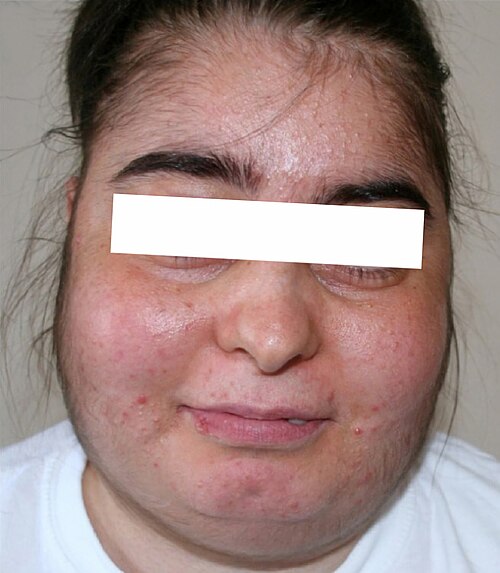
📷 CUSHING HABITUS: central obesity, moon face, thin extremities · tap to expand
🌕
Moon Face
Cortisol redistributes fat to the face, creating a round, plethoric appearance. The redness (plethora) is from cortisol thinning the skin and dilating facial capillaries.
🐫
Buffalo Hump
Dorsocervical fat pad. Cortisol tells fat to move centrally: face, trunk, and upper back. Extremities stay thin because cortisol simultaneously breaks down peripheral muscle and fat.
🔴
Purple Striae💡Purple + wide = collagen gone. Pink + thin = just fat. clinical medicine love this distinction.
Wide (>1cm), purple/violaceous. Cortisol breaks down collagen in the skin, making it paper-thin. Normal stretch marks are pink or white and narrow. Purple and wide = cortisol.
💪
Proximal Weakness✋Can't get out of a chair = proximal weakness. Cortisol is eating the thigh muscles to make glucose.
Cortisol is catabolic to muscle. It breaks down protein in proximal muscles (thighs, shoulders) to fuel gluconeogenesis. Patient cannot rise from a chair without pushing off.
💓
Hypertension
Cortisol at high levels activates the mineralocorticoid receptor (mimics aldosterone), causing sodium retention, volume expansion, and elevated blood pressure.
🍬
Hyperglycemia
Cortisol opposes insulin at every turn: increases gluconeogenesis, increases glycogenolysis, decreases peripheral glucose uptake. Many Cushing patients develop frank diabetes.
🦴
Osteoporosis
Cortisol inhibits osteoblasts and increases osteoclast activity. Chronic excess = pathologic fractures, especially vertebral compression fractures in a young person.
💧
Thin Skin & Easy Bruising
Cortisol degrades collagen. The skin becomes fragile and translucent. Minor trauma causes large ecchymoses. Wounds heal poorly.
★The #1 board clue for Cushing: wide, purple striae. Normal stretch marks from weight gain are thin, pink, or white. If the striae are purple, wide (>1cm), and on the abdomen/axillae/thighs, you are looking at cortisol excess.
⚠️
Board Trap: Striae Color
Pink/white striae = normal (from rapid weight gain, pregnancy, growth spurts). Purple/violaceous striae = pathologic cortisol excess. The color is the key. Don't diagnose Cushing from normal stretch marks.
THE SOURCE
Where Is the Cortisol Coming From?
Three possible sources, and identifying which one changes everything about the workup.
The Three Categories
Before you even start testing, know that cortisol excess has three possible origins:
Exogenous (iatrogenic): patient is taking steroids (prednisone, dexamethasone, inhaled/topical steroids at high doses). This is the most common cause overall.💡Most common cause = the pill the doctor prescribed. Always ask about medications first.
ACTH-dependent: a tumor is making ACTH, which is telling the adrenals to make too much cortisol. Either the pituitary (Cushing disease) or ectopic (lung cancer).
ACTH-independent: the adrenal gland itself has a tumor making cortisol on its own, ignoring all signals.
Cushing Syndrome
The umbrella term. Any cause of pathologic cortisol excess: pills, pituitary tumors, adrenal tumors, ectopic ACTH. All of these produce the clinical features. The syndrome is the clinical picture.
Cushing Disease
One specific cause: a pituitary adenoma making excess ACTH. It is the most common endogenous ACTH-dependent cause. Disease is a subset of syndrome.
💡Syndrome vs. Disease: All Cushing disease is Cushing syndrome, but NOT all Cushing syndrome is Cushing disease. Syndrome = any cortisol excess. Disease = specifically pituitary adenoma.
Causes at a Glance
Most common cause overall: Iatrogenic (exogenous steroids)💡The answer to "most common cause of Cushing syndrome" is always "the doctor did it" (prescribed steroids).
Most common endogenous cause: Pituitary adenoma (Cushing disease, ~70% of endogenous cases)
Classic ectopic ACTH source: Small cell lung carcinoma💡Small cell lung cancer is the great mimicker: it can make ACTH, ADH (SIADH), Lambert-Eaton antibodies. It produces everything.
If the question says "most common cause of Cushing syndrome" = exogenous steroids (iatrogenic). If the question says "most common endogenous cause" or "most common cause of Cushing disease" = pituitary adenoma. The word "endogenous" completely changes the answer.
THE VILLAINS
Rogues Gallery
Each one floods the body with cortisol. Tap any card to flip it and learn how.
🧠
The Pituitary Puppet Master
Cushing Disease
tap to unmask
Pituitary Adenoma
A corticotroph adenoma secretes ACTH autonomously, ignoring normal negative feedback. ACTH whips both adrenals into overdrive.
~70% of endogenous ACTH-dependent cases. Bilateral adrenal hyperplasia on CT.
Break it down: ACTH high + MRI shows adenoma
💫
The Silent Adrenal
Adrenal Adenoma
tap to unmask
Adrenal Adenoma
The adrenal gland grows a benign tumor that pumps out cortisol on its own, ignoring all ACTH signals. ACTH is suppressed by the feedback.
Unilateral mass on CT abdomen. Contralateral adrenal atrophies.
Break it down: ACTH low + adrenal mass on CT
💩
The Lung Hijacker
Ectopic ACTH (SCLC)
tap to unmask
Small Cell Lung Carcinoma
A neuroendocrine lung tumor secretes ACTH ectopically. No pituitary involvement. ACTH is sky-high. Onset is rapid.
Clues: heavy smoker + rapid onset + hypokalemia + hyperpigmentation.
Break it down: ACTH very high + MRI negative + no dex suppression
💊
The Doctor's Mistake
Iatrogenic
tap to unmask
Exogenous Steroids
Prednisone, dexamethasone, high-dose inhaled/topical steroids. The most common cause overall. ACTH is suppressed. Adrenals are atrophic.
Ask about medications before ordering any test.
Break it down: ACTH low + small bilateral adrenals + medication history
THE CENTERPIECE
The 3-Step Diagnostic Algorithm
This is the most tested part of Cushing syndrome. Work through each step by making a choice.
⚡ clinical medicine trick
If the stem hands you a sky-high cortisol that did not suppress on low-dose dex, the screen is already done. Skip Step 1. Go straight to ACTH. Step 1 only matters when the question is whether Cushing is real at all. Once the writer hands you a confirmed elevated cortisol, your only remaining job is to source it.
STEP 1 OF 3
Confirm Hypercortisolism
You suspect Cushing syndrome from the clinical features. Before anything else, you need to prove the patient actually has too much cortisol. Which test do you order?
STEP 2 OF 3
Is It ACTH-Dependent or Independent?
You confirmed hypercortisolism. Now you need to figure out why the cortisol is high. The pivot point: is someone telling the adrenals to make cortisol (ACTH-dependent) or are the adrenals doing it on their own (ACTH-independent)?
You measure serum ACTH. What does the result tell you?
STEP 3 OF 3 · ACTH-DEPENDENT
Pituitary or Ectopic?
ACTH is high. Something is making ACTH that is telling the adrenals to overproduce cortisol. The two main sources: the pituitary (Cushing disease) or an ectopic source (most classically small cell lung cancer).
What is the next step?
STEP 3 OF 3 · ACTH-INDEPENDENT
Find the Adrenal Source
ACTH is suppressed. The adrenals are making cortisol autonomously, and that high cortisol is suppressing ACTH via negative feedback. The adrenal is ignoring the brain.
What is the next step?
BONUS STEP · MRI NEGATIVE
ACTH-Dependent but MRI Shows Nothing?
Brain MRI is negative. ACTH is still elevated. Either the pituitary adenoma is too small to see on MRI, or the ACTH is coming from somewhere else entirely.
Now what?
Algorithm Summary
Step 1: Confirm cortisol is high (24h urine free cortisol, late-night salivary cortisol, or 1mg dex suppression test)
Step 2: Measure ACTH to determine if it is ACTH-dependent or independent
Step 3a: Low ACTH = adrenal source = CT abdomen
Step 3b: High ACTH = pituitary or ectopic = Brain MRI first
Step 3c: High ACTH + negative MRI = high-dose dex suppression test
Cushing Workup at a Glance
The static map of the algorithm. Every step flows from one question.
💡High-dose dex suppression: If cortisol suppresses (>50% decrease), the source is the pituitary (Cushing disease, adenoma too small to see). If cortisol does NOT suppress, the source is ectopic (small cell lung cancer is the classic). Pituitary tissue still responds to very high doses of dex. Ectopic tumors ignore dex completely.
⚠️
Board Trap: Low-Dose vs. High-Dose Dex
Low-dose (1mg) = screening test. Answers: "Does the patient have Cushing?" Normal people suppress cortisol. Cushing patients do NOT. High-dose (8mg) = localizing test. Answers: "Is it pituitary or ectopic?" Only used after ACTH is confirmed high AND MRI is negative. Do not confuse the two.
CLINICAL TOOL
Decision Tree: Cushing Workup to Source
Walk through the 3-step algorithm one branch at a time.
Step 1: Confirm excess cortisol (need any 2 abnormal)
Screening tests: 24-hr urine free cortisol, late-night salivary cortisol (x2), 1 mg overnight dexamethasone suppression test. Two or more abnormal = confirmed hypercortisolism.
Step 2: Is it ACTH-dependent? Measure plasma ACTH.
Adrenal source (ACTH-independent). Next step: CT adrenal.
Adrenal carcinoma: large, calcified, may invade surrounding structures. Poor prognosis. Surgery + mitotane.
Bilateral adrenal hyperplasia: both glands enlarged. Rare. May be autonomous (primary pigmented nodular hyperplasia) or part of a syndrome (McCune-Albright).
ACTH-dependent: pituitary or ectopic. Proceed to Step 3.
Step 3: Pituitary vs. ectopic? Start with MRI pituitary.
Cushing disease (pituitary adenoma): most common endogenous cause at about 70%. Treatment: transsphenoidal resection. Confirm with IPSS if tumor is small or equivocal.
High-dose DST (8 mg):
Pituitary source (Cushing disease): the adenoma still responds to strong negative feedback. Proceed to IPSS for confirmation if needed.
Ectopic ACTH source: autonomous tumor, not responsive to feedback. CT chest and abdomen to find SCLC or carcinoid. Classic clue: smoker with rapid-onset Cushing and hypokalemia.
IPSS (inferior petrosal sinus sampling): definitive test. Central-to-peripheral ACTH ratio above 2 confirms pituitary source. Ratio below 2 points to ectopic.
Medically reviewed by Kaitlyn Cocuzzo, MD and Fatima Ali, DO · Last reviewed June 2026
Bone Wizardry is an independent educational resource for visual learning in the medical sciences. It is not affiliated with, endorsed by, or sponsored by any licensing or examination board, contains no real or recalled examination questions, and does not guarantee any educational or examination outcome.
CHALLENGE
Clinical Questions
5 randomized questions from a pool of 10. Reload for a fresh set.