Hypersensitivity Pneumonitis

The lung that overreacts to the barn, not to pollen. Why farmer's lung is an antibody-and-T-cell ambush with a totally NORMAL IgE, and why it is never the fungus ball.

A 50-year-old cattle farmer has recurrent cough, breathlessness, fever, and chest tightness for several weeks, always a few hours after a shift mucking out an enclosed moldy hay barn. He has no seasonal allergies. Labs: serum IgE is NORMAL, but he has high serum precipitating antibodies to thermophilic actinomycetes. PFTs: restrictive pattern with reduced diffusing capacity. Chest film: multiple bilateral nodules sparing the very top and very bottom of the lungs.

What is the underlying immune mechanism?

A. Type III immune-complex plus type IV cell-mediated reaction to an inhaled antigen
B. Type I IgE-mediated atopic reaction
C. A fungus ball colonizing an old lung cavity
D. Neoplastic transformation
E. IgE-mediated allergy to Aspergillus with mucus plugging
F. Caseating granulomatous infection

Break Down the Clues

A farmer with the same illness every time he works the barn. Three clues set the trap.

Clue 01
Cattle farmer + enclosed moldy hay barn
The exposure is the diagnosis. Hypersensitivity pneumonitis is named for the trigger: an inhaled organic antigenA protein or microbe you breathe in, not a chemical irritant. Classic ones: thermophilic actinomycetes in moldy hay (farmer's lung), bird droppings and feathers (bird fancier's lung), and molds in hot tubs or humidifiers. The lung reacts to the protein, not to a toxin.. Moldy hay grows thermophilic actinomycetes, the classic cause of farmer's lung. When the job and the timing line up like this, stop reaching for zebras.
Makes less likely: Random idiopathic lung disease (this one has a clear, repeatable trigger)
Clue 02
Fever + cough + dyspnea a few hours after exposure, then it fades
This rhythm is the whole game. Symptoms hit 4 to 8 hours after he walks into the barn and ease when he stays away on weekends or vacation.🔑Farmer + Fevers a Few hours after work that Fade away on days off = HP, not asthma. That delay is too slow for an instant allergy and too fast for a tumor. A reaction that takes hours and brings a fever screams immune complexes, not pollen.
Makes less likely: Atopic asthma (that wheeze hits within minutes, no fever), pneumonia (would not clear on weekends)
No seasonal allergies · serum IgE is NORMAL
Clue 03: the red herring trap
Here is where most students slip. "Allergy to mold? Must be an IgE thing." No. In HP the IgE is normal and there is no history of hay fever, eczema, or atopy. The allergic diseases that ride on high IgE (atopic asthma, ABPAAllergic bronchopulmonary aspergillosis: a type I (IgE) plus type III reaction to Aspergillus living in the airways of asthmatics and cystic fibrosis patients. Sky-high IgE, eosinophilia, central bronchiectasis, brown mucus plugs. Totally different from HP.) are off the table the moment IgE comes back normal.
Makes less likely: Atopic asthma and ABPA (both need a high IgE)

Two Findings That Seal It

One blood test, one breathing test, and a film that points away from the impostor.

Clue 04: the lock
High serum precipitating antibodies (IgG) to thermophilic actinomycetes
Precipitins are IgG, not IgE. They form when his immune system has made loads of antibody against the inhaled antigen, so when antigen and antibody meet they clump into immune complexesAntigen stuck to antibody (IgG) forms a lattice that drops out of solution ("precipitates") and lodges in tissue. The complexes activate complement and drag in neutrophils, which is what damages the alveolar walls a few hours after exposure. This is the definition of a type III reaction..🔑Precipitins = IgG = type III. The antibodies Pile up and Precipitate when they meet the antigen. Finding precipitins says: he has been sensitized, and the antibody arm is loaded and waiting.
Clue 05
Restrictive PFTs with low diffusing capacityDLCO: how well gas crosses from the air sac into the blood. When the alveolar walls get inflamed and thickened, oxygen has a harder time crossing, so DLCO drops. Restrictive pattern (low volumes, normal-to-high ratio) plus low DLCO is the signature of interstitial lung disease, the opposite of asthma's obstruction. · CXR: bilateral nodules sparing apices and bases
Restriction (stiff, small lungs) with a low DLCO means the disease lives in the alveolar walls, not the airways. That is interstitial, not obstructive. And the film matters: HP scatters nodules through the mid lung and spares the very top and very bottom. The impostor, aspergilloma, does the opposite: one round ball inside one old cavity, usually up high.
CT scan showing an aspergilloma fungus ball inside a pre-existing cavity
📷 What HP is NOT: a single fungus ball in one old cavity with an air crescent · tap to expand
Diagnosis: Hypersensitivity Pneumonitis (Farmer's Lung)
Repeated barn exposure + delayed fever and dyspnea + normal IgE + IgG precipitins + restrictive PFTs = extrinsic allergic alveolitis. The mechanism is a type III plus type IV reaction to an inhaled organic antigen.

A Two-Punch Immune Reaction

Tap each phase. The acute attack and the chronic damage use different weapons.

Here is the cleanest way to hold it: HP is the immune system doing two things to the same antigen at two different speeds. The fast punch is antibodies. The slow punch is T-cells. Neither one is IgE.

⏱️
Acute punch → Type III
Hours after exposure
He has already made tons of IgG against the moldy-hay antigen. Walk back into the barn, breathe the antigen, and antigen meets antibody in the alveolar wall → immune complexes form, complement fires, neutrophils flood in. That inflammation is why the fever, cough, and breathlessness arrive 4 to 8 hours later, not instantly. Leave the barn and it cools off. This is the classic immune-complex (type III) reaction, the same family as serum sickness.
🧹
Chronic punch → Type IV
Repeated exposure over months to years
Keep inhaling the antigen and T-cells take over. CD4 and CD8 lymphocytes pile into the lung and organize into poorly formed noncaseating granulomasLoose, "loose-knit" clusters of macrophages and giant cells with no cheesy center. Unlike the tight, well-formed granulomas of sarcoidosis or TB, HP granulomas are sloppy and scattered around small airways. No central necrosis means non-caseating.. This is delayed-type (type IV) hypersensitivity, the same machinery as a TB skin test. If exposure never stops, the granulomas give way to interstitial fibrosis and the damage stops being reversible.🔑III then IV: antibodies bring the fever first (hours), T-cells bring the scar later (years).

Tap a card to open it.

Chronic hypersensitivity pneumonitis histology with interstitial fibrosis
📷 Chronic HP: repeated type IV injury scars into interstitial fibrosis · tap to expand
⚠️
Board Trap: Normal IgE Is the Tell
The word "allergic" in extrinsic allergic alveolitis fools people into picking a type I IgE answer. But HP runs on IgG and T-cells, so the IgE is normal and there are no eosinophils driving it. Compare:
Type I (atopic asthma, ABPA): IgE sky-high, eosinophils up, reaction in minutes.
HP (type III + IV): IgE normal, IgG precipitins up, reaction in hours.
If a "mold allergy" vignette gives you a normal IgE, it is HP, not an IgE disease.

Four Lookalikes, One Right Answer

Each one shares something with HP. Flip the card to see how it gives itself away.

🌾
Hypersensitivity Pneumonitis
The right answer
tap to flip

How to spot it

  • Trigger: inhaled organic antigen (moldy hay, birds, hot tubs)
  • Immunology: type III + IV, IgE normal, IgG precipitins up
  • PFTs: restrictive, low DLCO
  • BAL: lymphocytosis, low CD4:CD8 ratio
  • Fix: remove the antigen → early disease reverses
🦠
Aspergilloma
The fungus ball
tap to flip

Why it is NOT HP

  • What it is: a ball of Aspergillus colonizing a pre-existing cavity (old TB, sarcoid, bulla)
  • Not an allergy at all: it is colonization, not hypersensitivity
  • Imaging: one round mass in one cavity, "air crescent," moves when the patient rolls over
  • Classic sign: hemoptysis
  • No precipitin-driven alveolitis, no restrictive PFT pattern
🥕
ABPA
The IgE Aspergillus reaction
tap to flip

Why it is NOT HP

  • Who: asthmatics and cystic fibrosis patients
  • Immunology: type I + III to Aspergillus → IgE sky-high, eosinophilia
  • Airways, not alveoli: central bronchiectasis, brown mucus plugs
  • PFTs: obstructive (it is an airway disease)
  • The high IgE alone rules it apart from HP
💨
Atopic Asthma
The instant wheeze
tap to flip

Why it is NOT HP

  • Immunology: type I, IgE high, mast cells and eosinophils
  • Timing: wheeze within minutes, no fever
  • PFTs: reversible obstruction (bronchodilator helps)
  • History: atopy, eczema, hay fever
  • HP has none of these: normal IgE, delayed fever, restriction

Guess Before You Look

Don't just click through. Commit to an answer first, then see if you were right.

1. A farmer has cough and fever 6 hours after the barn. You order one immunology test to separate HP from atopic disease. Which result fits HP?
2. You do PFTs. Which pattern points to HP rather than asthma or ABPA?
3. The disease is caught early, before fibrosis. What single intervention helps the most?

Forms, Diagnosis & Treatment

Tap the form cards, then read what to order and what to do.

🔥
Acute
Hours after a heavy exposure
Flu-like: fever, chills, cough, dyspnea, malaise 4 to 8 hours after a big antigen hit. Looks like an infection but clears in a day or two away from the trigger. Fully reversible if exposure stops.
📅
Subacute / Chronic
Weeks to years of low-grade exposure
Progressive cough, breathlessness, weight loss, fatigue. Repeated type IV injury builds interstitial fibrosisScar tissue replacing normal lung. Once the lung is fibrotic, the damage is permanent and antigen removal can no longer reverse it, though it can stop further progression. This is why catching HP early matters.. By the chronic fibrotic stage, removing the antigen halts progression but cannot undo the scar.

Tap a card to open it.

What to order:

TestFindingWhy
Serum IgENormalHP is not IgE-mediated; this separates it from atopic disease
Serum precipitinsIgG to the antigen, elevatedProof of prior sensitization (type III arm)
PFTsRestrictive, low DLCOInterstitial wall disease, not airway disease
HRCTGround-glass, centrilobular nodules, mid-zone, air trappingSpares apices and bases; mosaic pattern
BALLymphocytosis, low CD4:CD8T-cell driven (type IV); opposite of sarcoidosis
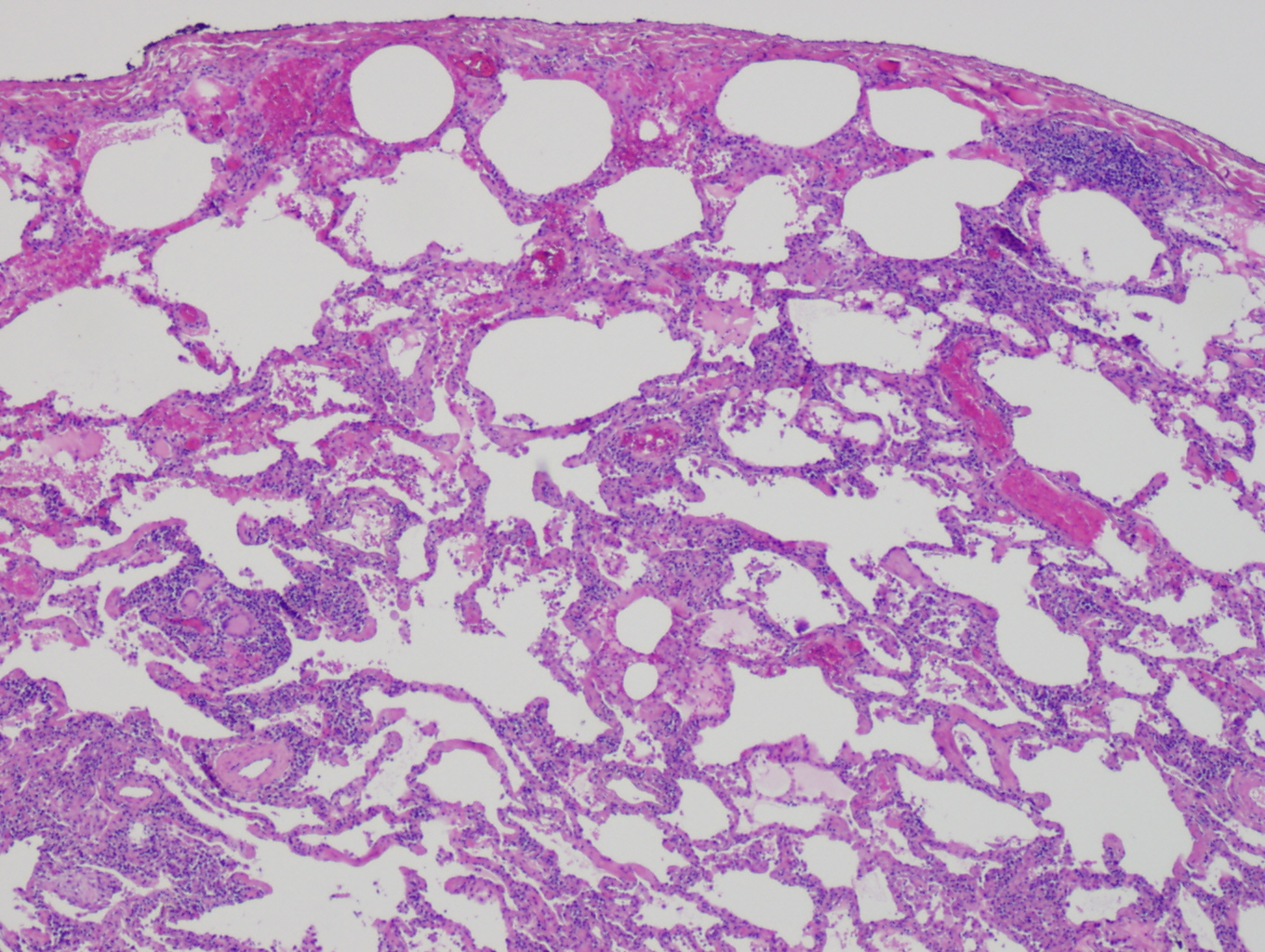
Biopsy (if needed)Poorly formed noncaseating granulomas around airwaysConfirms; loose granulomas, no cheesy necrosis
Hypersensitivity pneumonitis histology with loose noncaseating granulomas and giant cells
📷 Biopsy: loose noncaseating granulomas and a giant cell near the small airways · tap to expand

Treatment, in order of importance:

1. Remove the antigen. This is the whole ballgame. Get him out of the barn, use respiratory protection, fix the moldy hay storage. Early disease reverses on avoidance alone.

2. Corticosteroids for severe acute attacks or progressive disease, to calm the inflammation while exposure is controlled. Steroids speed recovery but do not replace avoidance.

3. Chronic fibrotic disease: supportive care, oxygen, and in end-stage cases, transplant. Steroids will not un-scar a fibrotic lung.

⚠️
Board Trap: HP vs Sarcoidosis on BAL
Both give a lymphocyte-rich lavage, so the CD4:CD8 ratio is the splitter.
HP: LOW CD4:CD8 (CD8 cytotoxic cells dominate).
Sarcoidosis: HIGH CD4:CD8 (CD4 helper cells dominate, often greater than 3.5).
Same lymphocytosis, opposite ratio.

Mechanism Elimination

Four mechanisms. One is farmer's lung. Watch the clues knock out the rest.

Type I IgE Reaction
Mast cells, instant allergy
Type III + Type IV
Immune complexes then T-cells
Fungal Colonization
A ball growing in a cavity
Neoplastic Transformation
Uncontrolled tumor growth
Ready? Let's eliminate.

Clinical Vignettes

5 patients just walked in from the barn. Don't let the impostors fool you.

Not bad for someone who just learned this.
clinical Walkthrough

clinical Walkthrough

Original clinical vignettes. Shuffled, never-repeat, full explanations for every choice.

Medically reviewed by Kaitlyn Cocuzzo, MD and Fatima Ali, DO · Last reviewed June 2026
Bone Wizardry is an independent educational resource for visual learning in the medical sciences. It is not affiliated with, endorsed by, or sponsored by any licensing or examination board, contains no real or recalled examination questions, and does not guarantee any educational or examination outcome.