Section 1 of 4
The Grief Journey
Kubler-Ross mapped five stops on the way to acceptance. They aren't linear, they aren't required, and patients ricochet between them. Tap each stop to walk it.
The wall goes up. The patient cannot face the truth yet. "There must be a mistake. Run the test again."
"My son is fine. The doctor is wrong. Get another opinion."The wall cracks. Rage spills out: at the doctor, at God, at themselves, at strangers. The anger isn't really about you; it's the only outlet that doesn't feel like drowning.
"How could you let this happen? You should have caught it sooner."The negotiation phase. Wishful thinkingMagical-deal-making with God or the universe. "If I do X, please make Y not real." Hallmark of stage 3. and offerings to God. "If I just pray harder, if I just donate more, if I just promise to be a better person."
"God, if you save him, I'll never miss church again. I'll do anything."The deal didn't work. The truth lands. Intense sadness, decreased sleep, hollow days. This is the stage that LOOKS like MDD but isn't, as long as function and reality-testing hold.🔑Stage 4 grief = sad + sleeps poorly. MDD = sad + can't function + can't feel joy + lasts >2 weeks. Sad alone is not a diagnosis.
"I can't get out of bed. Everything reminds me of him. I just want to sleep."Not "I'm happy about this." More like "this is my new shape now." The loss becomes part of the patient's story instead of a wound that defines every minute. They can talk about the person without falling apart, then fall apart again next week. That's still acceptance.
"I'll always miss him. But I'm starting to live again."Section 2 of 4
SIGECAPS Detective
MDD needs 5+ symptoms for 2+ weeks, and at least one must be depressed mood or anhedonia. Tap each symptom your patient has. Watch the threshold.
Imagine a real patient. Tap every symptom they actually have. You're trying to reach the diagnostic threshold (or stay safely under it).
Section 3 of 4
Grief vs. The Disorder
Two patients look identical from across the room. Flip each card. The differences live on the back.
Sadness with a reason. Healing on its own clock.
A disease state that doesn't always need a reason.
The Bedside Algorithm
You're standing in the room with our widow. Walk the decision tree. Guess before you tap to reveal.
Clinical Reference Images
 Serotonergic synapse: SSRI mechanism of action targets the reuptake transporter
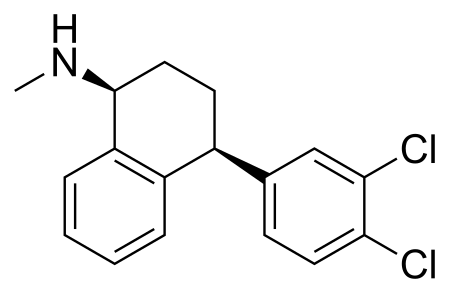 Sertraline (Zoloft): first-line SSRI for MDD, pregnancy category C
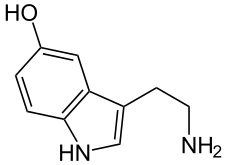 Serotonin (5-HT): the monoamine implicated in the monoamine hypothesis of depression
 Grief and melancholia: historically recognized as distinct from clinical depression
Section 4 of 4
Board Walkthrough
30 original clinical vignettes. One at a time, shuffled, never repeats. Right-click or long-press to cross out. Double-tap to highlight.