Trunk cannot sit upright but finger-to-nose is okay? That is vermis. Limb overshoot on one side? Hemisphere. Flinging is not cerebellum.
Before you scroll: A 46-year-old man has difficulty walking and cannot sit upright without swaying. Finger-to-nose testing is relatively preserved, but he has a wide-based gait and marked truncal instability. Which cerebellar region is most likely affected?
The trunk is the clue. The cerebellar vermis coordinates axial and proximal musculature for posture and gait. Lateral hemispheres coordinate ipsilateral limbs, so they give dysmetria and intention tremor on finger-to-nose testing. Subthalamic lesions cause hemiballismus, not truncal ataxia. Truncal instability and wide-based gait with preserved limb testing = cerebellar vermis.
Ataxia split
Trunk, Limb, Input, or Brake?
The movement pattern tells you which part of the motor system failed.
Cerebellar vermis
Axial coordinator
Body partTrunk, posture, gait, proximal/axial muscles
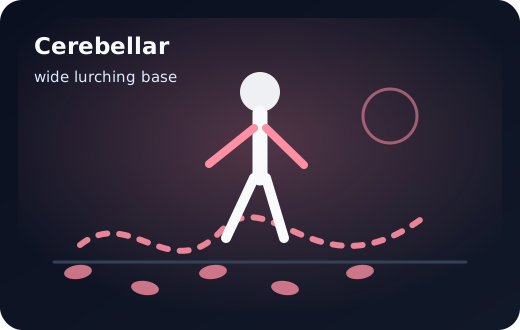
Classic findingsTruncal ataxia, wide-based gait, cannot sit without swaying
TrapThis is input failure, not cerebellar computation failure
Subthalamic nucleus
Broken movement brake
MovementContralateral hemiballismus
PatternLarge-amplitude flinging, proximal, sudden
Not ataxiaStrength and coordination can be intact
TrapFlinging is basal ganglia, not cerebellum
Board trap: A wide-based gait alone is not enough. Add the limb exam and Romberg behavior to separate vermis, hemisphere, sensory, and vestibular patterns.
Ataxia switchboard
Localize the Movement Error
Pick the movement. The readout separates cerebellar trunk, cerebellar limb, sensory input, vestibular, and basal ganglia patterns.
Which structure owns this finding?
Pick a clue.Ask what is abnormal: trunk balance, limb targeting, proprioceptive input, vestibular signal, or basal ganglia brake.
Board trap: Subthalamic nucleus is a basal ganglia brake problem. It causes flinging, not dysmetria or truncal sway.
Two-gate discriminator
Decision Tree
Use the exam to decide whether the trunk, limb targeting, sensory input, vestibular signal, or basal ganglia brake is failing.
1
Is the main problem axial posture and trunk control, especially sitting or wide-based gait?
Yes. Limb targeting is relatively preserved.
No. The problem is limb targeting, sensory dependence, vertigo, or flinging.
2
Is finger-to-nose or heel-to-shin abnormal on one side?
Yes. It is limb coordination on the same side.
No. Look for sensory, vestibular, or basal ganglia pattern.
3
Does it worsen dramatically with eyes closed, or is it large-amplitude flinging?
Eyes closed makes it much worse.
Large-amplitude flinging dominates.
Make it stick
Hooks and Images
Picture the patient: trunk swaying on the stool is vermis; hand overshooting the finger is hemisphere.
MID
Vermis is midline body
Midline cerebellum controls the midline body. Trunk, sitting, stance, gait.
tap to reveal
SIDE
Hemisphere stays ipsilateral
Right cerebellar hemisphere makes right limb dysmetria. Do not cross cerebellar signs like cortex.
tap to reveal
EYES
Romberg is input
If eye closure dramatically worsens the gait, the cerebellum was borrowing vision to replace lost proprioception.
tap to reveal
Cerebellar gait · tap to expand
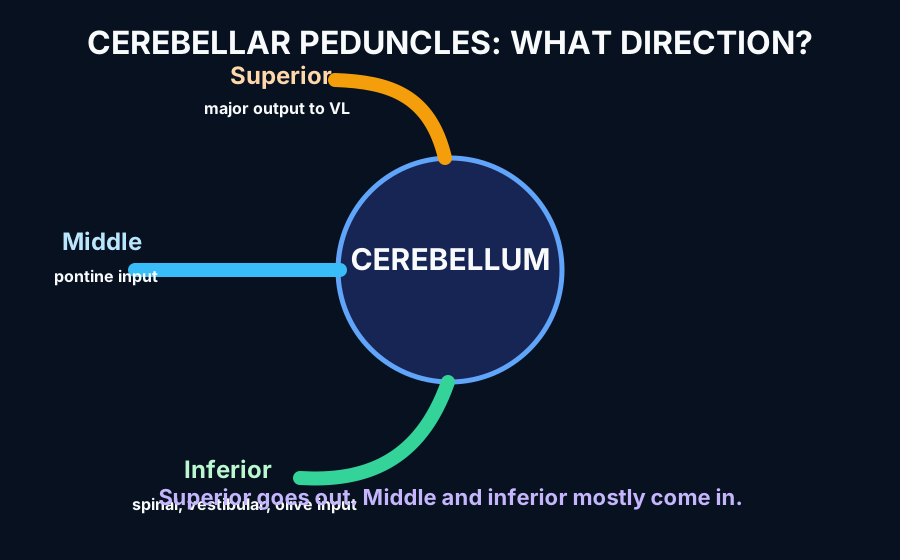
Cerebellar wiring · tap to expand
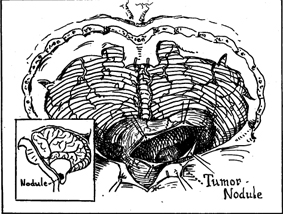
Cerebellar lesion · tap to expand
Board walkthrough
Prove It
One vignette at a time. Choices shuffle. The bank does not repeat until it is exhausted.
Vignette 1Never-repeat tracking ready
Exam tools: right-click or long-press to cross out a choice. Double-click or double-tap to highlight one. Tools switch off after you answer.